
Gortyna in Cretee
It is believed that Gortyna was inhabited as early as the 3rd millennium BCE. However, the settlement flourished much later: between 1.600 and 11.00 BCE. Around the 7th century BCE, the Acropolis, or temple complex, was built.
Gortyna became an important center when, in the 3rd century BCE, it defeated Phaestos and took control of the entire southern Crete region. At that time, approximately 300.000 people lived here, which attests to the immense power of the polis at that time. During the period of Roman rule, from 69 BCE, Gortyna was the capital of the entire island and North Africa.
In the 1st century CE, St. Paul visited Crete. In Gortyna, he met the apostle Titus, whom he appointed Bishop of Crete. A reminder of his teachings is the Letter to Titus in the New Testament. The seat of the archbishop was established in Gortyn.
The city's decline began in 330 AD after its conquest by the Byzantines. The Saracens completed the decline, conquering and destroying the city in 826 AD
Visiting Gortyn
The excavation site of ancient Gortyna, covering approximately 400 hectares, is the largest not only on the island but even in all of Greece! The vastness of the site reflects the city's historical splendor, which was home to 300,000 people around the 3rd century BC. It housed not only dwellings and palaces, but also temples, public buildings, schools, baths, theaters, agoras, gymnasiums, and workshops—all workplaces. Water was brought to the city by aqueducts from springs on the slopes of Psiloritis. Further, a system of aqueducts supplied fountains and baths. Stone quarried from the so-called Messara Labyrinth in Ambelouzos was used in the construction.
The Gortyn Law Code
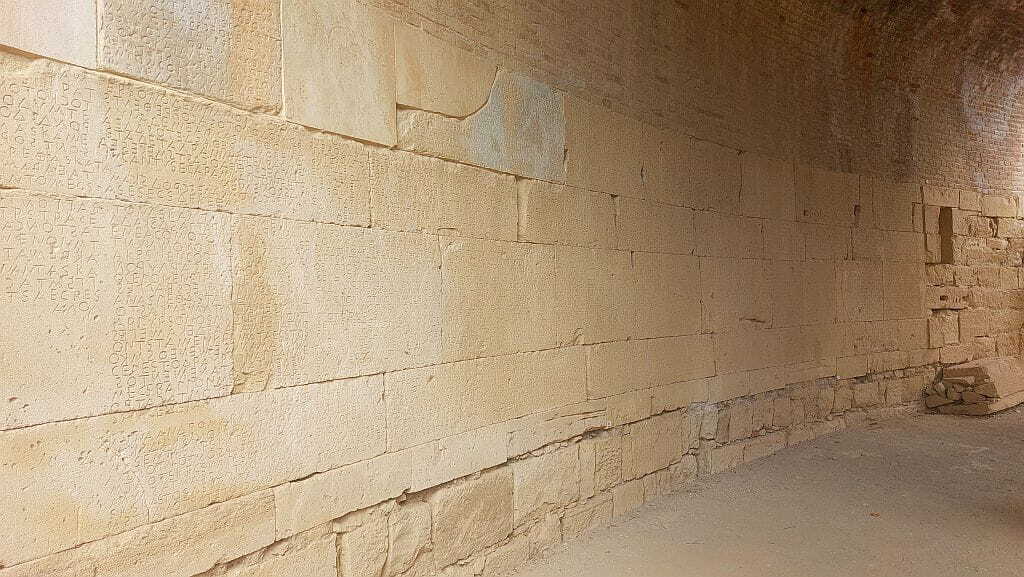
Around the 5th century BC, the Gortyn Law Code was written on stone tablets using the boustrophedon system. The first line of the text is read from right to left, the next from left to right, and so on. It's worth noting this while you're there.
The main content of the Gortyn Law Code concerned areas of family law, for example, those related to inheritance. The law did not provide for the possibility of transferring property. Unfortunately, daughters were disadvantaged, inheriting half of what their brothers inherited.
An interesting fact is the law regarding marriage. A young girl married her uncle. If the family had more daughters than uncles, the next candidates were cousins. It should be added that monogamy was common in ancient times.
According to Plato, a father was unlucky if his daughter was not married during his lifetime. In such a situation, this responsibility fell to the girl's brother, as he had to find a husband for his sister. Horror of horrors (my humble feminine addition), the Law Code of Gortyna is considered very progressive and significantly increased women's rights.
Sculptures from Gortyna
Immediately upon entering the excavation site, you can admire the sculptures found here. In ancient times, statues were very important to the people. They were believed to have souls, and people even prayed to them and asked for various favors. They were also a reflection of wealth.
Basilica of St. Titus in Gortyn
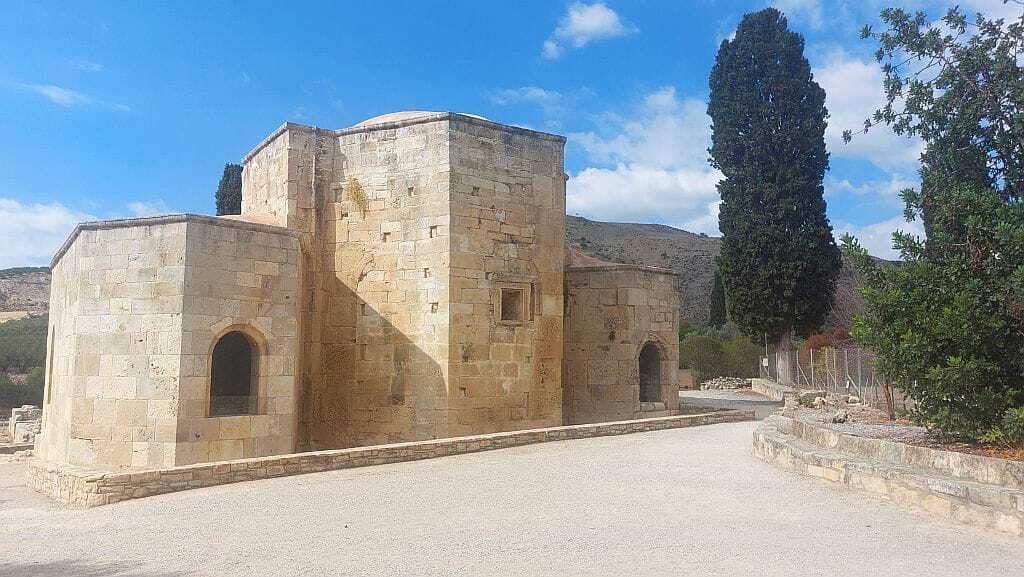
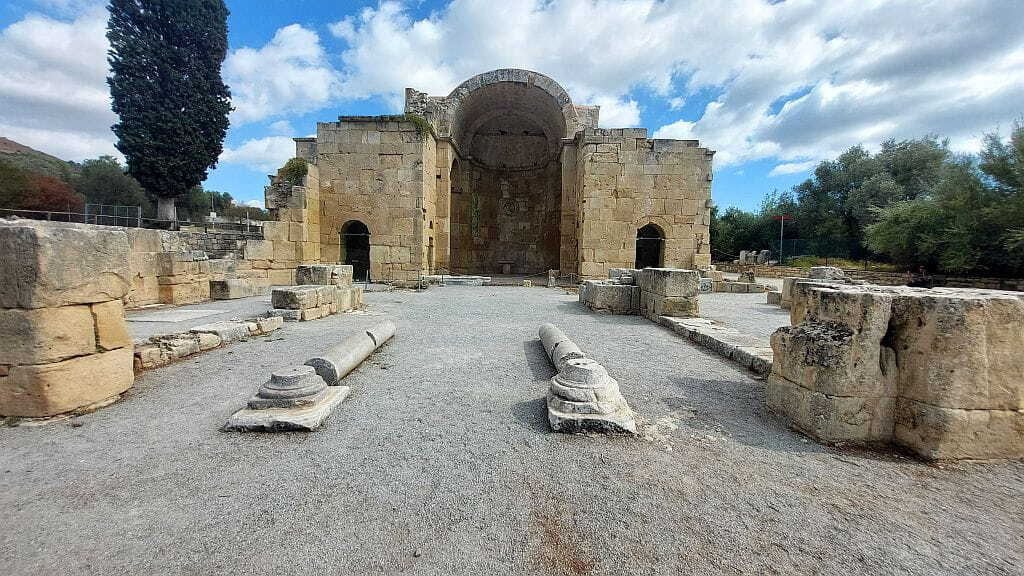
The first sight on the tour is the ruins of a basilica dedicated to St. Titus. He was a pagan, likely of Cretan origin. When St. Paul arrived on the island, he converted and was baptized. Moreover, the visiting apostle trusted Titus so strongly that he appointed him Bishop of Crete. As a disciple of St. Paul, he accompanied his teacher on his travels and teachings. After the apostle's martyrdom in Rome in 67 AD, he returned to Crete and taught until the end of his life. He was martyred in Gortyn. His tomb is likely located somewhere within the excavation site. Unfortunately, the Saracens, after conquering Crete in 823 AD, destroyed the basilica. A relic of St. Titus's head has been preserved, which the Venetians, fearing Turkish invaders, removed to St. Titus's Basilica in 1662. Mark in Venice. In 1966, Pope Paul VI returned the relic to Crete. It is currently located in the Church of St. Titus in Heraklion.
Odeon, or Roman Musical Theatre
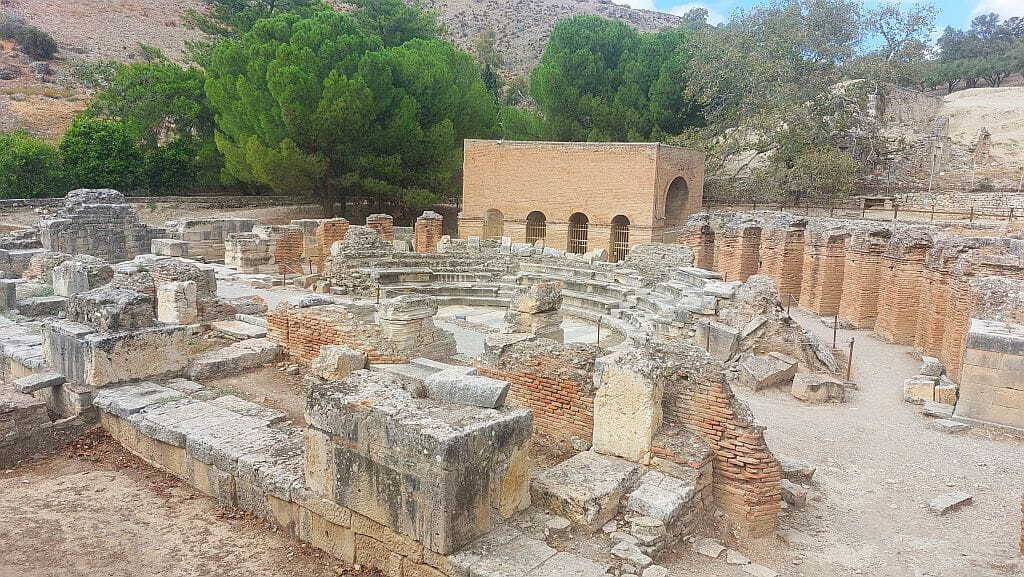
When the Romans took power in Crete, they introduced their own government, culture, and architecture. Odeons, built in larger cities and still awe-inspiring today, were among the most impressive structures.
Because Gortyna was the island's capital, it had its own musical theatre. It was a very important cultural venue, hosting theatrical and musical performances, as well as large gatherings. The structure, benches, and walkways for actors remain to this day. At the rear of the theatre are the aforementioned tablets with the Code of Laws.
Mythological Connections
Zeus is known for his love affairs. One of them is connected with Gortyna. The god of Olympus was very attracted to a mortal princess named Europa, who was renowned for her extraordinary beauty. Zeus took the form of a white bull and appeared at Europa's revelry. Enchanted by the animal's beauty and gentleness, she sat atop it. The god seized the opportunity, transformed into a large, white eagle (or swan) and quickly flew away with the prize to Crete. They landed on the beach of Matala, from where they continued on to Gortyna. There, in the shade of a large tree, he took possession of the young girl.
The union produced two sons: Minos (later king of Knossos and the most magnificent palace in Crete today) and Rhadamanthys (king of the smaller islands of the Aegean archipelago, judge of the dead in Hades).
Some reports indicate that Zeus lavished special affection on Minos. For several years, he cared for the boy and took great care to develop his leadership and fighting skills.
He was not faithful to Europa for long. He arranged for her to marry Asterios, King of Crete, so that he could pursue further romantic adventures.
Archaeological Museum
Just 10 km away is the Archaeological Museum in Messara, dedicated primarily to Gortyna. The visit is made even more interesting by the interactive applications used to connect finds with their origins. Due to their proximity and significance, ancient Gortyna, the Minoan palace at Festos, and Matala receive the most attention.
The museum's exhibits span the periods from prehistory through the Greco-Roman period to the Christian era.
The name "Greco-Roman" is not accidental. While all of Crete was fighting against the Roman conquest, Gortyna established friendly relations with the occupiers. This is likely why, in 27 BC, Emperor Octavian Augustus chose Gortyna as the capital of Crete. The city and its inhabitants benefited from the arrangement, attracting merchants and wealthy landowners from the Roman Empire.
Until the 3rd century AD, the city continued to expand, and residents eagerly flocked there. Gortyna increasingly resembled typical Roman cities. Temples, theaters, baths, aqueducts, and a network of roads were built.
Impressive public buildings were constructed to emphasize Rome's glory. Statues of Roman emperors were erected, which were eventually given divine status.
Interestingly, in the 1st century AD, glass was produced by blowing glass. From that time on, glass objects were produced for religious, private, and funerary purposes. It quickly became a widely used product and much cheaper than the existing ceramic ones.
A significant portion of the museum is devoted to Matala, known today for its famous beach. However, it turns out that objects found there date back to the 6th century BC. Until the 3rd century BC, Matalon was the port city of Festos. Later, as Gortyna expanded its borders, Matalon took over. Independently, the remains of an acropolis, a temple of Artemis, and rock-hewn warehouses and water tanks were discovered, along with rooms for the protection and maintenance of ships. Today, Matala is known for stories about the hippies who lived there.
The exterior of the museum is dedicated to… water. Access to water was a key criterion for establishing a settlement. If it was difficult, it had to be transported somehow. A pioneer in this field was the Eupamides Tunnel on Samos, which, carved into the rock, provided drinking water to the inhabitants of Pythagoria in the 6th century BC. In Crete, a typical example is the aqueduct at Gortyn.