A small seaside settlement is located at the very southern tip of the island.
The name of the town is linked to Greek mythology. Carycus was the son of Chiron, the most famous and wisest centaur, half horse and half man, and the nymph Chariclo.
The history of the city dates back very far
It is known that the region was inhabited as early as the Neolithic period, which is several thousand years B.C. The city was founded during the geometric period.
The first mention of Karystos appears in Homer's Iliad in the list of ships sent to the Trojan War. The port in Karystos is mentioned as a safe place to which those returning from battle came back.
In 490 B.C., during the Greco-Persian Wars, the Persian forces targeted Karystos as their first objective. They besieged the city for so long, with a much stronger army, that they forced the inhabitants to surrender.
A few years later, after the battle of Salamis in 480 B.C., the Athenian fleet forced Karystos to pay tribute.
In the following years, Athens pressured for the annexation of Karystos to the Maritime League. The city long refused to join, as participation was associated with high fees. Athens, to enforce submission, attacked the city and completely plundered it. Realizing that they could no longer resist the strong Athenians, Karystos sided with the Maritime League.
In 196 B.C., the city came under Roman rule.
The occupiers extensively explored the area. They found unique green-hued marble. They opened quarries from which they exported finished elements. To this day, the remaining columns, entirely extracted from the quarries and located just 5 km from the city, are a valued attraction.
Asbestos was also sourced here. Today, the mineral is considered carcinogenic, but in ancient times it was valued for its resistance to high temperatures and its durability against water and temperature changes.
The city flourished in the Middle Ages. In the 13th century, during Venetian rule, life in the region centered around the castle, of which a coastal tower and Castello Rosso remain to this day.
Modern Karystos is not located in the same place. It has only taken the name from it.
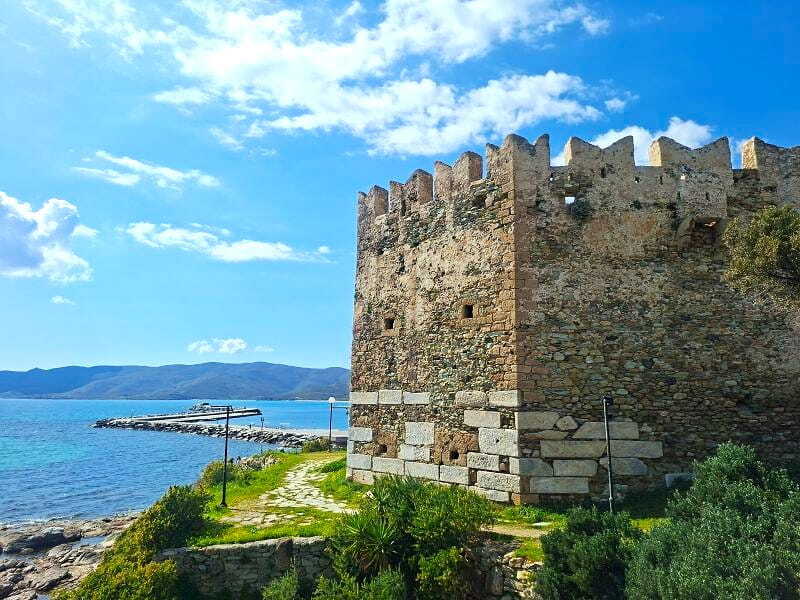
The Bourtzi Castle on Euboea
is located by the sea. The name of the castle comes from Arabic and means "seaside fortress."
Built in the 13th century from marble and stone, it was meant to protect the island from enemies approaching from the south.
The marble used for the castle's construction was probably sourced from a nearby Roman mausoleum.
The structure is simple, shaped like a hexagonal tower.
A massive iron gate leads to the two-story building. Above the entrance is an opening through which boiling oil was poured on enemies, preventing them from entering the bastion.
The castle has arrow slits and machicolations, from which tar, hot water, and oil were thrown at enemies.
On the southern and eastern sides, both facing the sea, there is a defensive embankment.
It is said that there was a 250-meter tunnel serving for water supply, communication, or as an escape route in case of a siege.
Currently, the castle serves as an exhibition space.
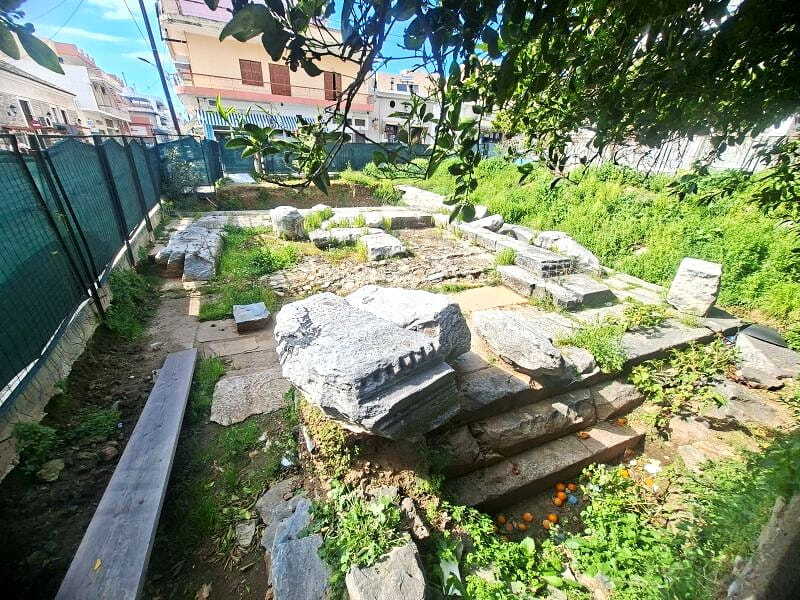
The mausoleum of the procurator
During the first excavations in 1908, it was determined that the find is a remnant of an ancient temple dedicated to Apollo or Artemis.
The building indeed resembles a temple, but subsequent findings proved that it was the tomb of a high-ranking Roman official.
It is believed to have belonged to a Roman responsible for overseeing the acquisition of marble from a nearby quarry.
To this day, a peristyle made of the highest quality marble has survived, shaped close to a square, measuring 13.2×12.3 meters, along with the bases of Ionic columns that surrounded the courtyard.
The five-step base had a cella, or small room, with an entrance from the port side.
One of the steps extended along the walls of the cella. It is likely that sarcophagi were placed on it.
The pediment was adorned with a bust of the deceased and a horse in a round medallion.
The monument is dated to the mid-2nd century.
The material obtained from the mausoleum was probably used for the construction of the Bourtzi Castle.
Currently, the mausoleum appears abandoned and neglected.
The Archaeological Museum
is located in the western wing of the Cultural Foundation established by Nikolaos Giokalas, which, according to his will, was transferred to the Ministry of Culture in 1980. His wish was to establish an Archaeological Museum in this place. The official opening took place in 1989.
The exhibition includes finds from the Karystos region.
Red Castle
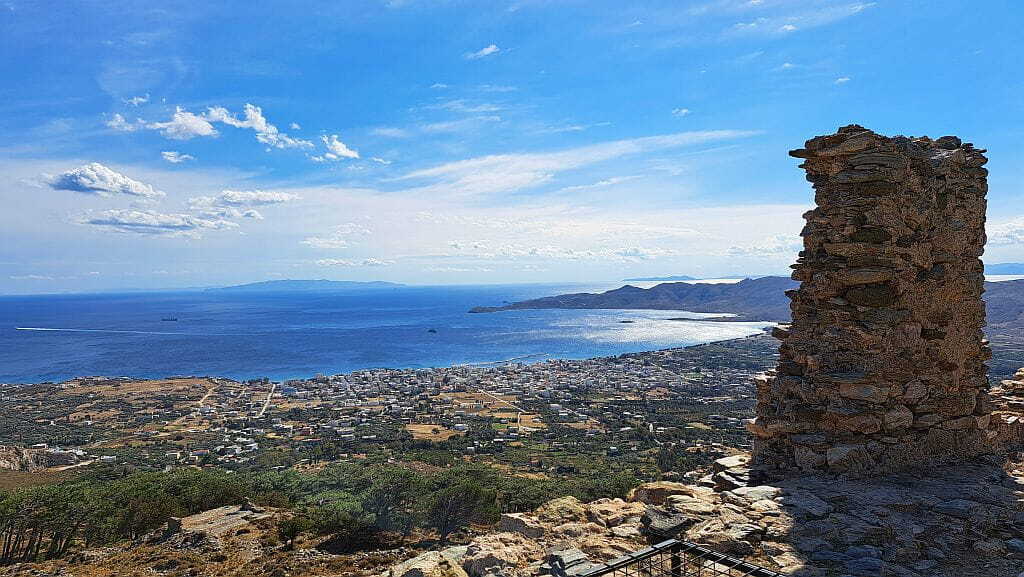
Just 3 km north of Karystos lies the largest castle on the island. Built of yellow and gray stone, it is unknown why it was named "Castello Rosso."
Once, the acropolis of ancient Karystos stood here, of which the only memory remains large, rectangular blocks of marble used in the lower parts of the western tower.
The original bastion was built by the Byzantines in 1030.
The Castle Castello Rosso was built by Baron Ravano dalle Carceri, a triarch. He received one-third of the southern part of Euboea.
The current fort was likely built between 1209 and 1216, on the foundations of the previous one.
The castle remained under Venetian control until its conquest by the Ottoman Turks in 1470.
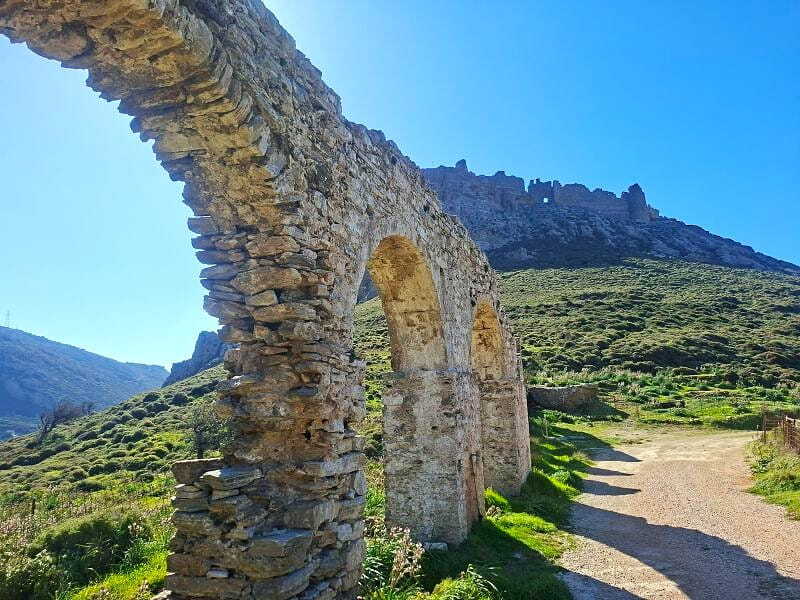
An attraction during the visit is the remains of a medieval aqueduct located just behind the castle. It brought water from springs on the opposite slope of the hill. The aqueduct was vulnerable to enemy attacks, so, fearing a lack of access to water, large quantities were stored in cisterns and a well located under the chapel's floor.
The Ottoman Empire fortified the bastion.
The tower in the southwest corner, with firing holes, was added during the Ottoman period.
During the Greek Revolution in 1821, many battles were fought for the castle, which was only returned to the Greeks in 1833.
Aqueduct
Just behind Castello Rosso, there is an aqueduct called Kamares.
Built by the Romans, it supplied water from the Montofoli spring, which was located on the slopes of Mount Ochi.
The aqueduct supplied water to the highest part of the ancient city. It was also the main water source for the castle.
Ancient quarry
About 4 km north of Karystos is the remnant of an ancient quarry.
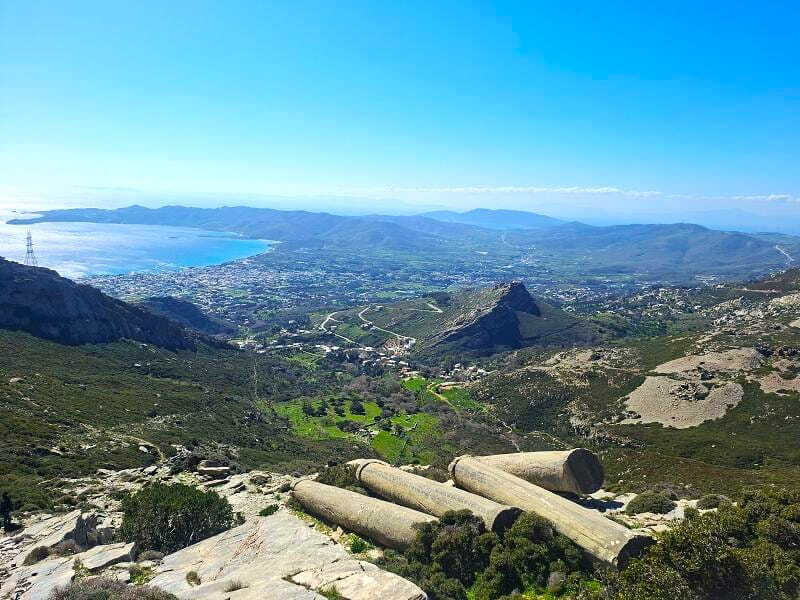
Tourists are delighted by the enormous marble columns lying on the hill, entirely hewn from the rock.
It turns out that the mines of precious stones have a rich history. Marble has been mined in Greece since ancient times, and later during the Roman occupation. It was used as a building material in significant Greek structures, such as temples, public buildings, and monuments.
Marble from Karystos was unique, possessing a specific and distinctive green hue. It gained its own name – Cipollino.
The quarry was discovered in the 19th century by archaeologists. Conducted studies revealed extensive remains of mining activity. It was revealed that the Greeks exploited marble, but it was only during the Roman Empire that the demand for Cipollino marble increased dramatically and repeatedly.
The Romans highly valued marble from Karystos for its unique green hue. They transported it not only with in Euboea, but also sent it to North Africa and the Middle East. They adorned palaces, baths, and important public buildings with it.
Cipollino marble was used in the construction of the Library of HadrianinAthens,as well as in Rome in the Odeon of Domitian, the Flavian Amphitheater, and the Temple of Omonia.
After the fall of the Roman Empire, the quarries ceased to be used. Untouched by human hands for centuries, they awaited rediscovery.
The exact date of the quarry's establishment is unknown. Archaeologists argue that the peak of mining activity occurred between the 1st and 3rd centuries AD.
The dating of the quarry's use was conducted through an analysis of tool marks and the examination of organic materials found on site. These actions helped to establish the approximate time of peak activity during the Roman period.
The Karystos quarry is not only a monument from ancient times but also provides information about the mining techniques of that period.
Enormous, rectangular trenches carved into the rock walls reveal the ancient method of cutting marble. The method of extracting marble involved cutting trenches in the rock, into which wooden wedges were driven. Then the wood was soaked, as it is known that it swells under moisture. These actions caused the marble to split.
To enable the transport of huge stone blocks in difficult mountainous conditions, a system of roads and tracks was prepared. The exact methods of transport across the Mediterranean remain shrouded in mystery to this day.
A major attraction among tourists consists of 5 columns, each about 11 meters long. Left many centuries ago, they lie high on the slope of Mount Ochi.
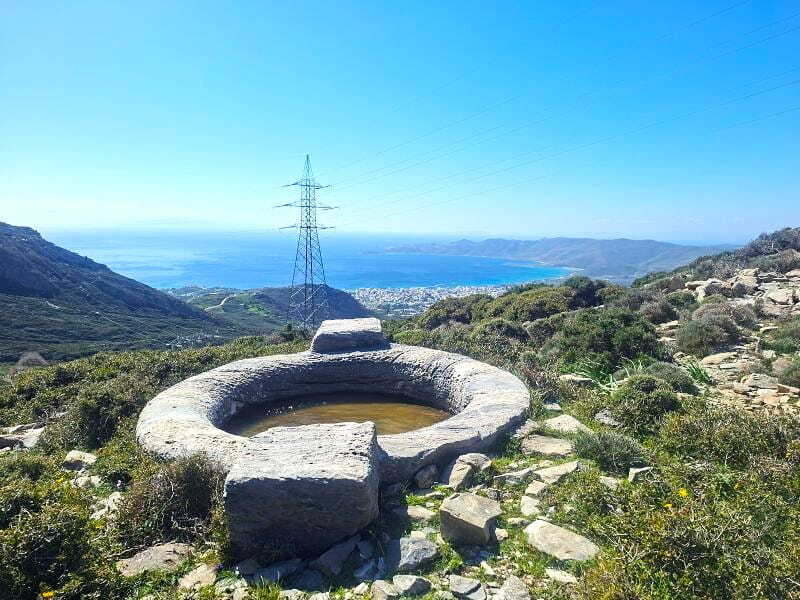
About 0.5 km away, at the foot of the mountain, there is another find related to the quarry.
The round, sculpted monolith has an outer diameter of 2.7 meters and an inner diameter of 1.8 meters, with a depth of half a meter.