Aulida and the Trojan War
On the outskirts of Chalkis, the capital of the island of Evia, lie today neglected yet historically significant archaeological excavations, namely the Temple of Artemis.
Why is this monument important?
Heading from Attica to Evia, but just before entering the new bridge leading to Chalkis, there is a small town called Aulida. It was here, in the bay of Evripos, that the fleet gathered, ready to set sail for the famous Trojan War. Due to bad winds, the ships could not depart. According to mythology, the famous and warrior-like Agamemnon, who was the main commander of the invading forces, unaware of this, invaded the territory dedicated to Artemis and killed a sacred deer. The enraged goddess demanded the sacrifice of Iphigenia, the warrior's daughter, in exchange for favorable winds for maritime navigation. The innocent young girl was saved from death by Artemis's compassion.
The ships set sail, and the further fate of the Trojan War and Agamemnon, the famous warrior from Mycenae, is a recurring theme in other Greek voyages. Nevertheless, Aulida and the thematic Temple of Artemis is one of the main places of worship of the goddess: of hunting, animals, forests, mountains, and vegetation.
The Temple of Artemis on the island of Euboea
Archaeological studies have shown that the area was inhabited as early as the 16th century BC.
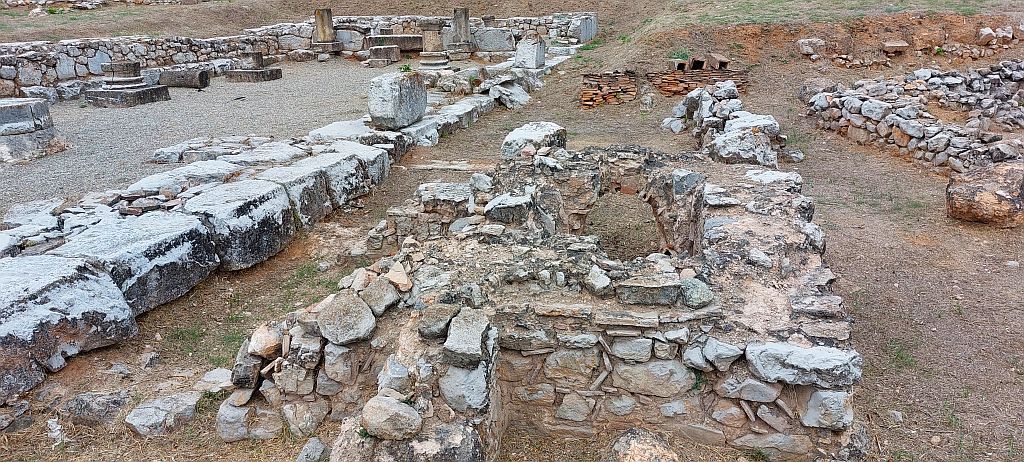
The Temple of Artemis, discovered and opened to visitors today (only from behind a fence), dates back to the 5th century BC, although it is highly likely that it was built on the ruins of an older one from the geometric period (which ended in the 8th century BC).
The dimensions of the structure in plan are: 9.40×31 meters. The entrance was adorned with 4 or 6 columns in the Doric style. It is not exactly known, as they have not survived.
There were two statues here: Apollo and Artemis, the twin siblings.
It is known that during the Roman period, all the columns were replaced.
The area also includes:
-
a sacred fountain: water was drawn from a square cistern measuring in plan: 1.8×1.8 [m],
-
a complex of buildings from the Hellenistic period, arranged around the sacred center,
-
Roman baths, i.e., thermae - a ceramic oven, benches were found - architectural stones and sculptures from the temple were used as building material.