
Hot springs on Euboea
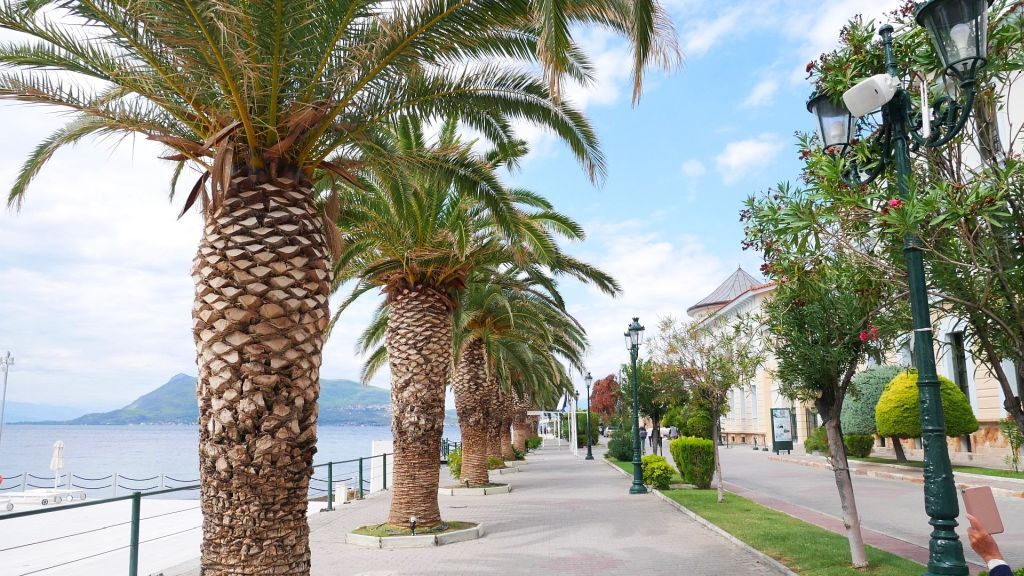
In the northern part of the island Evia, both in the center and the surrounding areas of the town of Loutra Edipsou, there are natural thermal water springs.
The history of thermal waters in Evia
dates back to ancient times. Sources suggest they have been here for at least 20,000 years!
According to mythology, it is said that even Athena sought their creation.
Another story claims that Hellen, the mythical forefather of the Hellenes, or the first Greeks, was born here. According to today's knowledge, his sons were the ancestors of the first Greek tribes; the Aeolians, Dorians, Achaeans, and Ionians.
It is certain, however, that among those who benefited from the baths in the thermal springs of Evia were:
-
Aristotle, one of the three most important (alongside Plato and Socrates) philosophers of ancient Greece,
-
Hadrian, Roman emperor from 117 to 138 AD,
-
Marcus Aurelius, Roman emperor from 161 to 180 AD,
-
Winston Churchill, twice Prime Minister of the United Kingdom, and also a Nobel Prize laureate in literature,
-
Maria Callas, a Greek singer once called the prima donna of the century.
The hot springs in Loutra Edipsou on Evia
The main springs are located in Edipsos, just 4 km north of Loutra Edipsou.
The thermal waters travel over 2,500 kilometers underground at temperatures ranging from 34 to 82 degrees. In the seaside resort town, Loutra Edipsou, they emerge at around 80 locations!
Based on the healing waters rich in sulfur, developers have built hotels. Tourists come here to treat their health issues, mainly related to rheumatism or back pain.
And, although the bathing facilities with hot springs (described below) are available for free, staying in a local hotel allows the ailing to enjoy the warm waters without restrictions.
Bathing in the hot springs of Euboea
For those with numerous ailments, it is recommended to book a stay at a local hotel. The range of prices and "stars" is so broad that everyone can find something tailored to their needs and possibilities.
Evia is an island interesting in terms of history and landscape, offering attractions for people of all ages. The town of Loutra Edipsou allows for a "quick" visit. There is no shortage of parking spaces in the morning, even in the middle of the season.
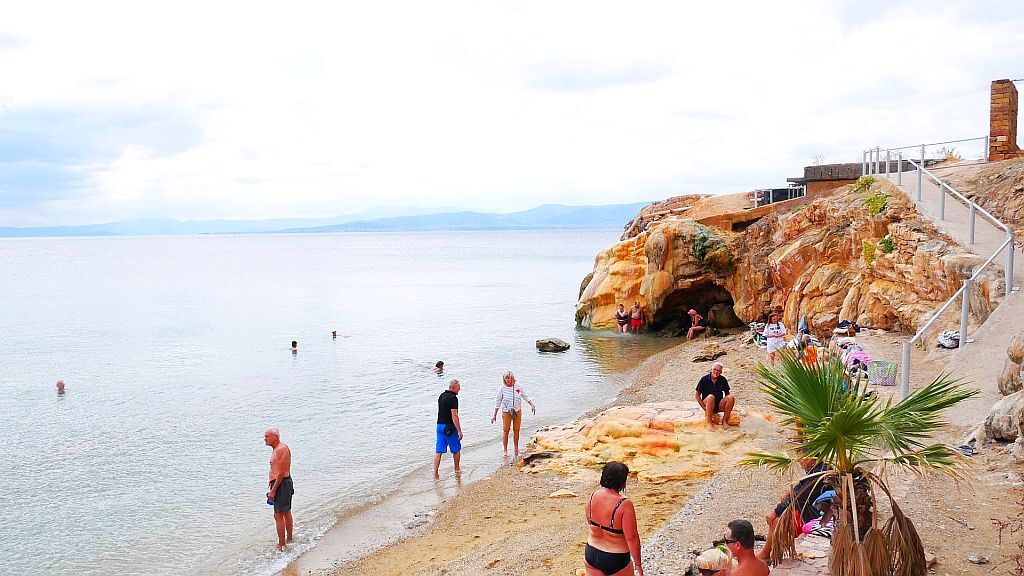
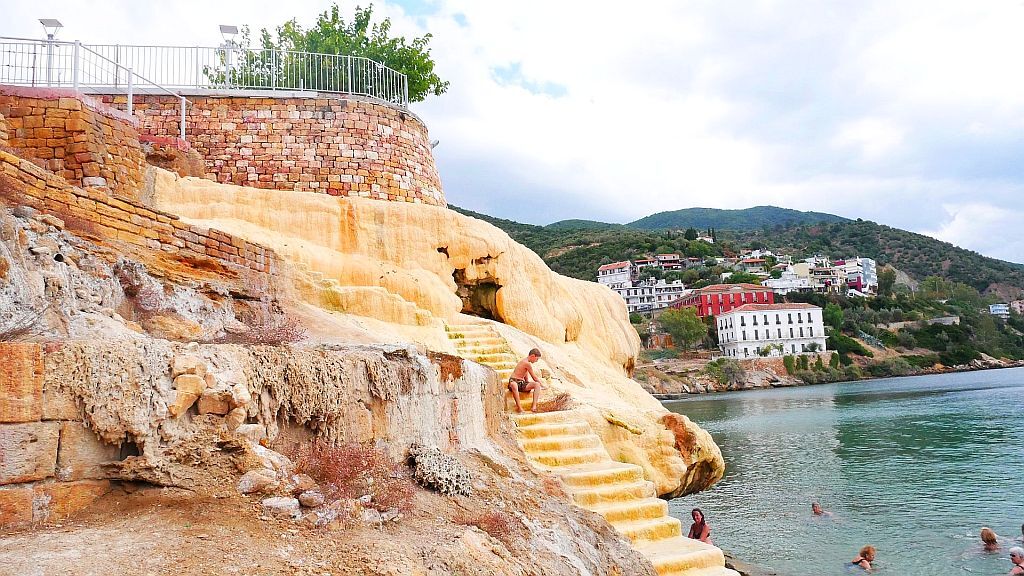
The thermal springs are visible right at the entrance to the town. The smell of sulfur permeates the air of the entire town. Yellow-red rock formations, with numerous caves and water passages, as well as foamy water or mini waterfalls, provide an interesting experience for people of all ages, including the youngest.
However, it is worth considering that the smell of sulfur can be bothersome for many. Also, the high temperature of the waters at over 30 degrees Celsius in the middle of the summer season may not be a pleasant experience for everyone.
Access to the hot springs is available year-round. It is precisely because of them that many people choose to visit Evia in the winter season.
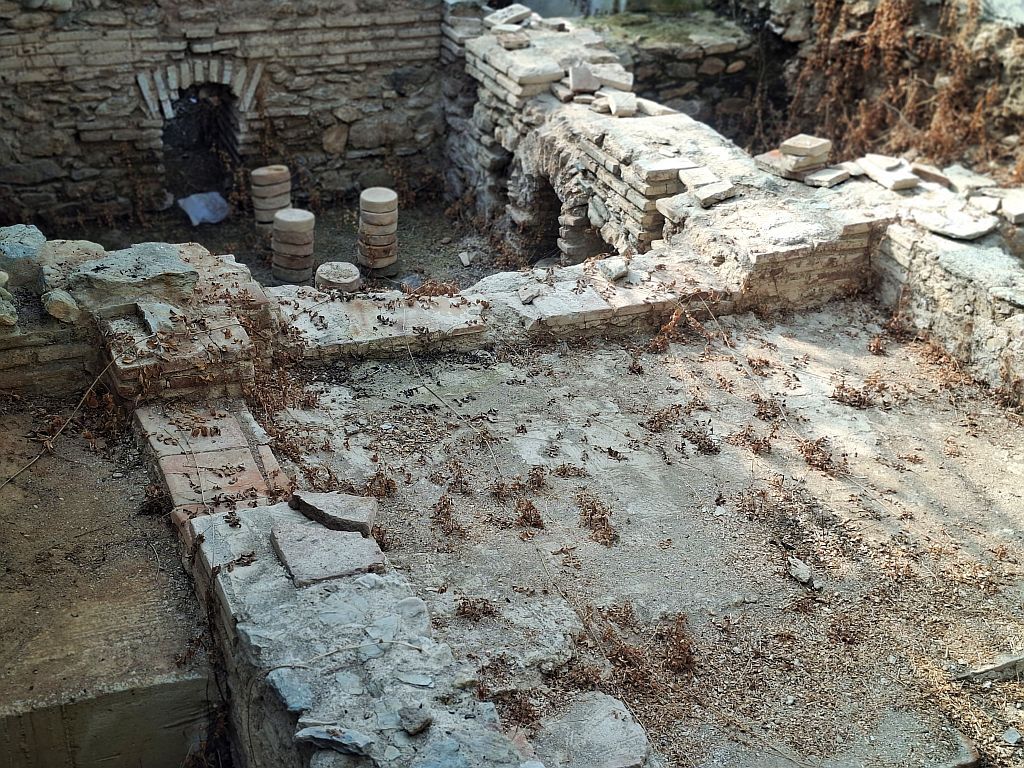
The Sulli Cave in Loutra Edipsou
While in the town, it is worth visiting the Sulli Cave.
The Roman general Lucius Cornelius Sulla Felix (who lived from 138 to 78 BC), commonly known as Sulla, liked Loutra Edipsos for its healing thermal waters that brought him relief after the hardships of war.
He built baths in a place where the sources of healing water are exceptionally strong.
It was named the Sulli Cave.
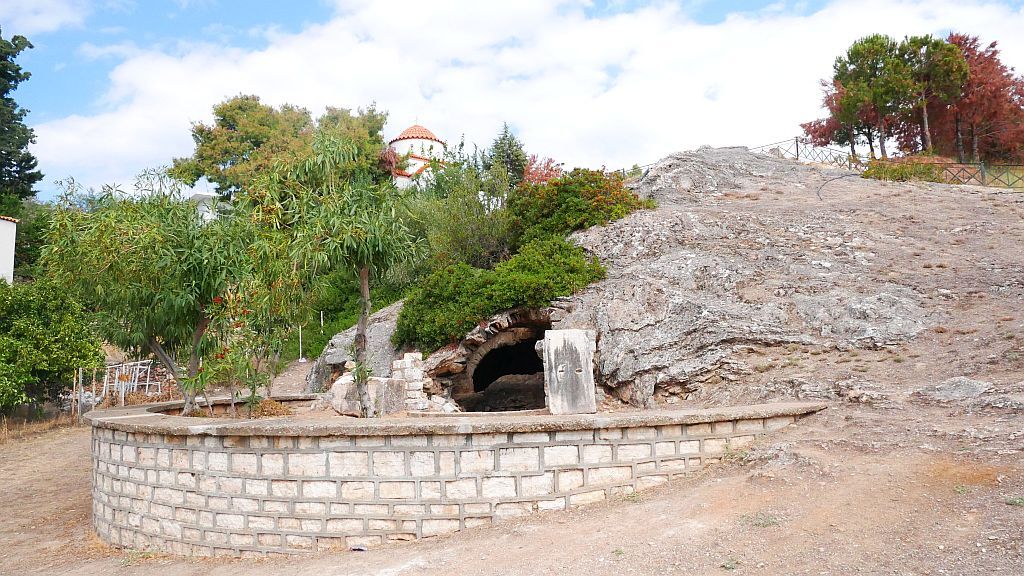
In fact, the dome-covered building, with a small stone entrance, resembles a cave. This is due to the deposits of sulfuric waters that have accumulated in this area over many, many years.
Entering the building, one indeed feels as if it is a cave.
At the entrance, there are two massive pedestals with inscriptions honoring Roman emperors:
-
Publius Aelius Hadrianus, known as Hadrian (who lived from 76 to 138). Interestingly, he was posthumously included among the gods.
-
Lucius Septimius Severus (who lived from 145 to 211).
The pedestals were funded by the municipality of Istiaia after Sulla's death.
Archaeological Collection
In the Hydrotherapy Center of the Greek Tourist Organization, on the ground floor and the mezzanine, there is an archaeological collection featuring exhibits found in the area of northern Euboea.
On the ground floor of the building, there are:
-
two inscriptions on local rulers from the Roman period on pedestals,
-
a plaque with symbols of the mythical hero Hercules with a bow and lion,
-
a statue of a man dated to the 2nd – 3rd century AD.
On the mezzanine, just before entering the room where the collection is displayed, there is a fragment of a grave stele from the 4th century BC originating from Gialtra. It depicts a naked youth and part of a Roman statue of Hercules. This confirms the prehistoric past of the area.
The main exhibits come from the prehistoric settlement of Koumpios, located on a hill about 2 km north of Loutra Edipsos.
Displayed are samples of pottery from the geometric period (c. 1100 to 750 BC) up to Roman times.
The most interesting exhibits include:
-
a Mycenaean sword found in the area of the settlement of Kastaniotissa, and
-
axes and chisels found on Mount Kantili.
Fragoula
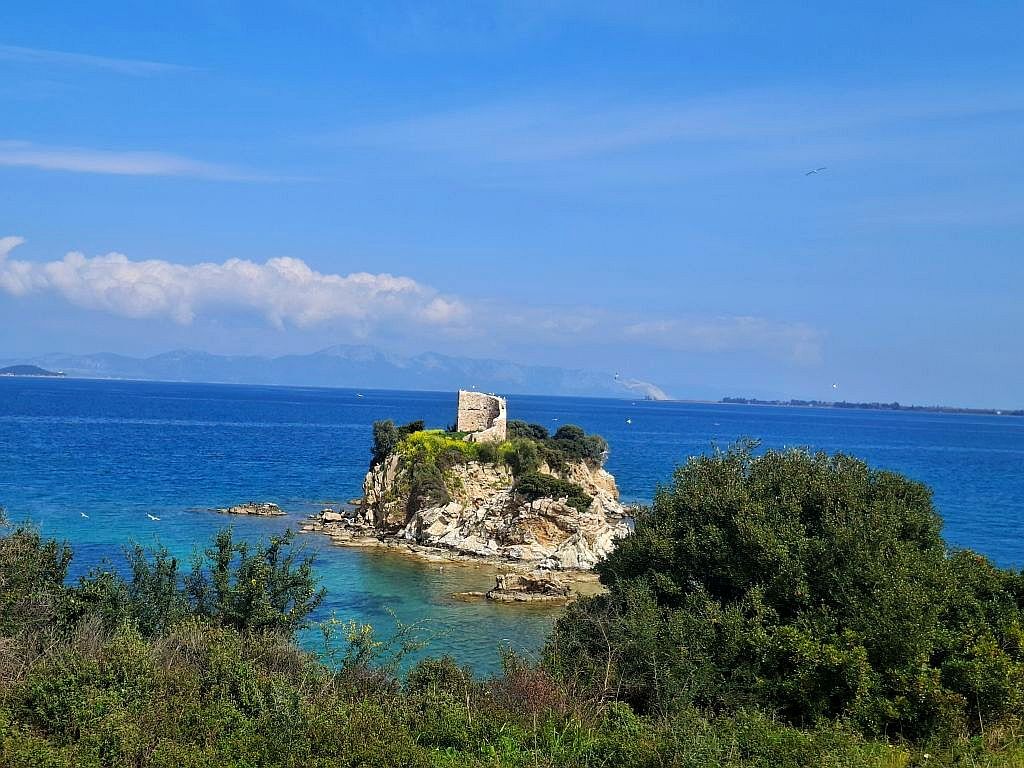
About 5 km north of the thermal baths in Loutra Edipsos are the ruins of a Venetian tower and a small chapel dedicated to Saint Agia Paraskevi.
Both buildings are called “Agia Paraskevi” due to a relatively recently built church of the same name that replaced an older one.
It turns out that the close proximity of both monuments (about 50 meters apart) is not coincidental.
They share a common history that begins after the Venetians conquered Euboea in 1205. New fortifications were built throughout the island, and existing ones were restored and strengthened.
One of the ideas brought by the Venetians to the island was the so-called phryktories. The name comes from phryktos, meaning torch, and horae, meaning protection. These small structures were always built on hills. Their purpose was to transmit signals over long distances. In case of danger, flames would emerge from them at night, and smoke during the day.
The small tower near Loutra Edipsos was built next to a small Catholic church dedicated to St. Paraskevi, a saint and martyr venerated by both Orthodox and Catholics.
This is not a coincidence.
The tower and the church were built for Baroness Petronella Tocco, who used the tower as a shelter and the chapel for religious purposes for herself and her guard.
The baroness held a high position from 1383 to 1410. She left the island in 1410, probably due to the increasing threat of pirate raids on the northern part of Evia.
Just 4 years later, in 1414, there was a pirate raid. The town and the surrounding villages were completely destroyed, and the inhabitants were sold as slaves in the markets of East and North Africa.
The exceptionally well-organized and effective raid, both by sea and land, suggests that the baroness helped or at least knew about the threat. This hypothesis is confirmed by preserved writings of contemporary researchers. It turns out that Venetian sailors stationed in the areas around the Aegean Sea often made favorable agreements with pirates, often at the expense of the residents.
The chapel of Agia Paraskevi was probably built in the 18th century and originally served as a Catholic church. Destroyed and abandoned, it was restored to serve as an Orthodox church.
In 1823, it was destroyed by the Turks.
The period during which the church was a Catholic church gave the entire area, namely the tower and chapel of “Agia Paraskevi,” the nickname “Fragoula.”
Monastery of Agios Georgios
About 12 km east of the thermal baths is the monastery of Agios Georgios.
Located on the hillside, it offers beautiful views.
The exact date of the monastery's founding is not known. However, it is known to have existed in the 15th century.
Originally, the monastery was closer to the thermal baths, which is mentioned by a small chapel of the same name located there.
The Turks, who attacked the monastery in 1821, contributed to the destruction of many valuable relics and spiritual treasures. However, the monastery survived even these difficult times.
It is worth visiting the women's monastery, as even non-believers will be captivated by the views. The monastery is not only a sacred site. It is a monument with interesting architecture and valuable relics.
When visiting the holy place, one should remember to dress appropriately. Greeks are very strict about women covering their knees, arms, and heads, and men wearing long pants. Otherwise, one may not be allowed entry.