
Agia Triada in Crete
is one of the most important archaeological sites, located just 3 km from Festos. It was discovered by Italian archaeologists in the early 20th century. They called it a small Minoan palace. In fact, according to one hypothesis, it served as the summer residence of King Festos.
Remains from several successive eras were discovered here:
- It is believed to have been built around 1600 BCE, during the era of the so-called Minoan palaces.
- After the destruction of the palaces in 1450 BCE, a Mycenaean-style residence was built here.
- During the Geometric period, around the 8th century BCE, the villa was a place of worship.
- During the Hellenistic period, from the 4th to the 1st century BCE, a sanctuary dedicated to Zeus existed here.
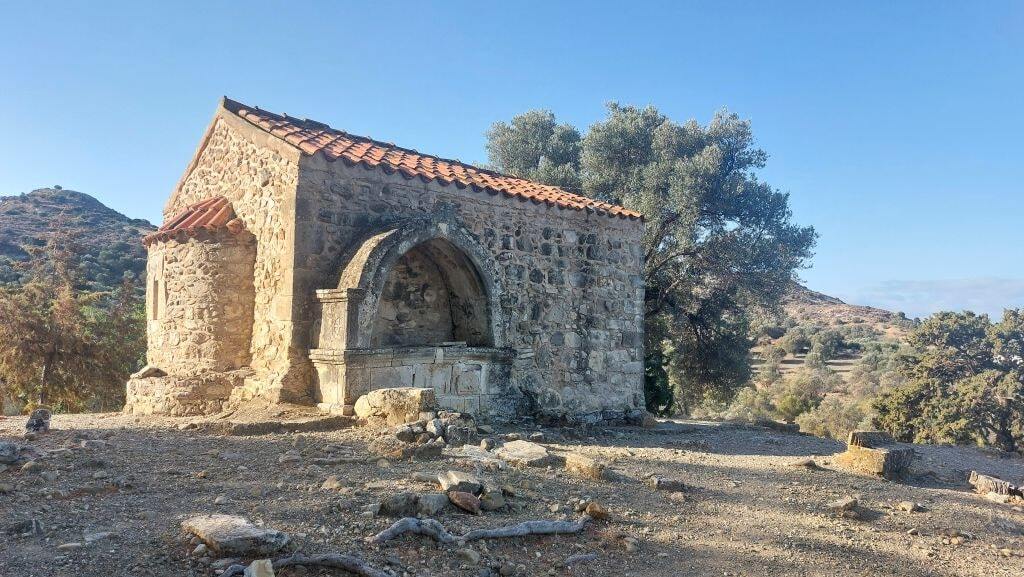
- During the Venetian period, in the 14th century A.D., the Church of St. George of Galatas was built in the courtyard of the manor.
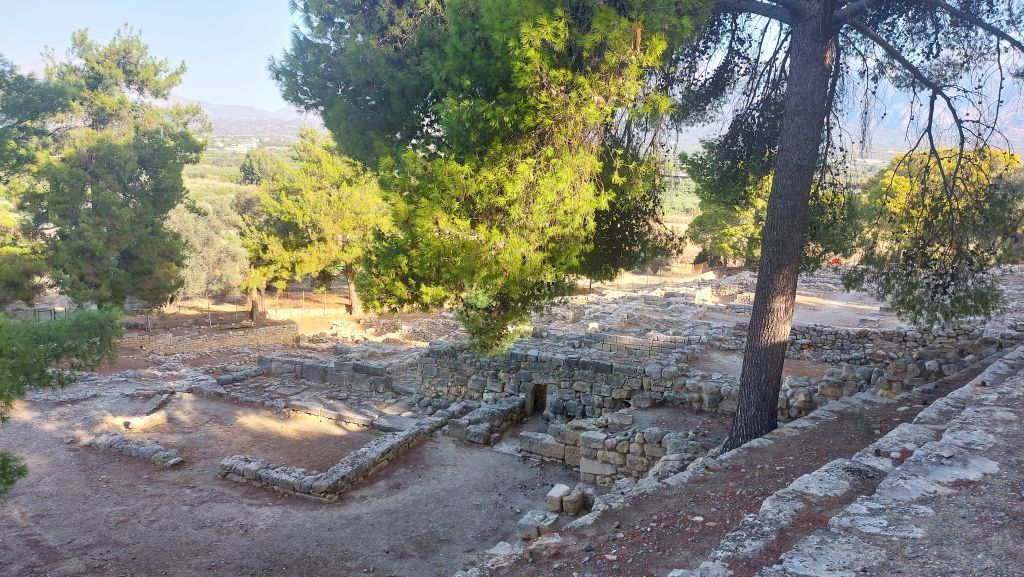
The complex of buildings at Agia Triada consists of two wings forming an L-shape. It is much smaller than the palaces at Festos or Knossos, but it has all the features of the architecture typical of Minoan palaces.
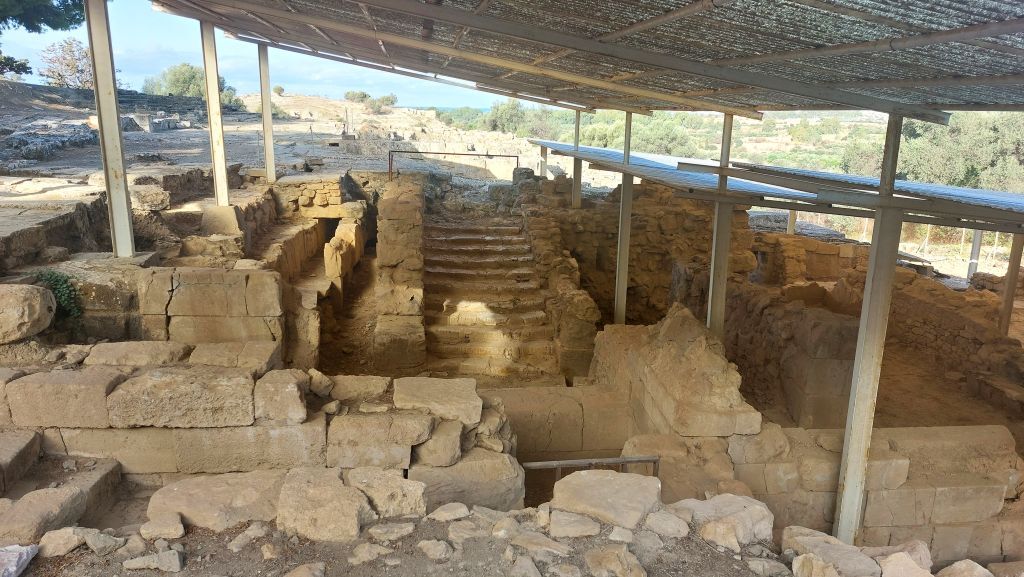
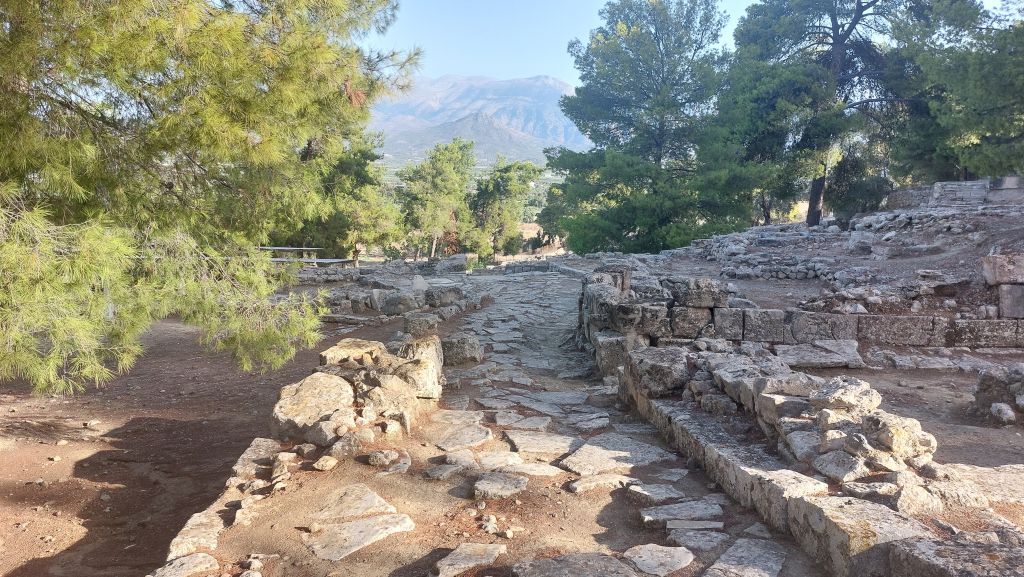
There were doors, apartments with skylights, sanctuaries, storage systems, vaults, workshops, staircases, arcades, courtyards, terraces and balconies, cobbled streets and courtyards. A series of stairs led to the upper floor.
The complex was characterized by exceptional grace and impressive ornamentation. The walls were covered with plaster panels decorated with frescoes, the number of which exceeded those found in all of Minoan Crete!
The site at Agia Triada isn't a well-known or popular archaeological site, which makes visiting it quite enjoyable. The architecture and art objects found here testify to its importance. The excavations haven't been restored and aren't painted. There are also no tablets with detailed descriptions, as are found at Knossos. Therefore, it's difficult to find confirmation of the site's greatness. Nevertheless, I think it's worth a visit if you're nearby, for example, in Festos.
In the southern part, the construction of which was very simple, there was a long corridor with a number of rooms adjacent to it, probably auxiliary ones.
In the northwestern part there were residential quarters.
The central hall was connected to the courtyard by a door and a skylight, which testifies to the advanced construction art typical of the palace period.
An archive with many clay seals was found here, and just behind it a room with frescoes depicting lilies and wild cats.
One of the rooms was called a treasury because nine bronze talents were found there.
On the western façade there are remains of a stepped path, which archaeologists have called the sea ramp.
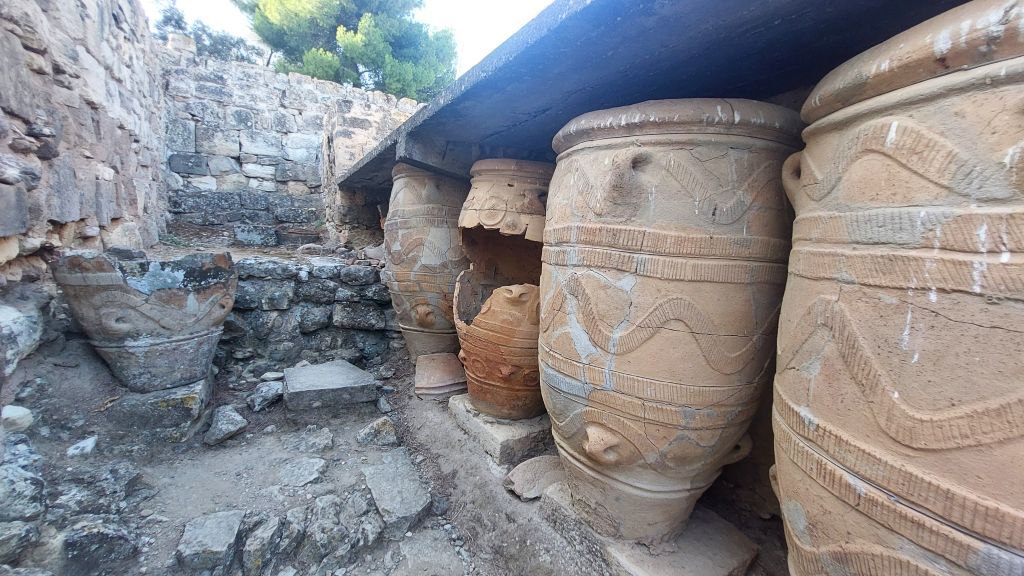
The northern wing contained a series of storage rooms containing enormous jars.
East of the utility rooms were luxurious apartments with multi-leaf windows and skylights, as well as places of worship.
After the destruction of the villa, the sanctuaries were expanded on the ruins of the remaining rooms.
Among the buildings dating from the Mycenaean period, the tripartite Mycenaean palace stands out.
Many objects were found at Agia Triada and are now on display at the Heraklion Archaeological Museum, including:
- Linear B tablets,
- examples of stone carving,
- three stone vases with bas-reliefs,
- a commemorative cup,
- a boxer rhyton and a harvester's vase,
- a clay figurine of a Minoan goddess in a cradle,
- nine copper talents,
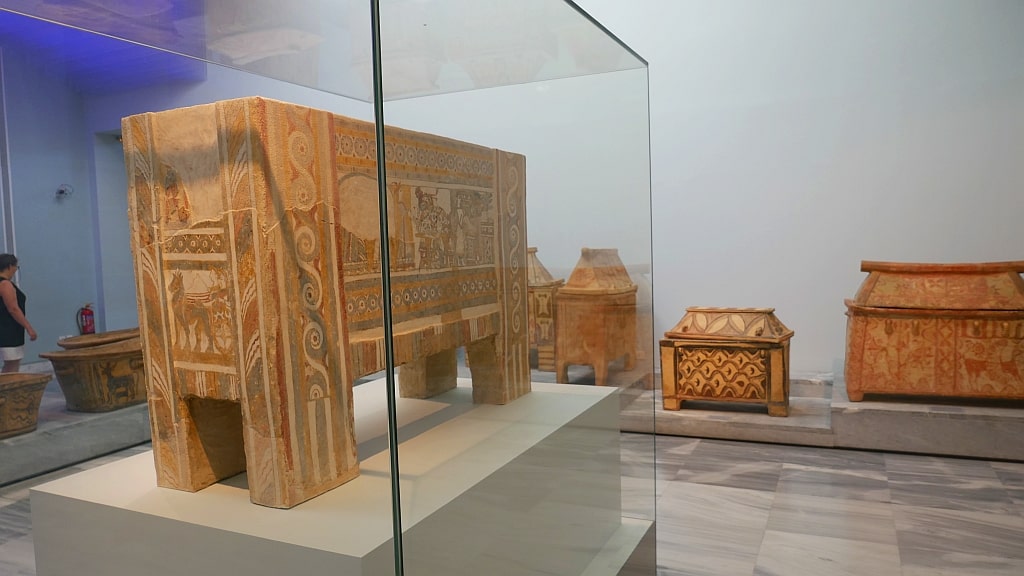
- the Agia Triada sarcophagus, considered the most important and in many respects the most interesting find.
The sarcophagus found at Agia Triada
was found inside the prince's tomb. It is covered with plaster and painted with frescoes depicting burial customs during the Mycenaean period.
The frescoes on one of the longer sides are divided into three areas, which depict:
- a procession of women,
- the moment of the bull sacrifice,
- a man offering sacrifices on the altar in front of a chapel topped with horns of consecration and a sacred wood.
The second long side of the sarcophagus is divided into two parts:
- On the left is a procession of men and women between columns topped with double axes and birds.
- On the right are male figures in animal skins offering gifts to their deceased loved ones, in the form of animals and boats.
Each of the shorter sides depicts two women in a chariot drawn by a horse and a griffin, respectively.
The sarcophagus dates back to 1400 BC. It is currently located at the Heraklion Archaeological Museum.
I recommend visiting those who are persistent.
The Kamilari tomb, dating from 1900 BC, is located just 2.5 km away.
It is one of three thoulos (round) tombs in Crete, and is the largest and best-preserved.
Its connection to nearby settlements is unknown. However, given the proximity of Agia Triada and Festos and the similarity in design typical of the heyday of both palaces, it is believed to be associated with the burial of someone from a high-ranking community.