Aptera in Crete
is not just an ancient city.
A battle took place here between the Muse and the Sirens. The Sirens had wings, as they were half-women, half-birds. In singing and music, they had no equals. Convinced of their uniqueness, they challenged the Muse to a duel. They miscalculated. The Muse won. As a trophy, she took the Sirens' wings, thus returning to them control over the water. The name of the city is linked to this legend, as Aptera means "without wings."
Monuments of Aptera in Crete
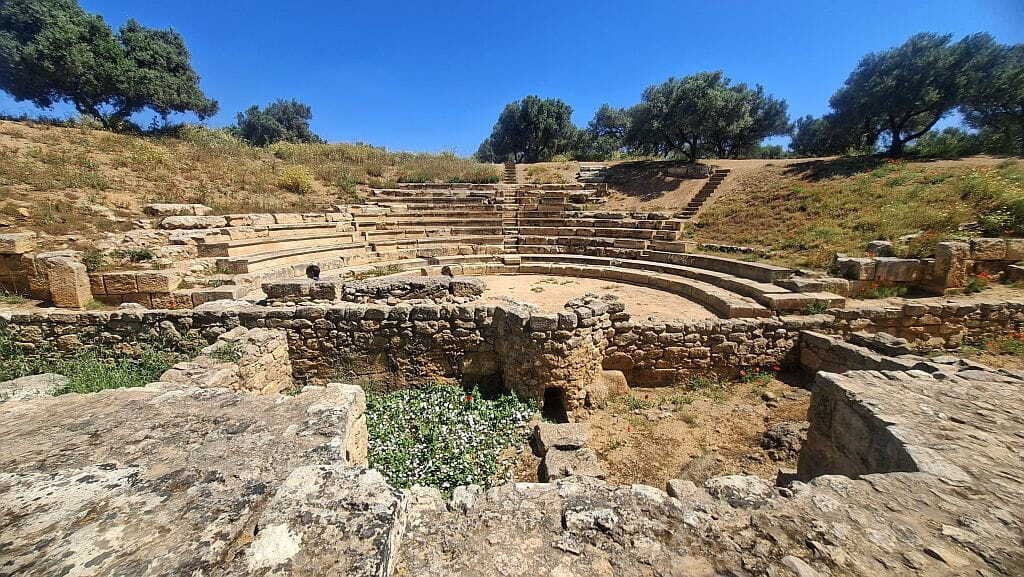
The Theatre
It was built of local limestone in a natural depression in the ground. Five rows of seats faced south, overlooking the White Mountains, providing a beautiful view.
The radius of the circular stage is 5,45 meters, one of the smallest found in ancient theaters.
Construction of the theater began in the first half of the 3rd century BC. Remains from this phase include a solid wall, part of the side aisle walls, the retaining wall of the cave, and the bases on which the seats were placed.
In Roman times, the theater underwent a radical reconstruction to adapt to the new needs of audiences. During the first reconstruction, in the second half of the 1st century AD, the amphitheater was reshaped and the stage modernized.
During the third phase of construction, the stage building was rebuilt.
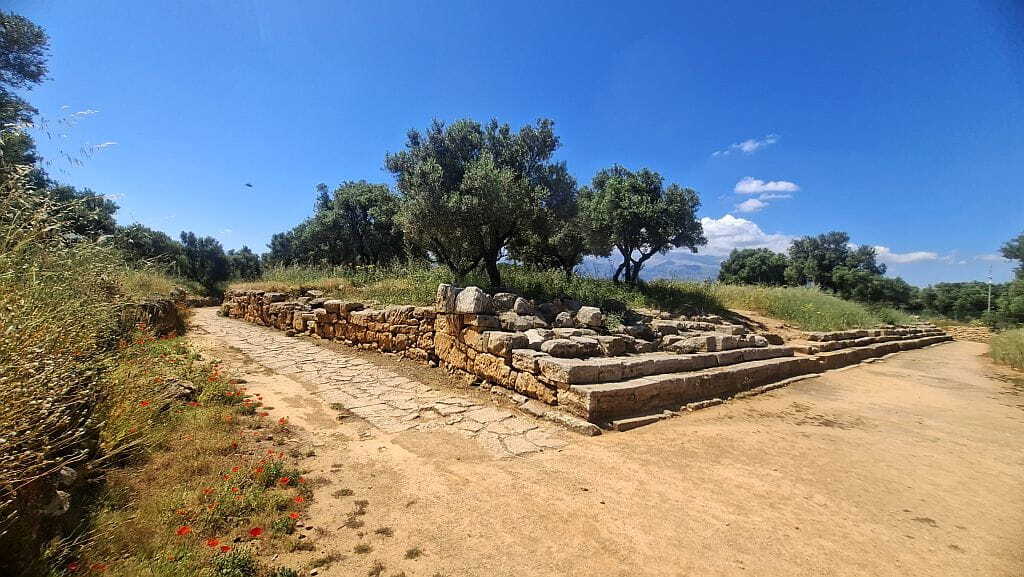
A paved road, totaling 55 meters in length, led to the theater. Excavations indicate that it also served other public buildings in the city located near the theater, including sanctuaries.
Rectangular Theatre
Just behind the theatre is another one, also built in the first half of the 3rd century BCE. Its purpose was likely to provide static support for the main theatre.
The building, 50 meters long, had four terraces and could accommodate approximately seven hundred people.
Four staircases divided the rectilinear theatre into four spaces. The presence of sculptures in the central seats suggests that these were seats for important figures.
Everything indicates that the building served as a so-called "cult theatre," where religious events and cult rituals were held. It may also have been used for sports or political gatherings.
Cisterns
The city's vast plateau lacked water sources, and no traces of an aqueduct have been discovered in the area. The nearest springs are 150 meters below Aptera. This necessitated the construction of large cisterns to store rainwater.
Two rock-cut cisterns were discovered:
- a three-aisled one,
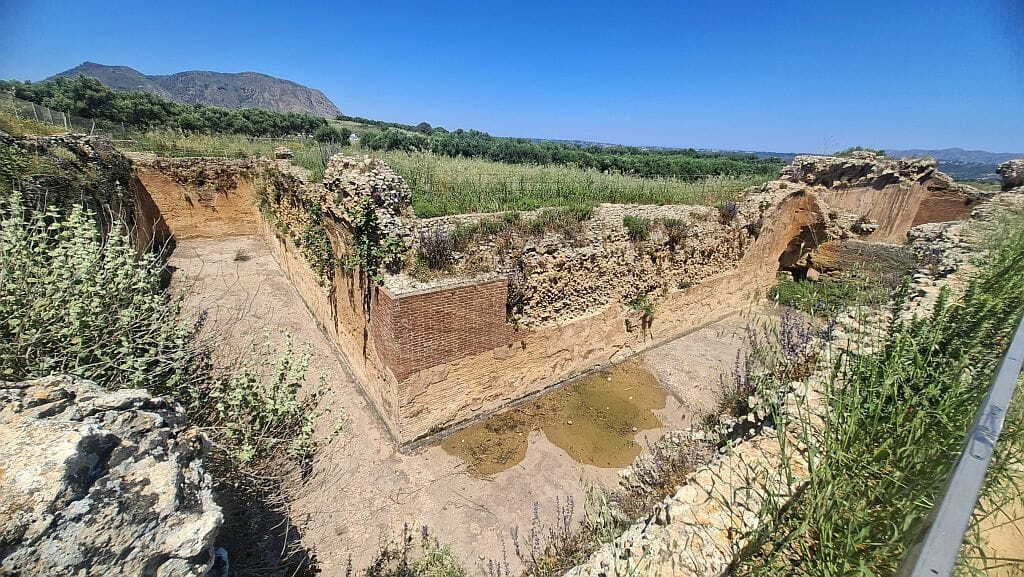
- an L-shaped one.
At Aptera, surface canals connected to smaller cisterns were also discovered.
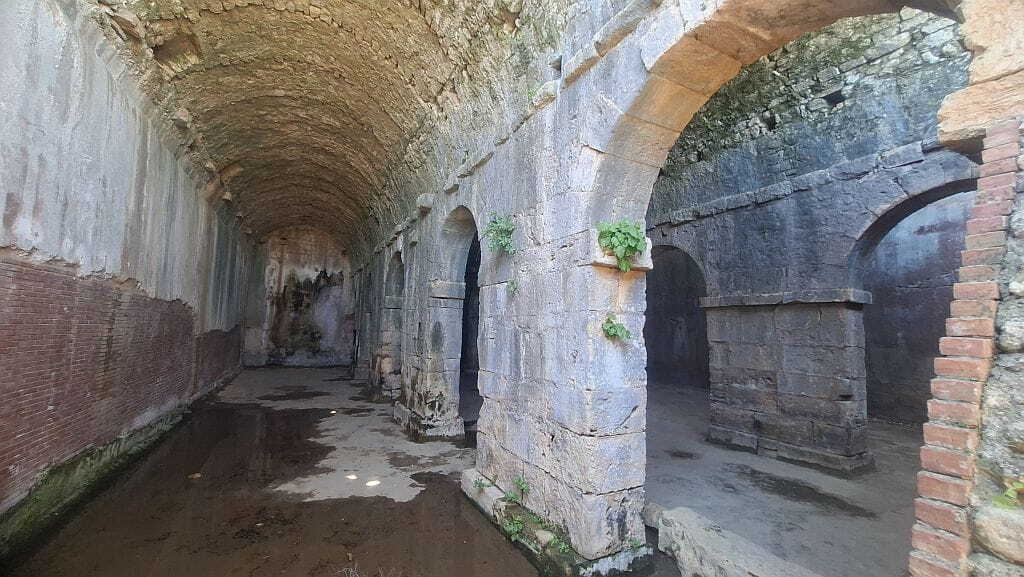
The two large cisterns were reinforced with external buttresses to counteract the pressure of water. They were freestanding structures, meaning they were not adjacent to other buildings.
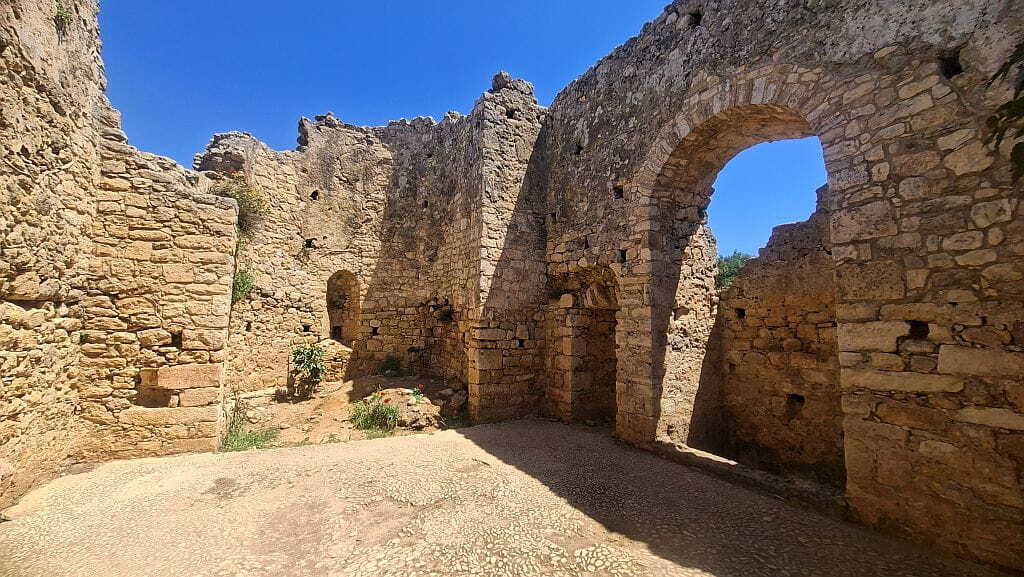
They were originally covered with brick vaults, but these collapsed. The stone vaults of the three-aisled cistern from the Middle Ages still survive.
The cisterns supplied the baths and satisfied the city's water needs during Roman times. The rectangular, three-aisled cistern measures 17×25 m and has a capacity of 2.900 m³.
The L-shaped cistern has a long side measuring 55,80 m and a short side measuring 34,20 m. Its capacity reached up to 3.050 m³.
The cisterns were made of so-called Roman concrete, commonly used from around 150 BCE. The walls were coated with waterproof hydraulic mortar. The vault of the L-shaped cistern, now lost, was likely made of whole bricks. The surviving vaults of the three-aisled cistern were made of stone.
Roman Baths
The size of the baths indicates prosperity and a high standard of living.
Archaeologists have distinguished three main sections:
-
the eastern section, consisting of three rooms;
-
the western section, consisting of two rooms with bathtubs, an arched room, and a corridor;
-
the northern section, which has not yet been fully excavated.
The eastern and western sections were separated by three corridors, which likely contained auxiliary rooms and furnaces.
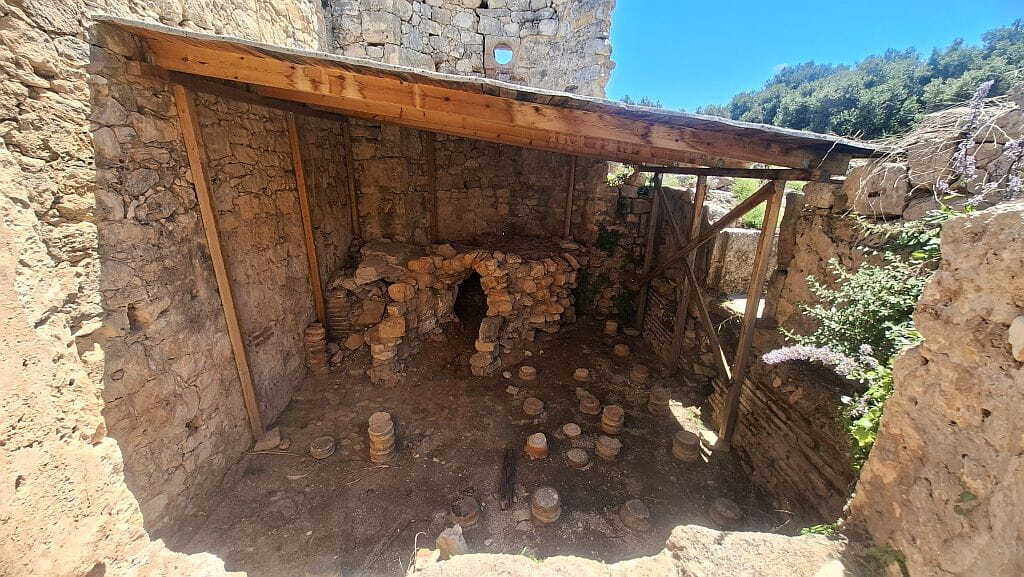
To the south of the corridors is a small arched room, which has not been excavated. Visible holes in the wall from wall heating pipes and a chimney stack suggest that the room was part of the hot zone.
North of the corridor are the remains of a nearly square room with a floor covered in marble in places. Its purpose is unknown, but archaeologists believe it was not a heated room. The building had a gabled roof covered with tiles, as evidenced by the damaged layer and traces of a roof.
The heated room has been thoroughly excavated. The interior dimensions are 4,50×5,00 m. The floor was raised by small brick pillars.
A fragment of the lintel above the main entrance to the baths bears an inscription with the name of an Athenian, likely the benefactor who financed the building's construction. The inscription dates to the first half of the 1st or early 2nd century CE.
The western baths contained eight vaulted rooms. Excavations have not yet progressed sufficiently to provide further information. However, a vaulted room with two bathtubs, chimney flues, and other elements have been discovered. The baths were supplied with water from an L-shaped cistern.
The extensive damage to the baths is the result of a strong earthquake.
The Small Temple
This small, two-room temple from the 5th century BCE is one of the city's earliest buildings.
The structure is tiny, with external dimensions of just 6,32×3,96 meters. Both rooms measure a mere 2,26×3 meters. It was constructed of hewn stone blocks of equal size, joined lengthwise with iron clamps in the shape of a double axe and vertically with iron pegs.
This small, unassuming structure holds enormous significance for ancient religious architecture. It dates back to Archaic times, and perhaps even earlier. Its bipartite layout proves its religious nature, eliminating other possibilities. It is assumed that during the Classical period, Artemis and Apollo were worshipped here together, as twin siblings.
This tiny temple is believed to have been part of a larger cult complex.
Roman House
To the west of the theater lie the excavations of a large Roman house.
The remains date back to the 1st century AD, but the original structure was likely built after the earthquake of 66 AD. It was ultimately destroyed during the great earthquake of 365 AD. In the following years, from the 5th to the 7th centuries AD, it was only partially used.
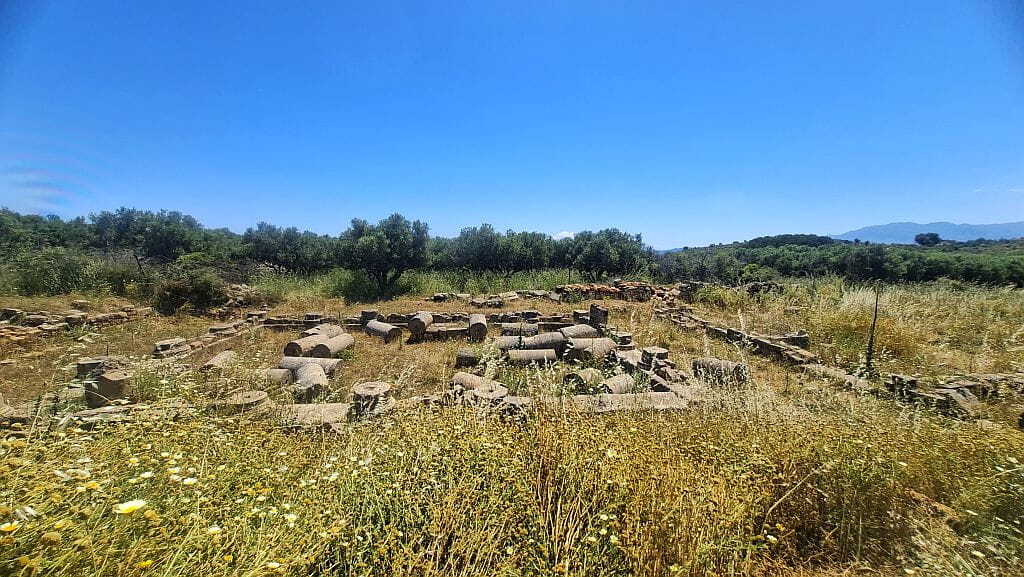
The house, arranged around a large courtyard with a peristyle, covers a large area of approximately 765 m².
During the excavations, numerous bronze and marble statues depicting Artemis and Apollo were discovered. The finds are dated to the earthquake of 365 AD.
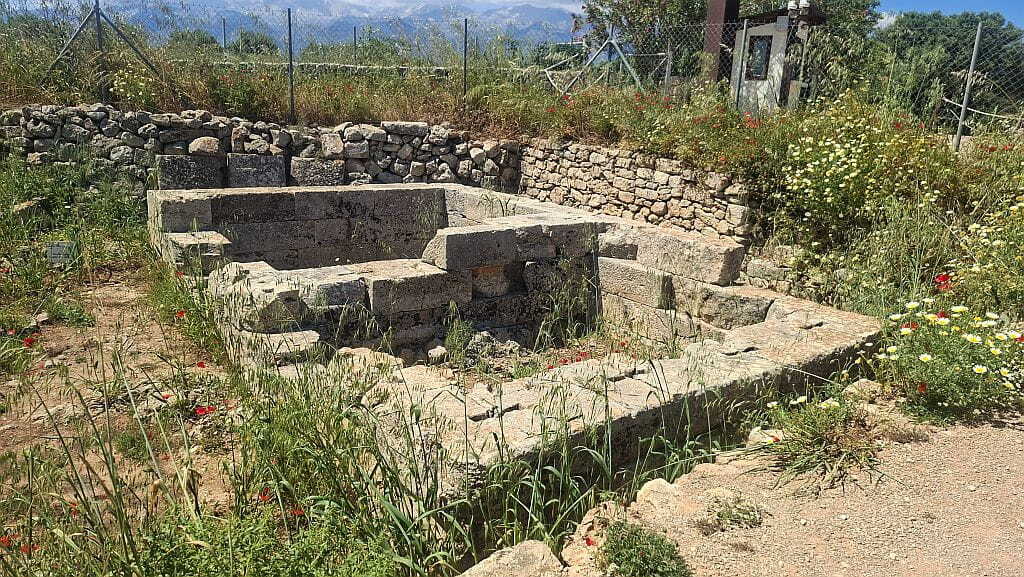
In the atrium of the house, there was a large cistern, the opening of which was built into the wall. A stone fountain base was discovered next to the cistern, and an intact clay water jug from the late 3rd or early 4th century AD was found at the bottom of the cistern.
The atrium, which likely provided light and air to the house, was surrounded by columns with Ionic bases and Doric capitals. Most of the column drums lie broken within the courtyard, indicating earthquake damage.
Small decorative sculptures and a marble table base were discovered in the courtyard. Surrounding the atrium were bedrooms, a dining room, and a guest room.
Defensive Wall
The plateau on which Aptera was situated is located 231 meters above sea level, with steep slopes and few access points. The city was protected by a 3.480-meter-long wall, which, combined, created a strategically located natural fortress.
The fortifications date to the first half of the 4th century BC, as evidenced by their construction and the pottery found in the excavated foundations.
Because the plateau is uneven, the wall was not built according to a uniform architectural design. Furthermore, weak points were protected by towers, of which six have been discovered.
The structure, width of the wall, and spacing between the towers are not uniform, but rather adapted to the terrain. The fortifications of Aptera are considered an advanced type of fortification, considering their date of construction. The walls incorporate defensive systems designed to protect against siege weapons. They feature siege ports, transverse walls, and multi-story square towers that housed war machines.
Numerous traces of siege have been discovered within the walls, including a catapult ball, slingshots and slingshot molds, and spear and arrowheads. These may be remnants of the Great Cretan War of 220 BC.
Main Gate
A 3.5-meter-wide road paved with wide flagstones leads to the main city gate, of which only the lower stones of the jambs remain.
The gate was built at the same time as the wall, in the 4th century BC.
The tower next to the gate was originally a tall structure. It was likely two-story, covered with a gable roof, and equipped with arrowslits and war machines. Only its lower section survives today.
During the Roman Empire, tombstones of wealthy families were carved into the rock near the gate. Although poorly preserved, they indicate that they belonged to wealthy and important citizens.
Heroon
Near the main gate of the city, a heroon* with inscriptions dating to the 1st and 2nd centuries AD was discovered. The bases are located between two groups of chest graves.
The first group of graves was plundered in Late Antiquity. Based on the pottery and inscriptions, it has been estimated that they were reused until the 3rd century AD. The second group dates to the 6th or 7th century AD.
Each of the partially preserved or intact bases consists of three sandstone blocks. One base retains a full inscription, while the others contain only the word "hero" or a single letter.
The inscriptions pay tribute to distinguished citizens of Aptera who were posthumously awarded the title of hero. These are not heroes who died in battle defending their homeland, but citizens who were awarded an honorary title, perhaps for their services to the city.
Between the pillars were traces of ritual pyres containing offerings from the Hellenistic and Roman periods. Numerous large cups and vessels containing liquids were found in the pyres.
*heroon means the tomb of a hero in ancient Greek. The structure was in the form of a tholos, or small temple.
Funerary Monument
The building was in the shape of a tholos or small temple.
Outside the western city walls was the main city cemetery, where families built mausoleums depending on their wealth.
One of the preserved tombs is a monument from the 1st century AD. It contained 10 burial chambers. It was plundered in the 7th century AD. A funerary relief from the early 2nd century AD, found near the entrance, depicts a young couple who were likely buried in the mausoleum. It is one of the best examples of its type in Crete.
Outside the western fortifications of Aptera, the underground section of the monument has survived. The above-ground section likely collapsed during the earthquake of 365 AD.
The monument's rich decoration and size indicate that the superstructure was in the form of a temple composed of four Ionic or Corinthian columns.
Parts of an epistyle have survived, bearing an inscription dating to the first half of the 2nd century BC: "This work was made by Soterios, son of Protogenes of Eleutherna".
The reference to Eleutherna suggests that the two cities shared close ties. The prominent location of the monument indicates that Soterios wished to boast of his wealth and ancestry.
The particularly well-crafted underground section of the monument consists of a vestibule and a burial chamber with four stone burial shafts, in which numerous objects were found: metal, iron, and bronze tools, glass and clay vases, terracotta figurines, and fragments of gold sheet. The finds allow us to date the end of its use to the early or mid-2nd century AD.
After the monument's destruction, in the late 5th or early 6th century AD, box graves were constructed there, using materials from the monument.
Aptera - interesting places
The city was founded around 1.000 BC, but it flourished during the Hellenistic period, that is in the 3rd century BC.
The polis (city-state) was developed enough to create its own currency. It was located close to the sea and established two ports, which also indicates the power of the place.
About 20.000 people lived here, of which only 1/5 were free people, the rest were slaves. This fact indicates that it was a place inhabited by wealthy residents.
In fact, Aptera was mainly inhabited by rich merchants, landowners, and sea traders. Additionally, the high elevation of the city provided a sense of security, as one could observe the sea and incoming invaders from one side, while the newcomer faced a difficult journey to the polis.
An additional flourishing occurred during the Roman rule, who also saw great potential in the place. They built, among other things, a large three-part cistern and public baths intended for the wealthiest citizens of the city - these places are still quite well preserved, awaiting visitors.
The end came, depending on the sources; either due to an earthquake in 700 or by an Arab raid in 832.