Mythological connections
The air over Crete is filled with mythology. The stories for which different regions of the island are famous form a single, familiar, and fascinating whole.
It all began on the beach of Matala, where Zeus, in the form of a white eagle, brought a beautiful princess named Europa. From there, they flew on to Gortyna to seize the girl beneath the legendary plane tree. Of course, the god of Olympus was not faithful for long. Zeus's love affairs, of which he had many, left an important fruit: three sons: Minos, Rhadamanthys, and Sarpedon.
Minos became king of the city of Knossos. He lived in a beautiful and vast palace. He was a good man and ruler. Unfortunately, life brought him much suffering. His wife, Pasiphae, cheated on him with a bull. This seems abhorrent to us. However, in those days, promiscuity was known and often accepted, even among close family members. Sex with animals was acceptable.
In any case, as a result of betrayal, a half-man, half-bull was born.
King Minos, in anger, named the strange creature Minotaur and placed him in a labyrinth designed and built by the famous and respected architect, Daedalus.
The king's betrayal wasn't the end of his wife's misfortunes. Athenian bull-taming competitions were extremely popular. During one of them, Minos's son died, literally torn to pieces. In a rage of despair and immense anger, the ruler ordered that seven girls and seven boys be sent every nine years. Trapped in a labyrinth, they became food for the Minotaur.
In one of the ships, the valiant Theseus, son of King Aegeus, arrived from the nearby peninsula of Sounion. He actually managed to defeat the Minotaur, and thanks to Ariadne's thread, he didn't get lost in the labyrinth. The king once again felt cheated and betrayed by fate. In revenge, he ordered Daedalus and his son Icarus thrown into the labyrinth.
The story of Daedalus and Icarus, who had only one way to escape the labyrinth, ends tragically. Enormous wings fused together with wax were supposed to free them both. Icarus, fascinated by freedom and the view from above, flew too high. Melting from the sun's rays, the wax melted, and the young man fell from the immense height to his death.
Knossos Palace in Crete
About 5 km southeast of Heraklion lies Knossos, the largest, most important, and most impressive center of the Minoan civilization. Built on an artificial hill, it covered an area of 22.000 m².
Although the city has been continuously inhabited since the end of the 7th millennium BCE, the first palace was built around 2.000 BCE and served as the seat of King Minos. Its peak development occurred between 2.000 and 1.350 BCE. At that time, it was the main and most populous center of Crete.
Advanced agricultural technologies began to be used, such as stone tools and loom weights. Residents became producers, farmers, and shepherds, with the settlement's population estimated at 1.000–2.000.
Around 1.900 BCE, the so-called First Palace was destroyed by a powerful earthquake. It was rebuilt almost immediately. It was destroyed again in 1.700 BCE by another earthquake, and it was rebuilt again.
The new, so-called second palace gained a larger and more impressive area, while retaining a similar layout. Luxurious houses and guesthouses with Minoan infrastructure were built. It is estimated that between 1.700 and 1.450 BC, it had a population of approximately 25.000 to 28.000.
By 1.450 BC, all the Minoan palaces on Crete, except Knossos, were destroyed and abandoned. The Achaeans from Mycenae settled in the city and conquered all of Crete. They enjoyed all the benefits of the palace, from which they controlled the entire island.
Around 1.350 BC, the palace experienced its last major catastrophe, leaving it in ruins. Small sections were rebuilt, but it ceased to function as a palace.
An interesting fact of this period is that neither the cities nor the palaces were surrounded by walls, as if the inhabitants were not afraid of the invader.
The city flourished again during the Hellenistic period. The sanctuary of Glaphcus, the sanctuary of Demeter, rock-cut tombs, and defensive towers were built.
In 67 BC, Quintus Caecilius Metellus Crete captured Knossos and founded a Roman colony called Colonia Julia Nobilis. The "Court of Dionysus," with its magnificent mosaics, dates from this period.
In the Byzantine era, Knossos was the seat of a bishop, and the remains of a basilica from the 6th century AD have survived to this day.
After the Arab conquest of Crete, the port of Heraklion began to gain importance, while Knossos slowly fell into oblivion.
Knossos was discovered in 1878 by Minos Kalokairinos.
In 1900, systematic excavations were begun by A. Evans, who continued them until 1931. Since then, excavations have been continued by the English School of Archaeology and the 23rd Ephorate of Prehistoric and Classical Antiquities.
Visiting the Palace of Knossos in Crete
The ancient remains of Knossos are scattered over a very large area.
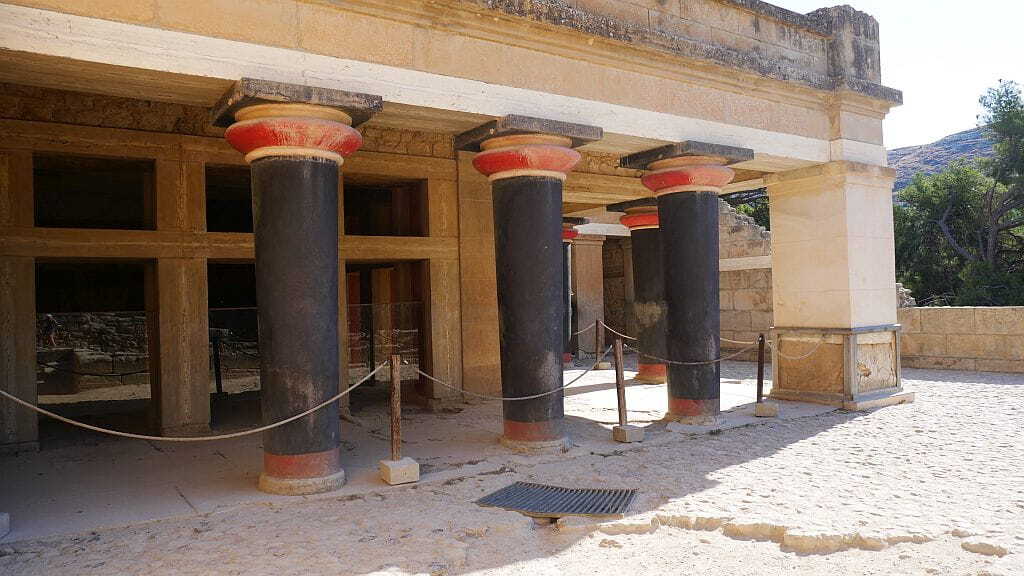
The preserved monuments date back to the neopalatial period, which includes the second palace (1700–1450 BC) and various other building complexes.
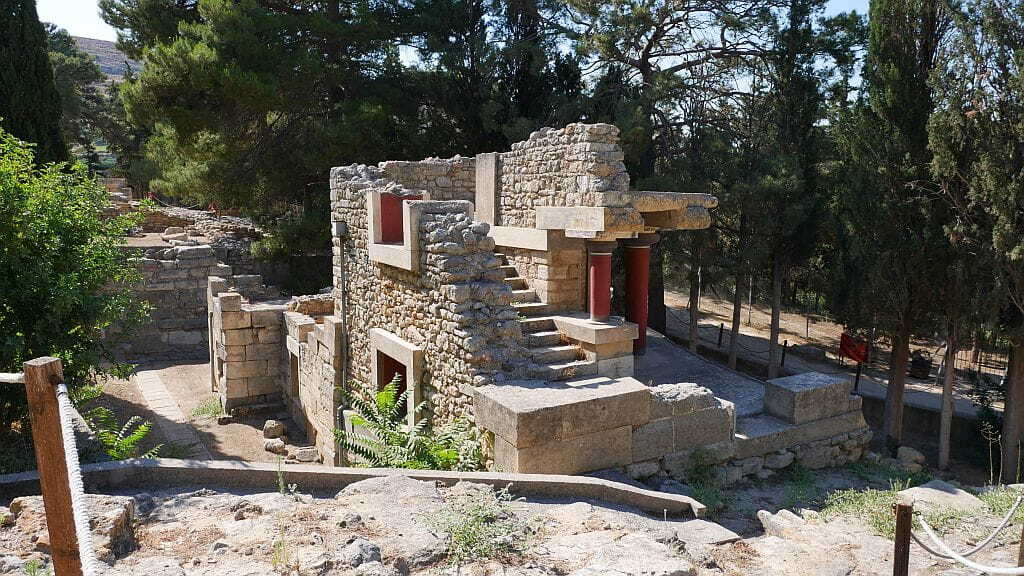
In addition to remains from the Minoan era, monuments from later periods have also been preserved, proving continuous habitation. This is an important archaeological site. In addition to the Minoan palace complex, visitors can see private houses with rich frescoed interiors, several public buildings, and several religious centers. A private Roman peristyle house with magnificent mosaic floors survives from the Roman period.
The Neolithic, or first, settlement was discovered beneath the central courtyard of the palace, at a depth of 7 meters. It was semi-permanent in nature, gradually evolving into a city with houses with stone foundations and clay superstructures, which were permanently inhabited. The settlement likely occupied an area as large as the later Minoan palace built on it. The pre-palatial settlement has almost completely disappeared, having been largely destroyed by the palace's construction.
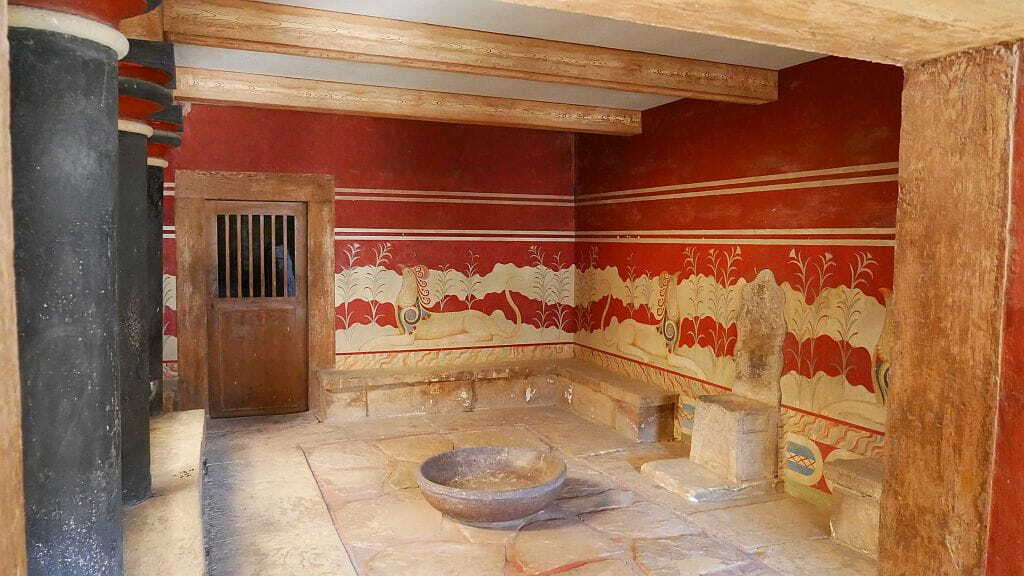
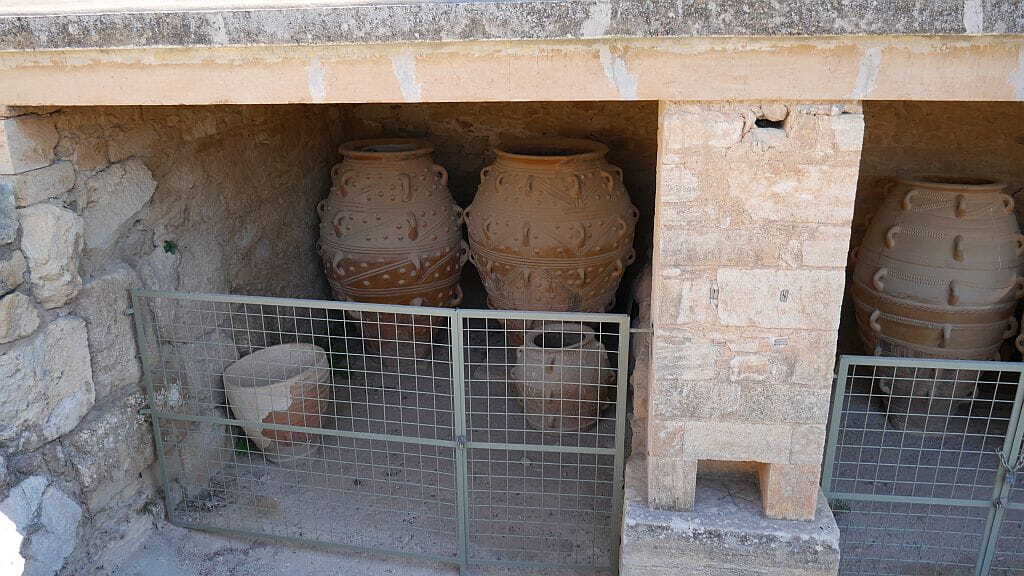
Economic and political development led to the construction of the first palace around 2000 BCE. Four wings were built around a central courtyard, containing royal apartments, workshops, sanctuaries, storerooms, treasuries, a throne room, and banqueting halls.
In the following centuries, further building complexes were built, documenting the rapid development.
The "Small Palace," dating from the 17th-15th centuries BC, is located west of the main palace and has all the architectural features of a palace, including hewn stone, reception rooms, a peristyle hall, a double court with multiple doors, and a cistern-sanctuary for purification.
The "Royal Court," dating from the 14th century BC, is located northeast of the palace. It has a strong religious character and may have been the residence of a prominent member of the aristocracy or hierarchy. Distinctive features of the court include numerous doors, a hypostyle crypt with a pillar, and a double staircase.
The "House of Paintings," dating from the 15th–12th centuries BC, is located northwest of the Palace. It is a small, urban-style house with a richly decorated frescoed interior.
The "Guest House" is located south of the palace and was believed to have housed and welcomed guests. A frescoed hall and a bathhouse were discovered here.
The "Unexplored House", dating from the 14th to 12th centuries BC, is located northwest of the palace and is of private craftsmanship.
The "Royal Tomb-Sanctuary" (17th–14th century BC) is located about 600 meters south of the palace. One of the last kings of Knossos was likely buried here. The tombs' distinctive architectural features include an entrance with a courtyard, a portico, a small vestibule, and a hypostyle crypt with two pillars.
The "High Priest's House" is located 300 meters south of the "Royal Tomb." A stone altar with two columns, framed by double axe bases, was found here.
The "Southern House" (17th–15th centuries BC) is located south of the palace and is a private, three-story urban residence with a purification tank and a hypostyle crypt.
From later periods, a characteristic example of a monument is the "Court of Dionysus" (2nd century AD), a private Roman residence in the peristyle with magnificent mosaic floors by Pope Apollinaris, depicting Dionysus.
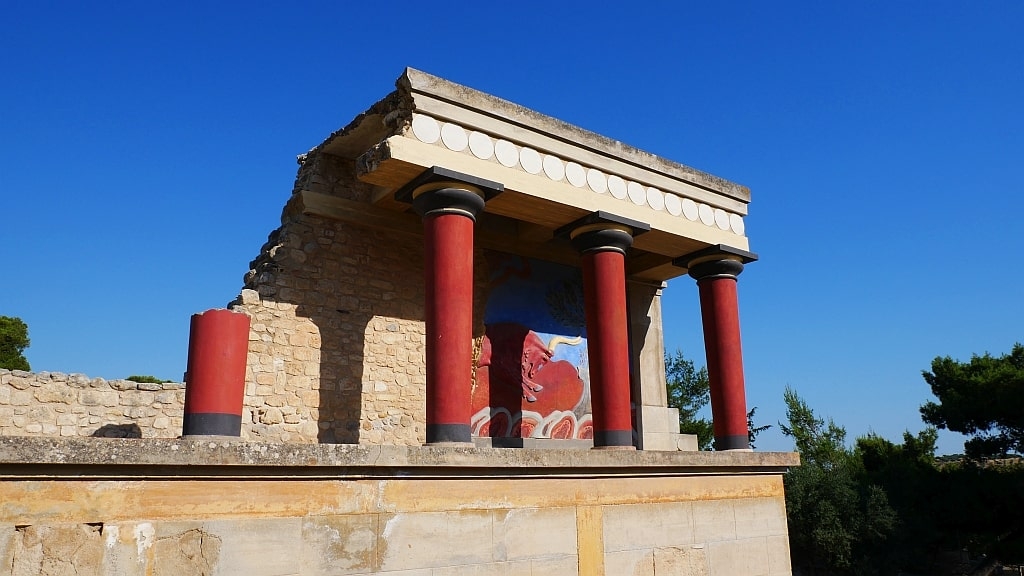
Art at the Palace of Knossos in Crete
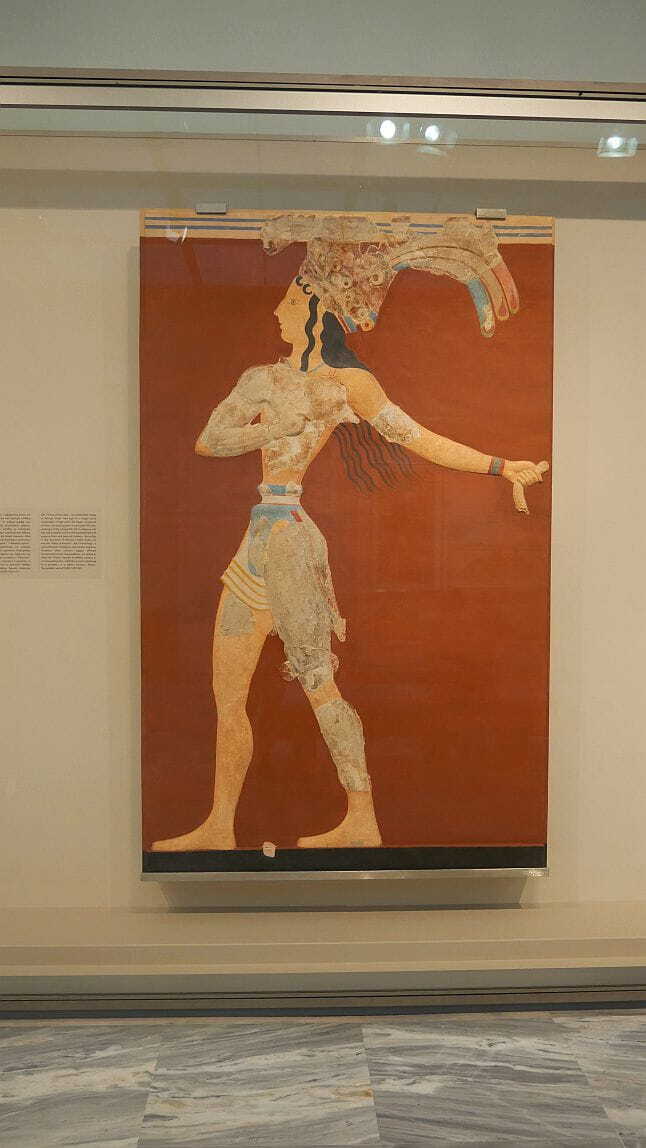
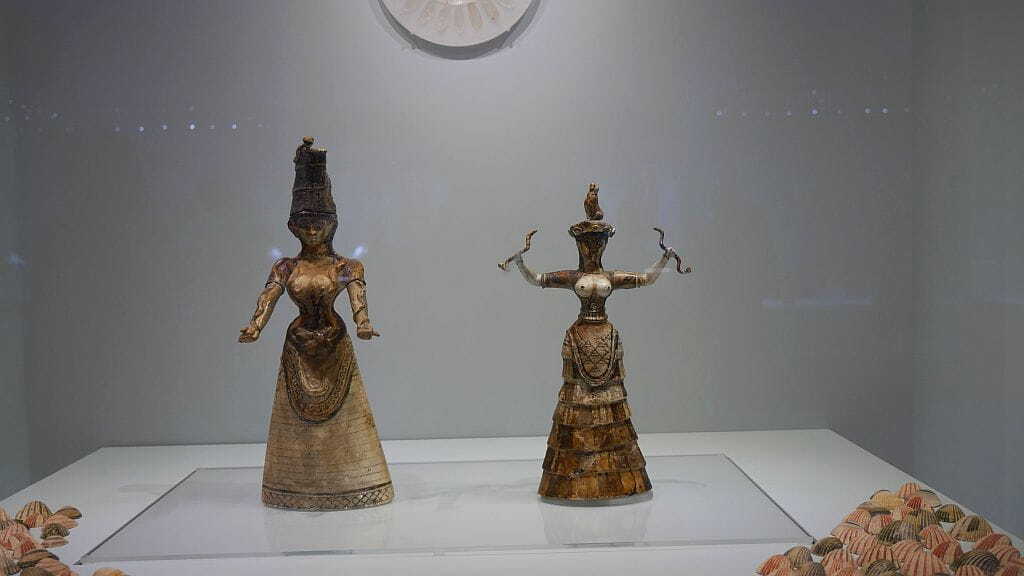
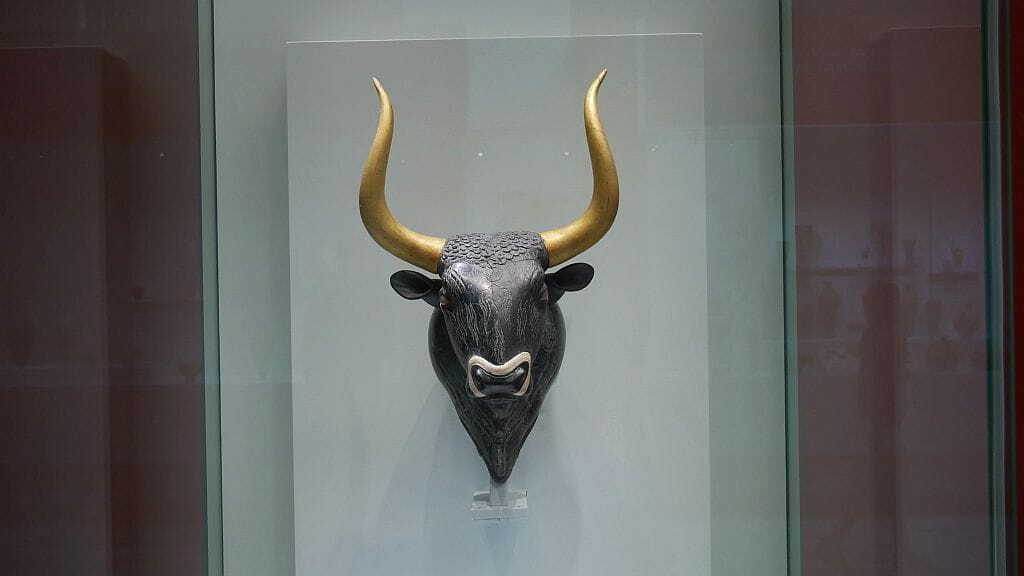
The Palace of Knossos is astonishing not only for its architecture. The wall decorations, artifacts, and everyday objects discovered here delight not only archaeologists.
Below are just three examples of the vast collection of exhibits on display at the Heraklion Archaeological Museum.