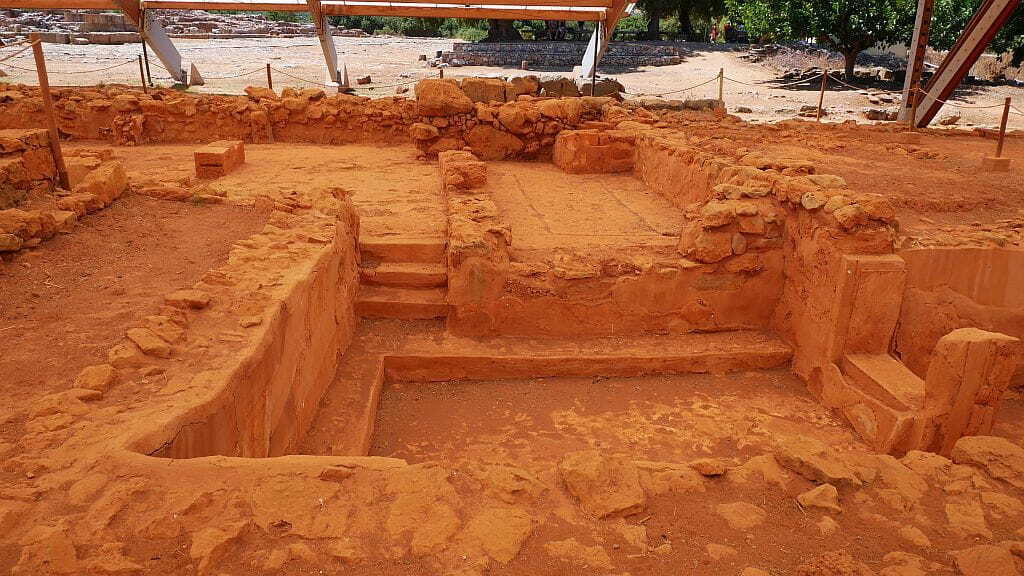
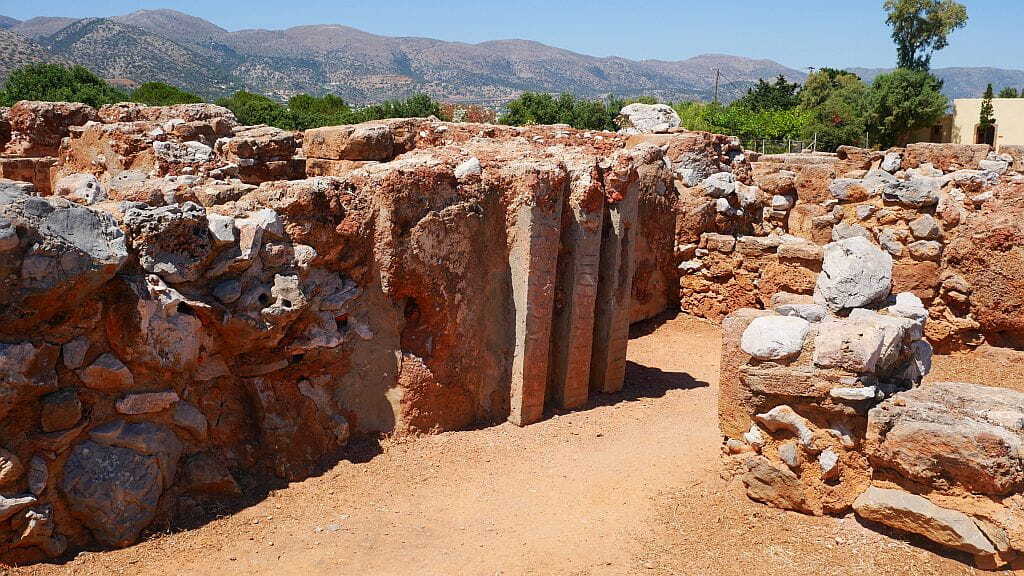
Minoan palace in Malia, Crete
The Palace of Malia is the third largest Minoan palace in Crete.
Excavations of the palace were begun by Iosif Khatzidakis in 1915 after the accidental discovery of bronze cauldrons and clay sarcophagi at the Azymos archaeological site.
Since 1920, archaeological research has been conducted by the French School of Athens in cooperation with the local Ephorate of Antiquities.
The settlement's location, right next to the sea and at the intersection of roads connecting central and eastern Crete, influenced rapid economic and commercial development.
The first palace complex, the so-called Old Palace, was built at the beginning of the 2nd millennium BCE. It is believed to have been founded in 1900 BCE, contemporaneously with the palaces at Knossos and Phaestos, although an alternative theory suggests a much earlier date, around 2300 BCE. Like Knossos and Festos, it was the center of the urban area. It was remarkably expansive, covering an area of 7,500 m².
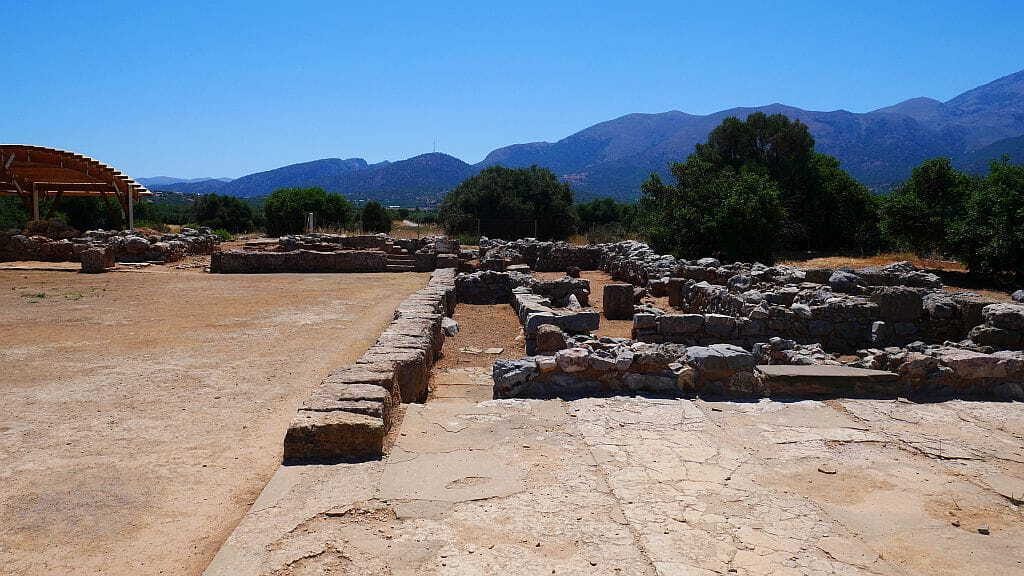
The inner courtyard, surrounded by buildings, had equally impressive dimensions of 48×23 m. Surrounding it were sanctuaries, royal chambers, and a theater.
These open spaces were used for celebrating festivals and communal ceremonies. Traces of more private forms of ritual have been preserved in the West Wing. In a small complex of rooms with intricately plastered floors, swords with gilded hilts and pommels were found, along with an impressive collection of pottery.
Remains of warehouses and workshops have been preserved at the northwest end of the palace.
A few hundred meters north of the palace, the northern cemetery and the Mu Quarter were discovered, as well as two large, luxurious, two-story private houses built of hewn stone. Numerous rooms served domestic, cultic, storage, and commercial purposes, testifying to the wealth of the inhabitants. Pottery, metalwork, sculpture, goldsmithing, engraving, and weaving workshops were the subject of local and international trade.
The Old Palace was destroyed around 1700 BC by a major earthquake that affected all the Minoan palaces of the time.
Reconstruction began quickly, but further destruction in the second half of the 16th century BC resulted in architectural changes that showed significant influence from Knossos.
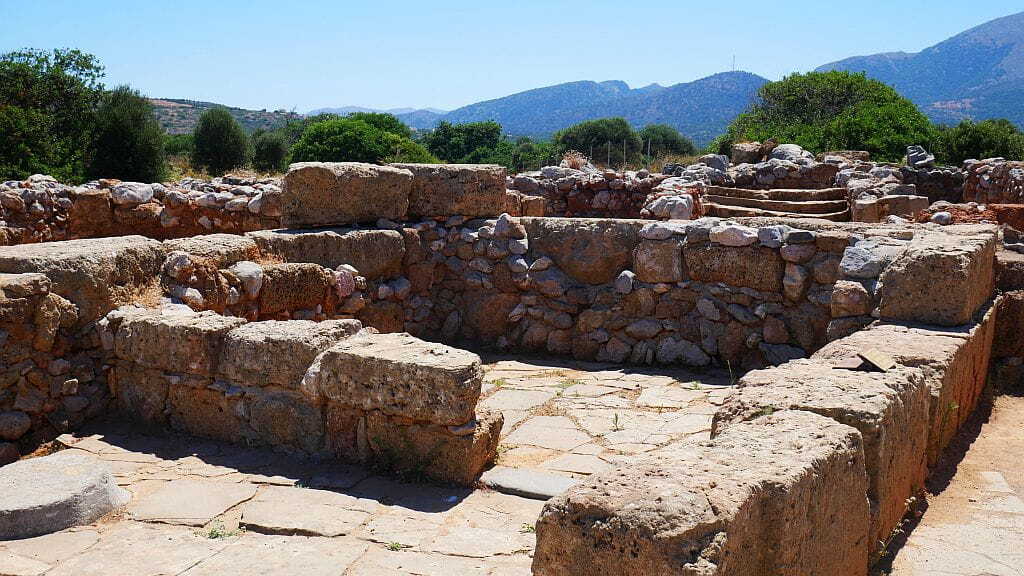
The new Palace was larger and consisted of separate wings arranged around a Central Courtyard. The buildings were two-story structures with luxurious chambers and open verandas.
The Central Courtyard remained the heart of the complex, hosting mass gatherings, official events, and religious ceremonies at an altar built directly on the ground.
The West Wing contained:
- long, narrow rooms for storing goods and essentials,
- lavish reception and banqueting halls, ritual chambers, and rooms for storing valuable ritual equipment,
- official palace apartments,
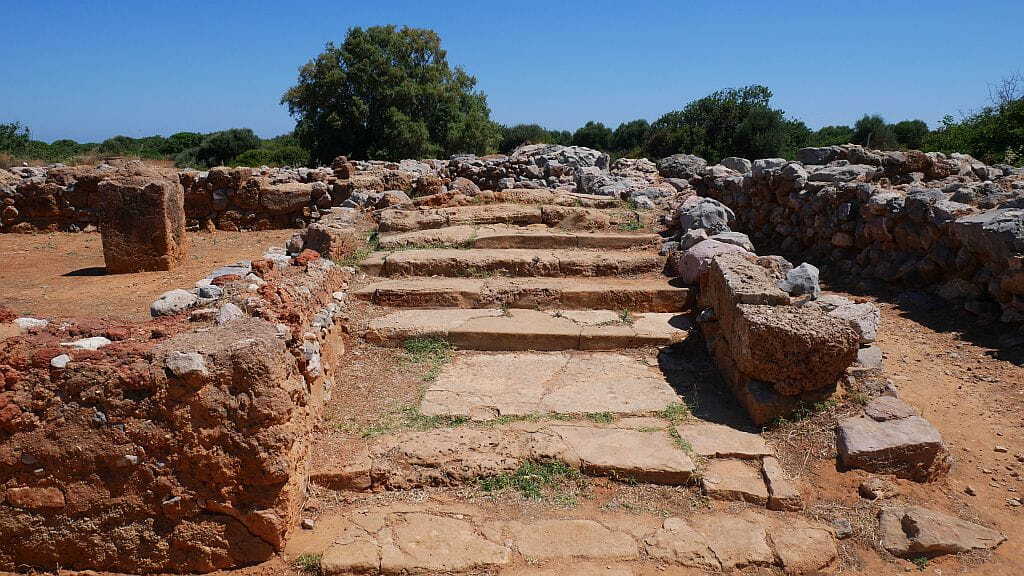
- a magnificent staircase leading to the first floor, of which 11 steps remain,
- a loggia with a column and four steps leading up, used for ritual offerings at a stone altar,
- a small treasury, where a sword with a gilded pommel and a stone axe in the shape of a leaping panther were found, exhibited at the Heraklion Archaeological Museum,
- at the northwest end of the courtyard were wide steps on which spectators sat during ritual offerings in the courtyard.
The South Wing was divided into two parts by a cobbled corridor,
- warehouses and workshops,
- a small chapel with a curved altar,
- eight circular, above-ground structures.
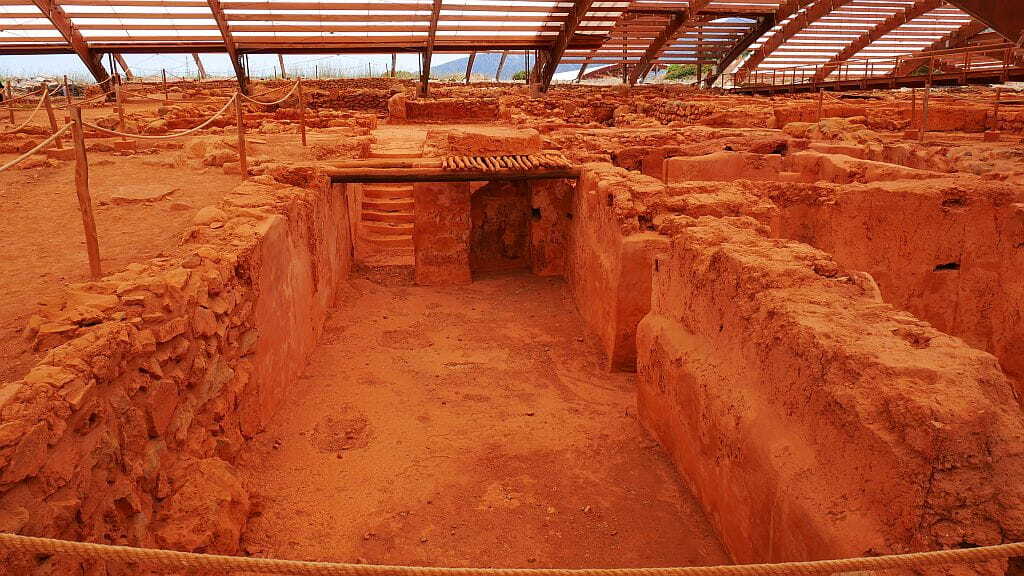
The eastern wing (now roofed) housed:
- a row of pithoi warehouses with agricultural products (food, olive oil),
- built-in benches and
- channels and collectors in the floor to collect spilled liquids.
The North Wing contained:
- warehouses and workshops,
- two spacious inner courtyards.
The palace was completely destroyed in 1450 BC and never reused. The city continued to be inhabited, maintaining contact with the thriving Mycenaean centers at Knossos, Kydonia (Chania), and mainland Greece. It was finally abandoned around 1250 BC.