
⛪ Zoodochos Pigi – From a Single Cell to a Monastery
In 1756, there was no large monastery here. In the mountains above Vlamari stood a small chapel dedicated to Zoodochos Pigi, and the hieromonk Dorotheos asked the Archbishop of Samos for permission to live beside it. He was granted the use of the chapel and permission to build a single cell, where he could remain for the rest of his life.
From that one cell, a community began to grow. Other monks arrived, new buildings were constructed, and in 1782 – just 26 years after Dorotheos came here – a large church was completed. This was the beginning of one of the most important monasteries on Samos.
To this day, it hides several remarkable details: doors made from 365 wooden pieces, four columns which, according to tradition, came by sea from Miletus, and traces of a time when the monastery cared for people with leprosy. And its story is far from over – since the beginning of the 21st century, the monastery has been home to a community of nuns.
📜 From a Single Cell to a Monastery
The story of Zoodochos Pigi began modestly. In 1756, a small chapel dedicated to Zoodochos Pigi – the Virgin Mary as the “Life-Giving Spring” – stood on this site. The hieromonk Dorotheos asked Kallinikos, the Archbishop of Samos at the time, for permission to live beside it. He was granted the use of the chapel and permission to build a single cell nearby, where he could remain for the rest of his life.
Dorotheos did not remain alone, however. Over time, other monks joined him, more cells and buildings were constructed, and the small hermitage gradually developed into an organised monastic community.
The clearest evidence of this growth is the main church. Its construction was completed on 18 May 1782, just 26 years after Dorotheos arrived. We know the exact date from a surviving inscription, which also names Dorotheos as the head of the community.
Within a single generation, a place where one monk had wanted to build a cell for himself had become a large monastery. Dorotheos lived to see his small community develop into one of the important monastic centres of Samos.
🏛️ Four Columns from Across the Sea
Inside the church are four stone columns supporting the dome. According to monastery tradition, they were not made on Samos – they are said to have been brought from ancient Miletus, on the opposite side of the strait, on the coast of Asia Minor.
If the tradition is true, transporting the columns must have been quite an undertaking. First, they would have had to be carried by sea to Samos and then transported high into the hills above Vlamari. There is, however, no archaeological confirmation that they came from Miletus, so this story should be treated as a long-standing monastery tradition rather than an established fact.
There is nevertheless something special about the story. From the area around Zoodochos Pigi, you can see the Mykale Strait and the coast of Asia Minor. You can therefore look across to the opposite shore – towards the very land from which, according to tradition, the columns now standing inside the church were brought more than two centuries ago.
🚪 365 Days Hidden in a Door
One of the most interesting details at Zoodochos Pigi is easy to miss. The doors leading from the narthex into the main part of the church are made from 365 small wooden pieces – one for every day of the year.
The number is no coincidence. Each piece is said to symbolise one day of the year, turning the entire door into an unusual wooden calendar. It is a simple idea, but one particularly suited to monastic life, whose rhythm has for centuries been shaped by successive days of prayer, work and religious feasts.
It is worth stopping here for a moment. There is no need to count all 365 pieces – it is far more interesting to look at the door knowing that its construction was given the symbolic meaning of an entire year.
🪵 An Iconostasis Created in Stages
One of the most valuable features of the church interior is its richly carved wooden iconostasis. It is often dated to 1802, but its history began earlier. The iconostasis itself was made in 1788, only a few years after the main church was completed.
It was not gilded until 1802. The work was carried out by Georgios Tantolos, and an inscription on the iconostasis records this information. Thanks to it, we can distinguish between two stages of its creation – the construction of the wooden structure and its later gilding.
Another important element of the church furnishings dates from the same period. The venerated icon of Zoodochos Pigi received a silver covering in 1793, and several years later a carved wooden proskinitarion was made for it.
Within just a few decades of Dorotheos’s arrival, the modest chapel with a single cell had acquired furnishings created by skilled craftsmen. It is perhaps the clearest indication of how rapidly the young monastery developed.
🩺 The Monastery That Cared for the Sick
For centuries, leprosy was one of the most feared diseases. There was no effective treatment, and fear of infection meant that people with the disease were separated from the healthy population and forced to live outside settlements. On Samos, people affected by leprosy lived in isolated places known as Louviarika. Before state institutions were established, monasteries also took on some responsibility for their care.
This was the case at Zoodochos Pigi. Those with leprosy could not live together with the monks inside the monastery walls. A separate building approximately 200 metres from the monastery was provided for them. The distance was not accidental – it kept them apart from the healthy community while leaving them close enough for the monastery to provide assistance.
Nor was this merely symbolic care for one or two people. At the end of the 19th century, the French physician Démétrius Zambaco Pacha, who studied leprosy, recorded 15–18 people with the disease at Zoodochos Pigi. For a small monastic community, this was a significant group.
Their lives were severely restricted, but they were not left entirely without support. The monastery provided food and basic necessities, using its own income as well as donations from the inhabitants of Samos. Surviving information concerning Samian monasteries also shows that agreements were sometimes made with people with leprosy who owned property. A person would transfer their property to the monastery and, in return, receive food and essential care for the rest of their life.
It is important to remember that this was not medical care in the modern sense. At the time, leprosy could not be treated effectively. The main aim was to provide shelter, food and basic assistance to people who had been excluded from normal community life because of their illness.
There are therefore two sides to this story. On the one hand, there was isolation – those with the disease had to live separately from the healthy population. On the other, in a world where virtually no public welfare system existed, the monastery took responsibility for people whom the rest of the island’s population feared.
It was not until the beginning of the 20th century that the situation began to change. The authorities of Samos attempted to establish a more organised, secular system for the isolation and care of people with leprosy. This was the same period in which the much better-known leper colony on Spinalonga was being established on Crete.
Zoodochos Pigi, however, represents an earlier stage in this history. There was no enclosed colony here like the one on Spinalonga. There was a monastery and, outside its walls, a separate house where more than a dozen people lived apart from the healthy population while remaining under the care of the monastic community.
Around 200 metres – that was all that separated the world of the healthy from the world of the sick. Far enough to isolate them, but close enough not to leave them entirely alone.
👩 From Monks to Nuns
For more than two centuries, Zoodochos Pigi was a male monastery. Its history began with Dorotheos in 1756, and for generations it was monks who formed the community here. Over time, however, their numbers declined, as they did in many other monasteries on Samos.
A new chapter began in 2002, when Zoodochos Pigi became a convent. Nuns moved into the former monks’ cells, allowing a place that might otherwise have gradually become empty to continue fulfilling its original purpose.
The nuns devote themselves to the monastery’s daily life, prayer and upkeep, as well as icon painting – creating icons according to the tradition of the Orthodox Church. This is therefore not simply a historic monument opened to tourists. A small monastic community still lives behind its 18th-century walls.
👀 Don’t Miss
🚪 The door made from 365 pieces – each of the small wooden elements symbolises one day of the year.
🏛️ The four columns beneath the dome – according to monastery tradition, they were brought across the sea from ancient Miletus.
🪵 The carved iconostasis – made in 1788 and gilded in 1802. Take a closer look at its intricate decoration.
🩺 The area outside the monastery walls – approximately 200 metres from the monastery stood the building where people with leprosy were isolated and cared for. We do not yet know whether any traces of it survive – we will check when we visit.
🌊 The view towards Asia Minor – look across the Mykale Strait to the opposite shore. This is where Miletus lies, the city from which, according to tradition, the monastery’s columns were brought.
👀 The courtyard and monastery buildings – remember that Zoodochos Pigi is still an active monastery. The former monks’ cells are now part of a community of nuns.
ℹ️ Practical Information
🗺️ GPS: 37.76910, 27.02882
🚗 Getting there: a mountain road leads to the monastery from the Vlamari area. The route climbs through pine-covered slopes and has numerous bends. Part of the approach is along an unpaved road, so it is worth checking its current condition before continuing. You can drive all the way to the monastery – there is no need to complete the final section on foot.
🅿️ Parking: you can leave your car beside the monastery.
🕘 Opening hours: the monastery welcomes visitors at set times, although these may vary depending on the season:
10:00–13:30 and 17:00–19:30
🎟️ Admission: free.
🙏 Dress and behaviour: this is an active convent. Shoulders and knees should be covered. Women wearing short shorts should be prepared to put on a longer skirt or scarf if required. Keep quiet inside and check whether photography is permitted before taking pictures.
⛪ Panagia Makrini – the Hermits’ Chapel Hidden in the Kerkis Mountains
This small chapel hidden beneath the rock was more than just a place of prayer. For the hermits who lived here, it was their entire monastic world.
You do not come across Panagia Makrini by accident. You have to leave the main road, climb for several kilometres along a track leading deep into the Kerkis massif, and cover the final section on foot. At the end, however, there is no large monastery waiting for you, but a tiny chapel hidden beneath a rocky overhang.
Today, reaching this place is an adventure. Several hundred years ago, isolation was exactly what people were looking for. The caves and remote slopes of Kerkis attracted monks and hermits who deliberately chose to live far from settlements. Panagia Makrini is one of the most fascinating traces of this tradition.
We do not know exactly when the first ascetics appeared here. Local traditions take us as far back as the early Middle Ages, but the oldest surviving traces allow us to say something with greater certainty: more than 700 years ago, the small chapel beneath the rock was already being decorated with frescoes.
🧙 The Hermits of Kerkis
Panagia Makrini was not the only place of its kind. For centuries, small hermitages known as askitaria were established in caves and rocky hollows across the Kerkis massif. Monks chose places far from villages and difficult to reach because solitude and separation from everyday life formed part of their religious path.
They did not need a large monastery. A natural cave provided shelter, a small chapel offered a place for prayer, and water could be collected from the rocks. Similar hermitages existed in other parts of Kerkis, including Agia Triada and Panagia Kantili.
Today, it is difficult to determine exactly when hermitic life began in this part of Samos. Local traditions trace its origins back to Byzantine times and connect Kerkis with St Paul of Latros. More tangible traces, however, were left by the hermits themselves – chapels, paintings and spaces created within natural caves.
Panagia Makrini is one of the best-preserved examples of this world. And it is its old frescoes that allow us to look much further back into the history of the hermitage than later traditions and legends.
⌛ How Old Is It Really?
There is no single, simple answer to this question. Tourist materials often state that Panagia Makrini was founded in the mid-9th century. However, no document has survived that would allow the first chapel to be dated so precisely.
Much firmer evidence has been left by the walls and paintings themselves. Archaeological research has shown that the chapel developed in several stages, while the oldest surviving frescoes date from around 1300. This means that monks were using the site more than 700 years ago.
What we see today, however, does not belong to a single period. The older chapel was gradually expanded. An inscription preserved above the entrance states that another church was completed in August 1764. Interestingly, we even know the name of the builder – Giorgis from Paros – while the work was financed by Nikolakis Chatzipanagiotis.
Panagia Makrini is therefore something of a historical puzzle: beginnings shrouded in tradition, medieval frescoes more than 700 years old and an 18th-century extension that incorporated the older chapel into a larger structure. When we look at it today, we are not looking at a single monument from one particular century, but at a place that evolved over hundreds of years.
🎨 Frescoes More Than 700 Years Old
The frescoes are the most valuable surviving traces of the medieval history of Panagia Makrini. They were not created all at once – research indicates several phases of decoration, with the oldest surviving paintings dating from around 1300.
On the walls, you can recognise figures of Christ, the Virgin Mary, saints and archangels, as well as scenes from the life of Christ. Among them is the Presentation of Christ in the Temple. Depictions connected with the Akathist Hymn, one of the most important hymns dedicated to the Virgin Mary in the Orthodox tradition, have also survived.
These are not frescoes that impress with intense colours. Some of the paintings have faded, while others survive only in fragments. And that is precisely what makes them so remarkable – for more than seven centuries, they have remained on the walls of a tiny chapel hidden high in the Kerkis Mountains.
Take the time to look closely at them. This is one of those places where an unassuming interior turns out to be far older than you might imagine while standing outside the entrance.
💧 Life Beneath the Rock
Panagia Makrini was more than somewhere people came to pray. The cave provided the hermits with natural shelter – protecting them from the sun and wind, while its rocky ceiling served as a roof. The chapel itself is tiny, measuring only around 4 × 2 metres, but the cave continues deeper into the mountain.
One of the greatest challenges of living high on Kerkis must have been obtaining water. The hermits made use of what the rock itself provided. Water dripping from stalactites was collected in clay vessels, remains of which have been described inside the cave. This was therefore not merely a religious symbol – in such an isolated place, every drop had practical value.
Human bones have also been found in the cave, which local tradition associates with monks who once lived here. We do not know, however, who they belonged to or when they date from, so this interpretation cannot be treated as established fact.
The small space, the chapel, water collected from the rock and almost complete separation from the outside world help us understand what life in an askitiri was really like. Panagia Makrini was not created to be easy to reach. Isolation was part of the very nature of this place.
👤 Paul of Latros – History or Tradition?
The hermits of Kerkis are associated with St Paul of Latros, one of the Byzantine ascetics who lived in the 10th century. He was primarily associated with Mount Latros in Asia Minor, near Miletus, but his Life also mentions a stay on Samos.
According to local tradition, Paul stayed in the caves of Kerkis and contributed to the revival of hermitic life in the area. Various askitaria are associated with his stay, and Panagia Makrini also appears in local stories. There is, however, no evidence that Paul lived in this particular cave.
It is therefore safest to regard this story as part of the tradition associated with Kerkis rather than as a documented episode in the history of Makrini. Paul himself is not a legendary figure – he really lived, and his connections with Samos appear in Byzantine sources. We simply cannot identify which of the Kerkis hermitages he stayed in.
This distinction is important for another reason as well. The hermitic tradition of Kerkis did not begin with Paul. When he arrived on Samos, places of retreat for monks probably already existed here. Rather than calling him the founder of Panagia Makrini, it is therefore better to see him as one of the people associated with the long history of ascetics who sought refuge in the mountains of Samos.
👀 Don’t Miss
🎨 Medieval frescoes – the oldest surviving paintings date from around 1300.
🪨 The chapel beneath the rock – notice how the tiny structure has been incorporated into the natural cave.
💧 Water dripping from the rock – deeper inside the cave, it was collected in clay vessels. For the hermits who lived here, it had a very practical purpose.
🏚️ Traces of the old hermitage – try to see the entire site not simply as an isolated chapel, but as a place where monks actually lived.
👀 The rocky surroundings – only when you are here can you fully appreciate just how isolated a place the hermits chose. At Panagia Makrini, the location itself is part of its history.
ℹ️ Practical Information
🗺️GPS: 37.72955, 26.60254
🚗 Getting there: before reaching Kallithea, look for the sign for “Ag. Panteleimon & Panagia Makrini”. From there, an unpaved road climbs for around 5 km into the Kerkis Mountains. The Chapel of Agia Aikaterini is a useful landmark along the way. Beyond it, continue for approximately another 1 km towards Makrini.
🚙 Car: the condition of the mountain road can vary, so a car with higher ground clearance is the best choice. After rain or damage to the road surface, the route may be more difficult. Check the terms of your car hire agreement before setting off – not all insurance policies cover driving on unpaved roads.
🥾 Final section: after leaving the car, there is an uphill walk of around 500 metres to the chapel. The route is marked with white cross-shaped signs. Closed shoes with good grip are recommended.
🕘 Opening hours: there are no regular visiting hours as at larger monasteries. This is a remote hermitage chapel, so do not assume that you will find the interior open.
🎟️ Admission: free.
💧 What to bring: water, a hat and something to eat. There are no shops or tourist facilities along the route.
🙏 Dress and behaviour: Panagia Makrini is a place of worship. Shoulders and knees should be covered. Keep quiet inside and check whether photography is permitted before taking pictures of the frescoes.
⛪ Timios Stavros Monastery – From a Small Chapel to a Great Monastery
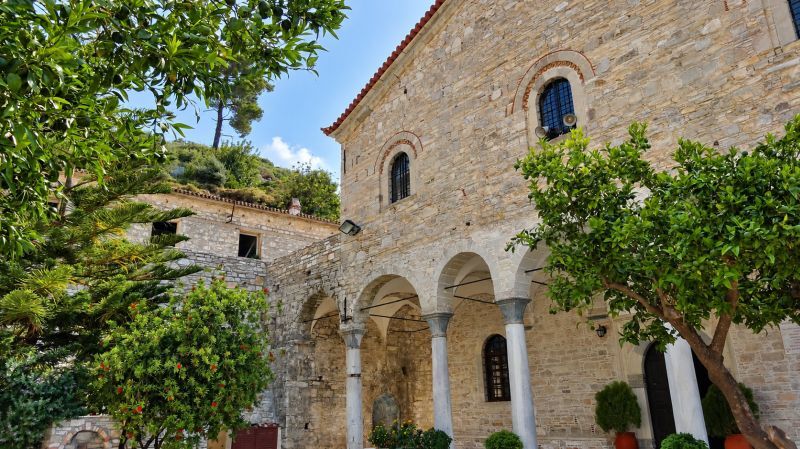
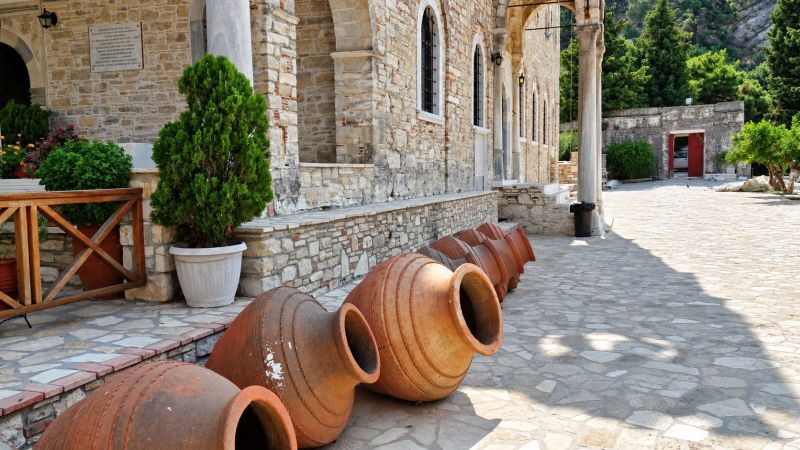
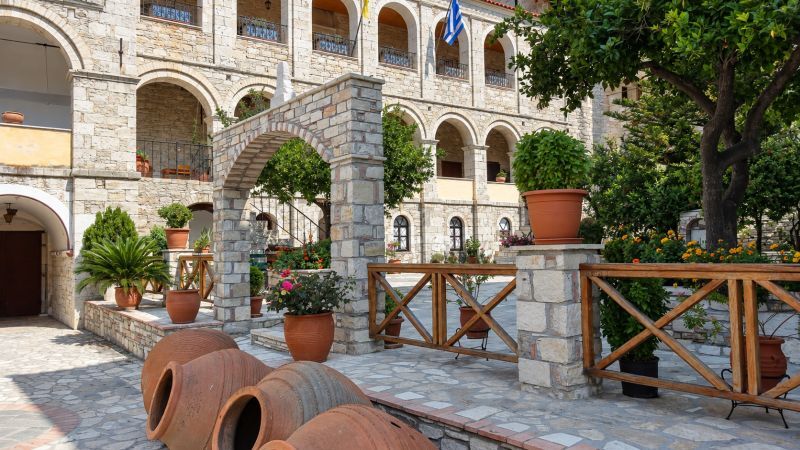
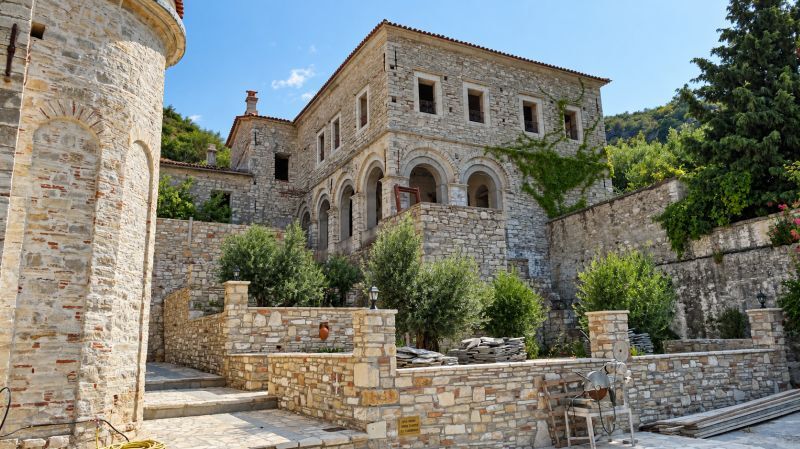
Timios Stavros is one of the oldest and most important monasteries on Samos. Its history began in the late 16th century with a small chapel and stretches across more than four centuries – through periods of expansion, war, fire and reconstruction. Interestingly, its story begins with a monk we have already met. Neilos had previously helped establish Megali Panagia Monastery, before beginning an entirely new chapter here.
Today, much more than a historic church lies behind the monastery walls. There is a richly carved iconostasis, objects dating back to the 19th century and the monastery’s greatest treasure – a relic of the Holy Cross. It is therefore worth not only stepping inside, but also knowing what to look for and which stories to discover behind the monastery walls.
🌿 It All Began with a Small Chapel
The history of Timios Stavros Monastery begins in 1592. That was when the monk Neilos, whom we already know from the history of nearby Megali Panagia Monastery, arrived here. This time, he decided to establish his own community and began with a small chapel dedicated to the Holy Cross.
According to local tradition, the choice of location was no accident. An icon depicting the Exaltation of the Holy Cross is said to have been discovered here. Buildings gradually appeared around the small chapel, and a community of monks began to develop.
Just over a decade later, in 1604, the monastery was expanded. The modest chapel thus gave rise to a place that would become one of the most important monastic centres on Samos over the following centuries.
🧙 The Same Monk, Two Monasteries
This is not the first time Neilos appears in the history of Samos. Several years earlier, together with the monk Dionysios, he had helped establish Megali Panagia Monastery. Around six years later, he left that community and moved to the place where Timios Stavros would be founded.
The histories of two important monasteries on Samos were therefore linked by one man. Neilos first helped establish Megali Panagia and later began building a new monastic centre. At first, there was only a small chapel – over time, an entire monastery grew around it.
🏗️ The Monastery Grows
The small chapel was only the beginning. As early as 1604, Timios Stavros began to expand, and as the community grew, new buildings appeared around the church – monks’ cells, utility rooms and other spaces needed for everyday monastic life.
The greatest changes came in the 19th century. The old church was already in poor condition, so it was decided to replace it with a much larger one. In 1838, the foundation stone was laid for a new three-aisled basilica with a dome. The work was carried out during the time of Abbot Grigorios from nearby Mavratzaioi, with local residents also contributing financially to the project.
It is this 19th-century church that forms the heart of Timios Stavros today. Over the following years, its interior was enriched with carved and gilded furnishings, making it one of the most interesting monastery interiors on Samos.
⚔️ War Reaches the Monastery Walls
The Greek War of Independence also affected Samos. In 1823, the situation at Timios Stavros Monastery became so difficult that the monks struggled to meet the expenses and financial burdens associated with the ongoing conflict. According to an entry preserved in the monastery’s codex, they even considered selling one of their valuable possessions – a silver candlestick.
It was then that Konstantis Lachanas, one of the important leaders of the Samian uprising, entered the monastery’s story. He is said to have raised the necessary funds, thereby saving the candlestick from being sold.
This small event reveals something much larger – monasteries did not exist in isolation from events taking place across the island. War brought not only danger, but also financial difficulties and the need to protect property accumulated over generations.
⛪ The Church of Timios Stavros
The present church of Timios Stavros dates from the 19th century. The foundation stone for the new building was laid in 1838, replacing an earlier and much more modest church. The result was a three-aisled basilica with a dome, which remains the most important part of the monastery today.
From the outside, notice the combination of stone, whitewashed walls and red roof tiles, as well as the buildings grouped around the monastery courtyard. The church, however, gives little indication of what awaits inside. Its greatest splendour is hidden in the interior.
This is where you will find the most valuable elements of its 19th-century furnishings: a gilded wooden pulpit from 1843, a bishop’s throne made a year later and an impressive carved iconostasis completed in 1854. Once inside, it is worth taking your time – some of the most interesting details are easy to miss.
👀 Take a Look Inside
The interior of the church at Timios Stavros certainly deserves a closer look. The richly carved and gilded iconostasis from 1854 immediately attracts attention. Its decoration includes scenes from the Old and New Testaments, figures of saints and countless small ornamental details. This is one of those historic works best viewed up close – only then can you appreciate just how much detail is hidden in the wood.
Look around the sides of the church as well. There is a gilded wooden pulpit made in 1843 and, nearby, a bishop’s throne dating from 1844. Both were created while the new 19th-century church was being furnished.
It is also worth looking upwards. The dome, arches and wall decorations create a completely different impression from the rather austere stone monastery buildings outside. Timios Stavros is therefore best explored without rushing – its most fascinating features are hidden in the details.
✝️ The Monastery’s Greatest Treasure
The greatest treasure of Timios Stavros, however, is neither its elaborate iconostasis nor the gilded furnishings of the church. The monastery preserves a fragment of the Timio Xylo – the Holy Wood, a relic believed to be part of the Cross on which Christ was crucified.
The relic came to Samos thanks to a clergyman from the island who later became Patriarch Cyril II of Jerusalem. According to local tradition, he presented it to the monastery in 1815. Since then, it has become one of its most important objects of veneration.
14 September, the Feast of the Exaltation of the Holy Cross, has particular significance here. On this day, the relic takes centre stage in the monastery celebrations, and Timios Stavros – whose name means “Holy Cross” – becomes a destination for pilgrims attending the annual feast.
🔥 Destruction and Reconstruction
Timios Stavros Monastery survived for several centuries, but the Second World War proved to be a particularly difficult period. During the German occupation of Samos, part of the complex was destroyed by fire. The flames consumed the eastern part of the monastery and its entire southern wing.
Not all of the destroyed buildings were later reconstructed. An orchard was planted on the site of the former southern wing, which means that the monastery’s present layout differs from its pre-war appearance.
Looking at the courtyard and surrounding buildings today, it is difficult to imagine that the complex was once larger. The missing section is therefore not part of the original design, but a trace of the dramatic events of the 20th century.
📅 14 September – the Most Important Day of the Year
The name Timios Stavros means “Holy Cross”, so the monastery’s most important feast falls on 14 September – the Feast of the Exaltation of the Holy Cross. On this day, the usually peaceful monastery becomes a destination for pilgrims arriving from different parts of Samos.
The celebrations begin on the evening of the previous day with religious services, followed by a solemn liturgy the next morning. The relic of the Holy Cross preserved at the monastery plays a particularly important role and is displayed for veneration on this day.
The feast has special significance here – it recalls both the relic kept at Timios Stavros and the monastery’s own beginnings, when more than four centuries ago it grew around a small chapel dedicated to the Holy Cross.
👀 Don’t Miss
Before leaving Timios Stavros, take one more look around. At this monastery, the most interesting features are not only the major architectural elements but also the details that are easy to overlook.
👉 The iconostasis from 1854 – step closer and examine the carvings. Scenes from the Old and New Testaments are hidden among the ornamentation.
👉 The gilded pulpit from 1843 – notice its elaborate wooden decoration.
👉 The bishop’s throne from 1844 – another element dating from the period when the new church was being furnished.
👉 The relic of the Holy Cross – the monastery’s greatest treasure and the reason why Timios Stavros becomes an important pilgrimage destination on 14 September.
👉 The courtyard and monastery wings – look at the complex as a whole and try to imagine its former appearance. Before the destruction of the Second World War, the monastery buildings occupied a larger area.
ℹ️ Practical Information
🗺️ On Google Maps: 37.70816, 26.87136
🕘 Opening hours: opening hours may change on religious holidays, so it is worth checking before your visit.
Tuesday–Sunday: 9:00–12:00 and 18:00–20:00
Monday: closed.
🎟️ Admission: free.
👗 Dress code: appropriate clothing is required in this place of worship – shoulders and knees should be covered.
📷 Photography: photographs can be taken in the courtyard, but before taking pictures inside the church, it is best to check the information on site or ask for permission.
⚠️ Good to know: the main church was damaged in the 2020 earthquake. In September 2026, monastery celebrations were still being held outdoors in front of the damaged church, so access to the interior may be restricted.
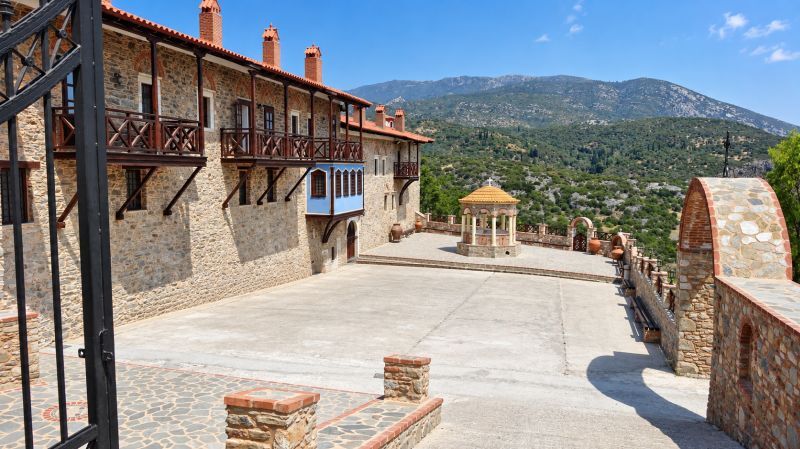
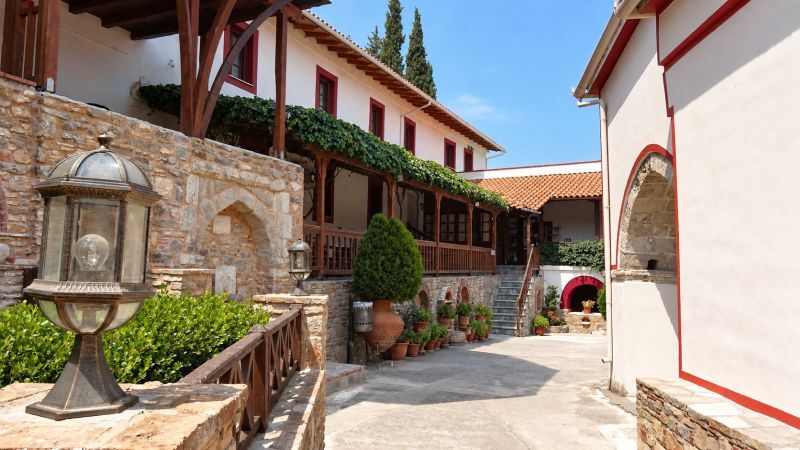
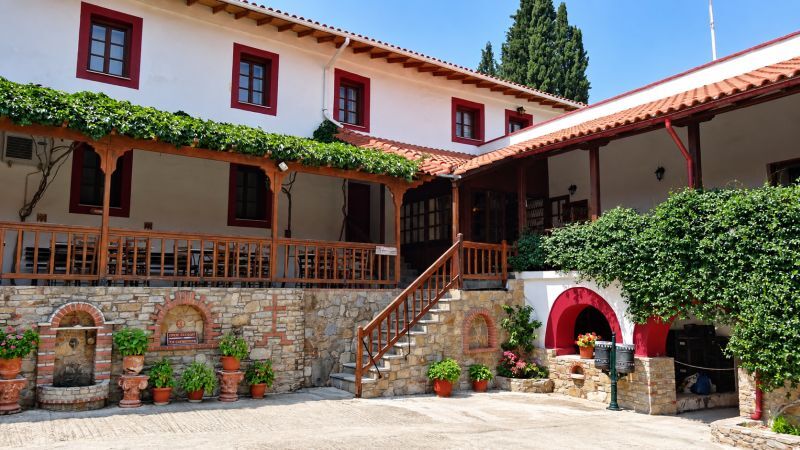
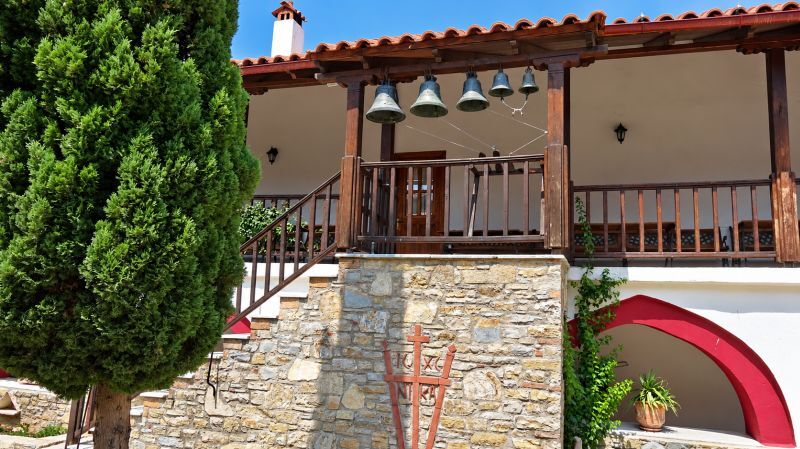
⛪ Megali Panagia – the 16th Century Hidden Inside
Megali Panagia does not reveal its greatest treasures at first glance. Behind the monastery’s stone walls are frescoes dating back to the late 16th century, an old marble floor, a carved iconostasis and the remarkable story of an icon with which, according to tradition, everything began.
The monastery was founded in 1586, but its beginnings were very modest. Before one of the most important monasteries on Samos grew here, there were said to have been just five small dwellings for monks. Their memory survives in the site’s second name – Panagia ton Pente Ospition, meaning Our Lady of the Five Houses.
To discover Megali Panagia, you therefore need to step inside its walls and start looking more carefully. Because this is where stories have survived that you would never expect from the outside.
🏘️ From Five Small Houses to a Great Monastery
The beginnings of Megali Panagia were far more modest than the monastery’s present appearance might suggest. In 1586, two monks, Nilos and Dionysios, began establishing a monastic community here. According to tradition, they had previously lived elsewhere, but the threat of pirates prompted them to move higher into the mountains, to a safer location.
Over time, other monks joined them. Five small dwellings were built, giving the monastery its second name, still used today – Panagia ton Pente Ospition, meaning Our Lady of the Five Houses.
The small community grew rapidly. In the following years, the main church and monastery buildings were constructed, and a place that had begun with just a few modest monks’ dwellings became one of the most important monasteries on Samos.
There is, however, another story associated with its beginnings. According to monastery tradition, one night the monks saw a mysterious light. What they are said to have found there later became one of the most important stories of Megali Panagia.
✨ A Light, an Icon and a Spring
The beginnings of Megali Panagia are associated with a story in which it is difficult to separate history from monastery tradition. According to the story, Nilos and Dionysios noticed a mysterious light emerging from the ground one night. When they began digging at the spot, they are said to have discovered an icon of the Virgin Mary.
But the story does not end there. Water is also said to have appeared at the place where the icon was found, and it came to be regarded as agiasma – holy water. Tradition links this event with the development of the monastery and the special veneration of the Virgin Mary at Megali Panagia.
There is no evidence that allows us to confirm the miraculous discovery of the icon. Interestingly, however, the place associated with the story can still be seen today. It is located beside the Chapel of the Apostles Peter and Paul, where several stone steps lead below floor level.
And what happened to the icon itself? Its story continues – and it does not have a happy ending.
🪜 Eight Steps Down
One of the most unusual places at Megali Panagia lies below the level of the church. Beside the Chapel of the Apostles Peter and Paul, eight stone steps lead down to a small space associated with the monastery tradition about the discovery of the icon.
This is where the agiasma – the holy water – is found. According to tradition, it appeared at the spot where the monks discovered the miraculous image of the Virgin Mary. For believers, therefore, it is not simply a spring, but part of the history and religious significance of the monastery.
The place itself was arranged many years later. A surviving inscription indicates that the work was completed in 1763. Beneath the church, two periods of history therefore meet: the 16th-century tradition surrounding the beginnings of Megali Panagia and a physical trace left by the monks almost two centuries later.
🖼️ The Icon That Survived in a Copy
The icon with which, according to tradition, the story of Megali Panagia began has not survived to the present day. The original image is said to have been destroyed in a fire at the monastery. Its appearance, however, was not completely lost.
Before the original was destroyed, a copy of the icon was made in 1670. It was painted by the Cretan artist Ioannis Dekarchos, and an inscription preserved on the image even gives the exact date – 4 December 1670.
The icon seen today is therefore more than simply a later replacement for a lost image. It was created while the original still existed and thus preserves the memory of the image that had been associated with the monastery’s beginnings for generations.
The copy can still be seen today. I do not show it in a photograph, however – Megali Panagia is an active place of worship, not a museum.
🎨 The 16th Century on the Walls
When you enter the church of Megali Panagia, forget about the iconostasis for a moment and look at the walls themselves. The dark paintings, faded and damaged in places, are more than 400 years old. They were created shortly after the church was built, and a surviving inscription dates the completion of the decoration to 1596.
The frescoes once covered almost the entire interior – the main part of the church, its vestibule (narthex) and the Chapel of the Apostles Peter and Paul. They depict scenes from the lives of Christ and the Virgin Mary, as well as apostles, prophets and ascetics. There is also a cycle connected with the Akathist Hymn, while the narthex contains a depiction of the Last Judgement.
We do not know the name of the artist. The style of the paintings, however, shows connections with the post-Byzantine artistic tradition known from the monasteries of Mount Athos. These are therefore not modern decorations created “in an old style” – we are looking at paintings that were actually made in the 16th century.
Their imperfect condition is part of their history. Faded colours, missing sections and faces that have almost disappeared from the walls in places remind us just how much time has passed since the painter put down his brushes here. And perhaps that is precisely why they make such a strong impression.
🔥 What Could Not Be Saved
Over the centuries, Megali Panagia accumulated not only icons and liturgical objects, but also books, manuscripts and documents. Much of this heritage disappeared in 1754, when a serious fire broke out at the monastery. The flames destroyed the library and part of the church furnishings.
Not everything was lost. Some of the books were saved and transferred to Timios Stavros Monastery, and some of them later entered the collections of the Metropolis of Samos. As a result, at least part of the old library survived outside the walls of Megali Panagia.
The monastery was once again threatened in 1987, when a major wildfire swept through the surrounding area. This time, the church’s most valuable historic features survived, while damaged parts of the complex were later rebuilt.
Today’s Megali Panagia is therefore a combination of different periods. We can still see old frescoes on its 16th-century walls, but many of the books, documents and objects preserved here by generations of monks are gone forever.
⚔️ The Monastery During the Revolution
In 1821, the peaceful monastery in the mountains became part of the struggle over the future of Samos. Megali Panagia served as a refuge and one of the headquarters of the leaders of the Samian Revolution, including Metropolitan Kyrillos and Lykourgos Logothetis – the political and military leader of the island’s uprising. Assemblies of Samians were also held at the monastery.
The monastery was chosen for good reason. Situated in the island’s interior, far from the coast, it offered far greater security than seaside settlements exposed to attacks by the Ottoman fleet. For a time, a place of prayer also became a place where decisions were made and resistance was organised.
One more reminder of those events has survived. Inside the church is a carved wooden throne which, according to monastery tradition, belonged to Lykourgos Logothetis. If he really did sit on it, it is one of those inconspicuous objects that directly connects the interior of Megali Panagia with the revolutionary history of Samos.
👀 Don’t Miss
🎨 Frescoes from 1596 – they are more than 400 years old. Notice the faded colours and the sections where time has almost erased the figures.
⚖️ The Last Judgement – look for this elaborate scene in the church’s narthex.
🪵 The gilded iconostasis from 1740 – richly carved, it is one of the most valuable features of the church interior.
🍎 Adam, Eve and the serpent – look down as well. On the old marble floor, look for the depiction of Adam and Eve beside the Tree of the Knowledge of Good and Evil.
🪜 Eight steps down – they lead to the place associated with the monastery tradition about the discovery of the icon and the holy water – agiasma.
⚔️ A trace of Lykourgos Logothetis – a carved throne has survived inside the church which, according to tradition, is associated with the leader of the Samian Revolution.
👀 Not everything needs to be seen in a photograph – we deliberately do not show the most valuable elements of the interior here. Step inside, take your time and discover them for yourself, remembering that you are in an active place of worship.
ℹ️ Practical Information
🗺️ On Google Maps: 37.69557, 26.842363
🚗 Getting there: the road to the monastery leads from the area around Koumaradei. It is easily accessible by car.
🅿️ Parking: you can leave your car beside the monastery.
🕘 Opening hours (check before visiting):
Monday: 10:00–13:00 and 17:30–20:00
Tuesday: closed
Wednesday–Sunday: 9:30–13:00 and 17:00–20:00
🎟️ Admission: free.
🙏 Dress and behaviour: this is an active monastery and place of worship. Shoulders and knees should be covered. Scarves or longer skirts to wear over your clothes may be available at the entrance – women wearing shorts should be prepared to put on one of these skirts. Keep quiet inside and, before taking photographs, make sure that photography is permitted.
Panagia Vrontiani – the Oldest Monastery on Samos
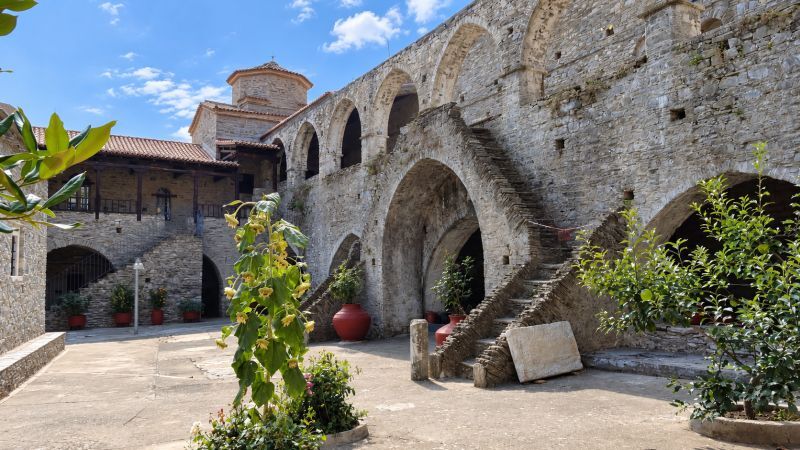
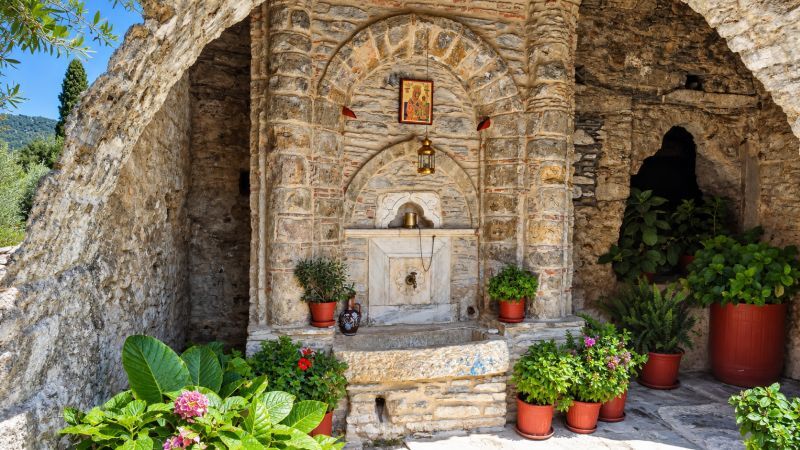
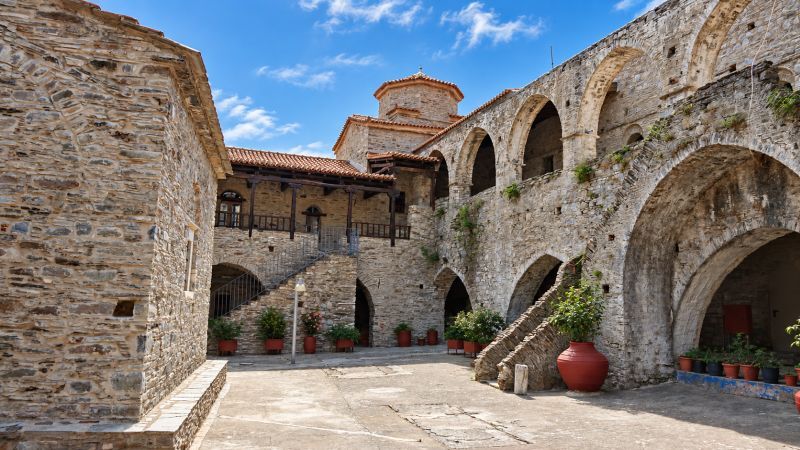
Panagia Vrontiani has something that cannot be captured by a single date. Its unplastered stone walls, arcades surrounding the courtyard, old wood, terracotta pots and greenery make the monastery seem much older than many other places on the island. It is peaceful, slightly austere and, at the same time, remarkably beautiful.
And indeed, Vrontiani is considered the oldest surviving monastery on Samos. It was founded in 1566, although its history began even earlier. What is more, not everything accumulated within these walls over the following centuries has survived to the present day.
⌛ The Oldest Monastery on Samos
Panagia Vrontiani was founded in 1566 and is considered the oldest surviving monastery on Samos. It was established by two monks, the brothers Iakovos and Makarios, who came to the area around present-day Vourliotes. However, they did not choose an entirely empty site – remains of an older religious centre already existed here.
The date of Vrontiani’s foundation is particularly interesting. The 16th century was a time of great change for Samos. After decades of raids, the threat of piracy and depopulation, the island was beginning to recover. It was during this period that a new wave of settlement began, and in the following years villages, farmland and religious communities were established or revived.
Vrontiani is therefore more than simply the oldest monastery on the island. Its beginnings date from the moment when Samos, after a difficult period, was starting a new chapter in its history.
🏚️ What Was Here Before?
When Iakovos and Makarios began building Vrontiani in 1566, they were not starting from scratch. Remains of an older monastery dedicated to the Nativity of the Virgin Mary already existed on this site. The sources, however, do not allow us to determine exactly when it was founded or who lived there.
The memory of this earlier monastery survived in the name of the area. Local people called the place Paliomonastiro – “Old Monastery”. Interestingly, Iakovos and Makarios built their new monastery on the same site and retained its earlier dedication – the Nativity of the Virgin Mary.
The year 1566 therefore does not necessarily mark the beginning of the monastic history of this place. Vrontiani is the oldest surviving monastery on Samos, but it grew from the remains of an even older one about which we know very little today. And it is precisely this gap in its history that adds a touch of mystery.
⛈️ Where Does the Name Vrontiani Come From?
The origin of the name Vrontiani is not entirely certain. One explanation connects it with an old name for the surrounding area or with a surname associated with the place. A much more intriguing local tradition, however, leads us to… the weather.
The monastery stands high on the slopes of Mount Karvounis, and its feast day falls on 8 September, when the first autumn storms may arrive after the dry summer. According to tradition, thunder echoed particularly powerfully between the mountains surrounding the monastery. The Greek word vrontí (βροντή) means “thunder”.
Does the monastery’s name really come from the sound of thunder? We do not know. But it is difficult to imagine a story better suited to the old stone monastery of Vrontiani hidden high in the mountains.
🔥 The Fire That Took Away Part of Its History
For more than four centuries, Vrontiani accumulated the things that formed its history – frescoes, icons, books, documents and liturgical objects. Some dated back to the 16th century. The interior of the church was once far richer than what we see today, with paintings covering its walls.
The greatest disaster in the monastery’s recent history came with the great Samos wildfire of 2000. The fire swept across vast areas of the island and reached Vrontiani as well. The monastery buildings were severely damaged, although the two churches survived.
Over the following years, the monastery was rebuilt with funds from the Metropolis of Samos and private donations. Much of the work was completed by around 2010. Walking through the well-kept courtyard surrounded by stone arcades today, it is easy not to realise how close the island came to losing one of its oldest historic monuments.
Interestingly, some sources also give 1999 as the year of the fire, but a more recent local study and documentation of the great Samos wildfire indicate that it occurred in 2000.
🎨 What Survived?
The fire did not erase the entire earlier history of Vrontiani. The most important surviving structure is the monastery’s main church, where elements of the interior dating from before the disaster can still be seen.
It is particularly worth looking closely at the carved and gilded iconostasis, decorated with scenes from the Old and New Testaments. Old icons, mainly dating from the 18th and 19th centuries, have also survived, along with fragments of the original frescoes. Paintings that once covered a much larger part of the church can still be seen in places, including the dome and the sanctuary.
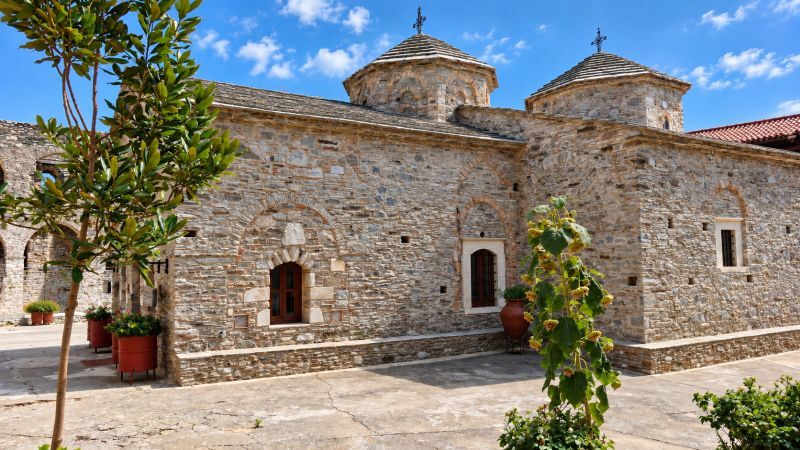
Outside, the stone bell tower dating from 1812 attracts attention. Decorative reliefs can be seen in its masonry – one of those details that are easy to miss if you do not know to look up.
Vrontiani is therefore a little like a puzzle with many pieces missing. What has survived, however, allows us to imagine how richly decorated the monastery must have been before the fire and earlier periods of destruction.
👀 Don’t Miss
🏛️ The stone courtyard – arcades, austere walls, terracotta pots and greenery create the unique atmosphere of Vrontiani.
🎨 The carved iconostasis – gilded and richly decorated with scenes from the Old and New Testaments.
🖌️ Surviving frescoes – look for fragments of the old paintings, particularly in the dome and the sanctuary.
🔔 The bell tower from 1812 – take a closer look at the stone reliefs decorating its walls.
🖼️ Old icons – some date from the 18th and 19th centuries. Remember that they are objects of worship, not merely historic artefacts.
👀 Traces of age – look closely at the stone, wood and architectural details. At Vrontiani, it is worth doing more than simply entering the church – take your time and look around the entire monastery.
ℹ️ Practical Information
💙 On Google Maps: search for Moni Vronta.
🗺️ Location: 37.77371, 26.85546
🚗 Getting there: an asphalt road leads to the monastery, although it is winding in places as it climbs through the mountains. You can drive directly to the area beside the monastery.
🅿️ Parking: there is space to leave your car near the monastery.
🎟️ Admission: free.
🕘 Opening hours: 10:00–14:00. Opening hours may vary seasonally, so it is worth checking the latest information before setting off. If you visit in the afternoon, you may find the gate closed.
🙏 Respect the site: Vrontiani is an active monastery. Shoulders and knees should be covered, visitors should behave quietly and, before taking photographs inside, make sure that photography is permitted.
⛪ Panagia Spiliani – Monastery Above Pythagorio
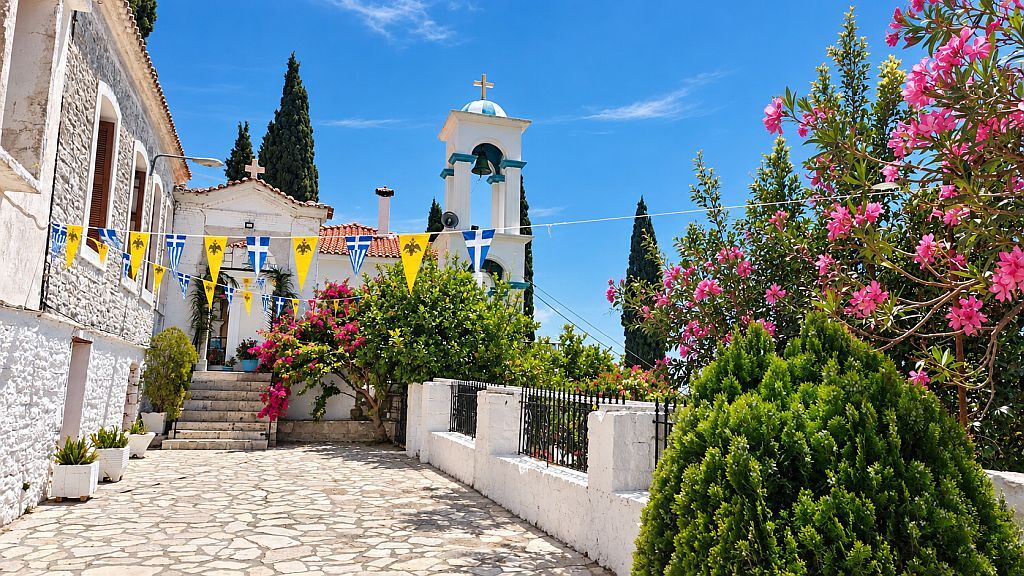
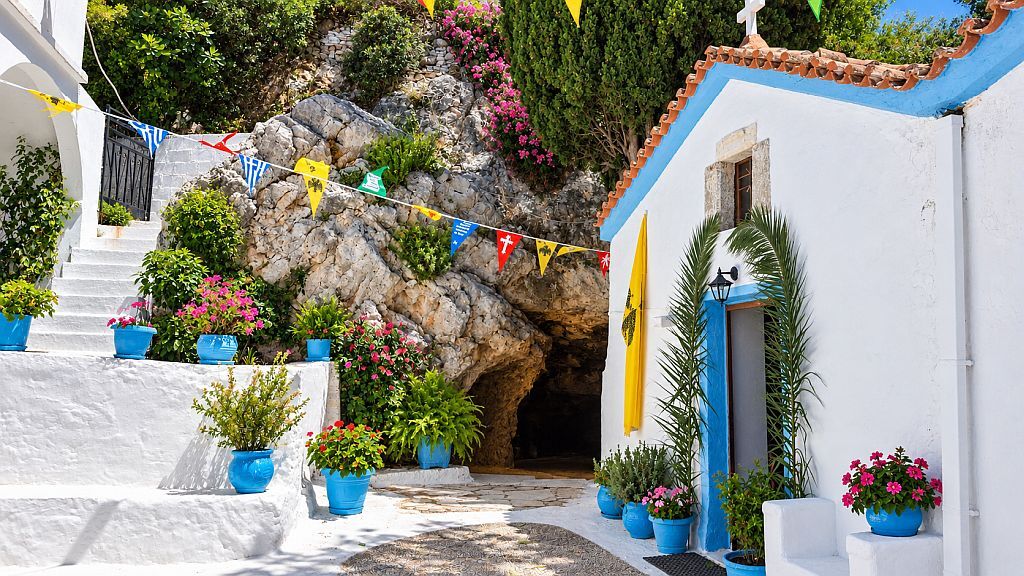
Panagia Spiliani lies on a hill above Pythagorio. You can drive up, but it is also worth walking from the town. The view alone makes the climb worthwhile – below lies present-day Pythagorio, built on the site of ancient Samos, with the sea and the coast of Asia Minor beyond. But the greatest surprise awaits underground.
🕯️ A Chapel Deep Inside the Cave
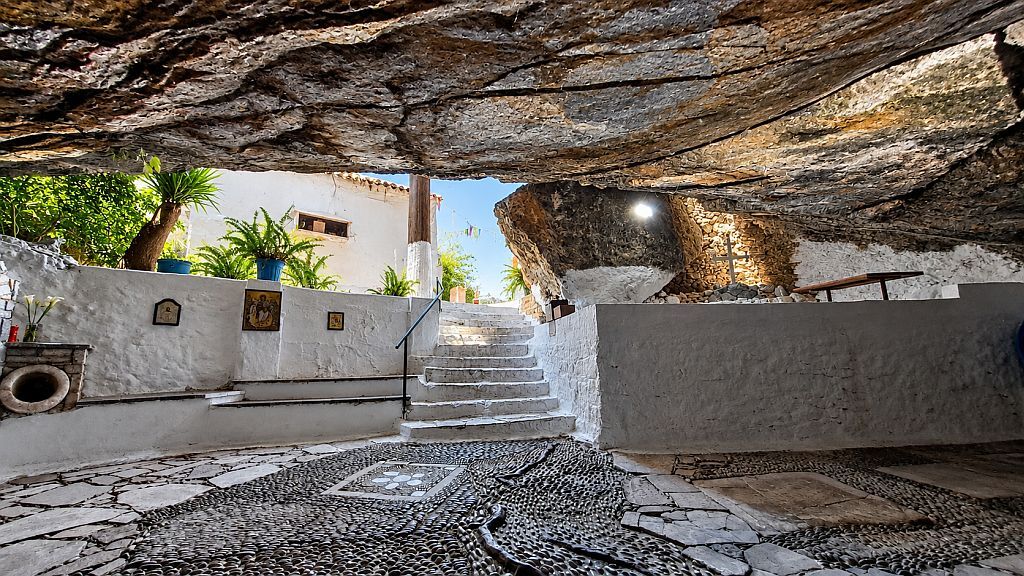
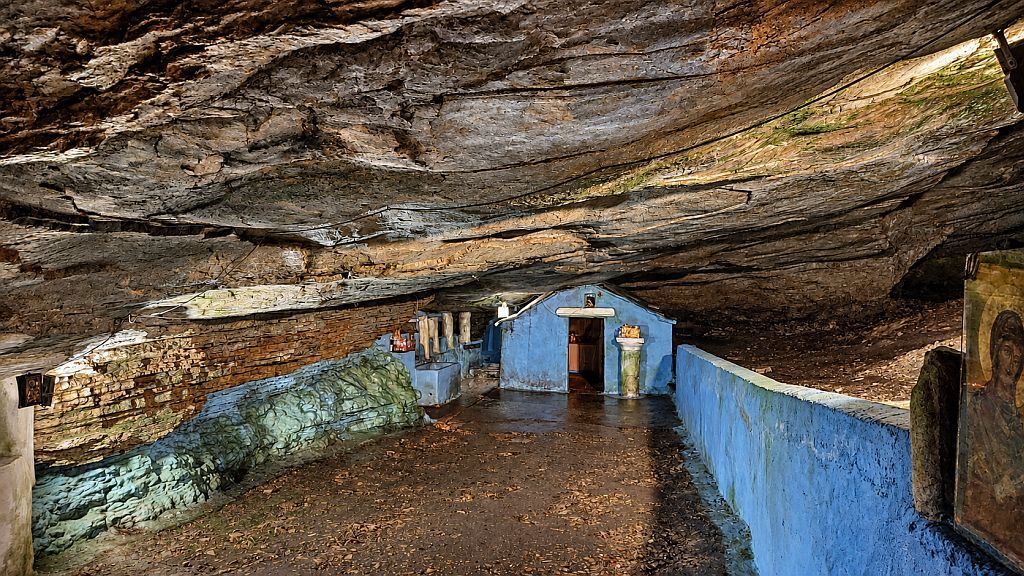
The most unusual part of Panagia Spiliani is not found within the monastery buildings, but inside the mountain. Hidden deep in the rock is a chapel reached by a long passage, approximately 120 metres in length. The farther you go from the entrance, the less daylight reaches inside, the cooler it becomes and the sounds from outside gradually disappear. Only deep within the cave do you reach the small chapel dedicated to the Virgin Mary.
This is not a cave that has been adapted so extensively that it has lost its natural character. The rock itself forms the walls and ceiling, water seeps from above in places, and the small chapel seems almost to be part of the cave. It is this contrast between the raw interior of the mountain and the place of worship that makes the greatest impression.
Interestingly, the chapel is much younger than the history of the cave itself. Its present form is associated with the 17th century, but people were coming to this cave long before the Christian sanctuary appeared. And this is where the most fascinating part of the history of Panagia Spiliani begins.
⛏️ Before the Monastery Was Built
The Panagia Spiliani cave did not always look as it does today. Its interior bears traces of human activity – parts of the rock were quarried, while sections left in place formed natural supports for the ceiling. Today, it is difficult to determine exactly when stone extraction began here or how long it continued.
Over time, the site acquired an entirely different function. The cave ceased to be merely a practical space and became a place of worship. And this happened long before the Christian chapel visible today was created. This is why the history of Panagia Spiliani does not begin with the monastery. Its origins take us much further back – to ancient Samos.
🏺 A Sacred Place Older Than the Monastery
Before a Christian chapel appeared inside the cave, the site already had religious significance in antiquity. We do not know exactly when worship began here or what rituals were performed inside the cave. The very fact that it was used as a place of worship, however, shows that its unusual character was recognised many centuries before the monastery was established.
Panagia Spiliani is also associated with a tradition linking the cave to Pythagoras. According to one story, he used it as a place for teaching and meeting with his students. There is, however, no evidence that allows us to regard this story as historical fact – it is best treated as one of the legends that have grown up around the mysterious cave over the centuries.
Religions changed, as did the people who visited this place, but one thing remained constant: the cave continued to be regarded as a place of special significance. Later, Christian ascetics and hermits would make use of the same silence and isolation.
🧙 Hermits in the Cave
Before the monastery was established here, the cave attracted people seeking silence, solitude and seclusion. According to old accounts, Christian ascetics and hermits lived here, using the natural cave both as a place of prayer and as a shelter.
Particularly interesting is the period when Samos was almost depopulated. After a large part of the island’s population left in the 15th century and before resettlement began in the 16th century, sources mention a small number of monks living in caves across the island. Panagia Spiliani is also traditionally associated with the presence of such hermits.
Perhaps they formed a link between the cave’s earlier significance and the later Christian sanctuary. We do not know exactly when the first chapel appeared inside the cave or when regular monastic life began here. The history of Spiliani therefore has no single, clearly defined starting date – the monastery developed from a place that people had chosen for prayer and shelter long before.
💡 Did You Know?
Spiliani was not the only place on Samos chosen by hermits. The tradition of ascetic life on the island dates back to Byzantine times, and particularly numerous hermitages were established in caves and hard-to-reach places on the slopes of Mount Kerkis. Small chapels and former askitaria – ascetic hermitages – have survived there to this day, including Panagia Makrini, Agia Triada and Kantili. Mount Kerkis is also associated with the Byzantine monk Paul of Latros, who, according to tradition, spent time on Samos and may have contributed to the development of ascetic life on the island.
This is a much larger story than the history of a single monastery. The hermits’ caves scattered across the mountains of Samos tell the story of people who deliberately chose to live far from settlements – we will return to them in a separate article one day.
💧 Water Dripping from the Rock
Deep inside the cave, water seeping from the rocky ceiling attracts attention. Drops fall slowly, collecting in natural hollows in the rock. For visitors, it is one of the small details that create the cave’s unusual atmosphere, but for believers the water also has religious significance.
The water from Spiliani is traditionally believed to have special, even healing properties. This is part of local tradition rather than something that can be scientifically confirmed. It is nevertheless worth noticing – a reminder that the cave is not merely an unusual historic site, but still a living place of worship.
🖼️ The Legend of the Icon That Returned to Samos
The chapel contains an old icon of the Virgin Mary known as Panagia Kalyarmenitissa. One of the best-known local legends is associated with its distinctive appearance. According to tradition, visitors once tried to take the icon away from Samos by ship. During the voyage, the image is said to have fallen into the sea and broken into several pieces.
But the story does not end there. The fragments of the icon are said to have miraculously returned to the cave, where they were joined together again. Cracks can still be seen on its surface today, and local people associate them with this very story.
We do not know whether the legend preserves the memory of a real event. For the people of Samos, however, it has become part of the history of Spiliani – the story of an icon that refused to be taken away from the island.
🛩️ The Cave That Became a Shelter
In November 1943, the Panagia Spiliani cave ceased to be only a place of worship. When German aircraft began bombing Samos, the inhabitants of Pythagorio sought shelter in Spiliani and nearby caves.
This was not a matter of hiding for just a few hours. Maro Smyrniotopoulou-Liakostavrou, who was six years old at the time, recalled many years later that local people lived in the caves for around seven months. Other local accounts say that many inhabitants of Pythagorio survived the bombing thanks to the shelter provided by Spiliani.
We do not know exactly how everyday life inside the caves was organised – where people slept, where food was stored or how long individual families remained underground. We do know, however, that Spiliani was not simply somewhere people rushed to during an air raid. For some residents, it became a wartime refuge for many months.
👀 Don’t Miss
🕯️ The chapel deep inside the cave – the most important place at Spiliani.
⛏️ Traces of the former quarry – look for surfaces where the rock has been worked.
💧 Water seeping from the rock – it has been attributed special significance for centuries.
🖼️ Sacred images – there are many inside the cave. Look at them carefully, remembering that they are not merely historic objects but objects of worship.
🌊 The view over Pythagorio – ancient Samos, the sea and, on a clear day, the coast of Asia Minor.
🛩️ The cave as a shelter – while standing inside, remember that the inhabitants of Pythagorio took refuge here during the Second World War.
ℹ️ Practical Information
🕘 Opening hours: 9:00–14:00 and 17:00–20:00, daily. Opening hours may vary seasonally and due to religious services.
🗺️ GPS: 37.69568, 26.93688
🎟️ Admission: free.
🚗 Getting there: you can drive to the monastery; parking is available nearby.
🚶 On foot: you can walk up from Pythagorio – it is worth it for the views.
🙏 Respect the site: this is an active place of worship. Appropriate clothing is required – shoulders and knees should be covered – and visitors should behave quietly and respectfully.
Monasteries on Samos – Which Ones Are Worth Visiting?
You do not need to visit every monastery on Samos. I have selected six places, each with something special – a remarkable history, old frescoes, a beautiful setting or a chapel hidden inside a cave.
Samos is home to dozens of churches, chapels and monasteries, but during a holiday it would be difficult – and probably unnecessary – to visit them all. It is worth choosing those that stand out in some way. Sometimes it is the age of the monastery, sometimes unusual frescoes, a view towards the coast of Asia Minor or a fascinating story connected with the place.
I have selected six monasteries and monastic sites on Samos that reveal very different sides of the island. They include large monastery complexes as well as tiny chapels hidden inside caves.
🧿 Before You Enter a Monastery
The monasteries on Samos are places of worship, and some of them still serve religious functions. Whatever your own beliefs, please respect the rules – wear clothing that covers your shoulders and knees, behave quietly and, before taking photographs inside, make sure that photography is permitted.