Minoan palace at Phaistos in Crete
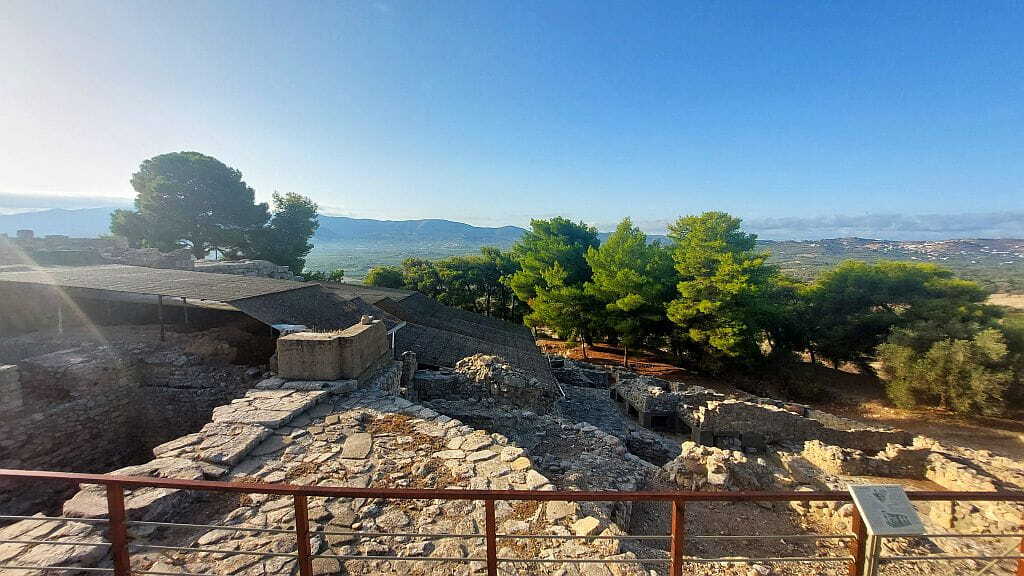
The Palace of Phaestos belonged to King Rhadamanthys, one of the three sons of Zeus and the Tyrian princess Europa. Despite much damage, the excavations are quite well preserved. The ruins are presented to visitors exactly as they were unearthed. No attempt has been made to recreate the interiors or colors, as is the case with the Palace of Knossos.
You will likely not encounter large crowds of tourists. Even in high season, it is peaceful. Therefore, you can view the excavations without jostling and take photos without the occasional crowd of other visitors. All this makes it, for many, the most precious place in Crete.
The palace's magnificent history complements its splendor. It is here that the legal code on stone tablets was written, which can be seen today in Gortyn. The just and respected King Rhadamanthys lived here, and after his death, he became the judge of the dead in Hades. During excavations, the famous disc was discovered here, one of the most important exhibits in the Heraklion Archaeological Museum. It's worth taking the time to see this site.
The first inhabitants arrived here as early as the 3rd millennium BCE, although the palace was built around the 2nd millennium BCE. Unfortunately, it was destroyed around 1700 BCE. Efforts were quickly made to build a new one, much larger and more impressive. Less than three centuries later, it was destroyed again, around 1450 BCE, this time by a powerful earthquake.
The ruins we can see likely date from the 8th century BCE. The city-state, or Polis, was in fierce competition with nearby Gortyn, which conquered Phaistos in the 2nd century BCE.
Mythological connections
The first inhabitants arrived in this region as early as the 3rd millennium BC, although the first palace was built around the 2nd millennium BC. Unfortunately, around 1700 BC, it was destroyed. Efforts were quickly made to create a new one. A much larger and more magnificent one was built. Again, three centuries did not pass before it was destroyed around 1450 BC, this time by a strong earthquake.
The ruins that we can see probably date back to the 8th century BC. The city-state, or Polis, was strongly competing with the nearby Gortyn, which conquered Festos in the 2nd century BC.
Memories of Phaistos
Epimenides, one of the seven sages of antiquity, was born in Phaistos. He was a priest, poet, and philosopher. Legend has it that as a child, he fell asleep in a cave, only to awaken 57 years later as an adult gifted with immense wisdom.
According to various accounts, he lived to the age of 157, or even 299.
Around 596 BCE, he was summoned to Athens. The inhabitants were dying of a terrible disease. The priest's task was to propitiate the gods for the plague to stop spreading.
The sage's memory found its place in the Holy Bible. In the Letter to Titus, St. Paul, characterizing the Cretans, quotes Epimenides' words: "Cretans are always liars, evil beasts, lazy gluttons." These words have been called the Epimenides paradox, because he spoke ill of the island's inhabitants, even though he was one of them.
Phaistos Legal Code
The tablets engraved with the legal code, which can be found in Gortyn, were written at the turn of the 6th and 5th centuries BC in Phaistos.
The records of criminal and civil law were carved into the stone walls using the boustrophedon method*. This code contained 12 columns, each containing 52 lines.
* The boustrophedon method involves writing text alternately from right to left and left to right in successive lines. This is intended to evoke the way peasants cultivated the land using oxen: "as an ox plows."
The code provides information about the legal status of slaves on the land at the time, according to which:
- a slave could sue and receive compensation from a freeman, but only if the court found that they had been wronged;
- a slave could marry a freewoman, and if the spouses lived in the wife's home, their children were free.
The Code also defines women's rights, some of which include:
- in the event of divorce, women are entitled to the assets they brought into the marriage and half of the joint income if it comes from her estate. Children conceived before the divorce but born afterward are cared for by their father unless the father disapproves of the child,
- If the husband dies, the wife retains the property until they become adults,
- adopted children have the same inheritance rights; women are not permitted to adopt a child.
The Phaistos Disc
It is the most enigmatic artifact of the prehistoric Aegean Sea.
It was discovered by Italian archaeologist Luigi Perniera in 1908.
It is a clay disc, approximately 16 cm in diameter, with hieroglyphic symbols embossed in a spiral pattern on both sides. Each symbol was embossed onto the wet clay using a separate, movable stamp before firing.
It dates to approximately 1550 BCE.
Many attempts have been made to decipher the inscription, but its meaning remains unknown. Most researchers believe it to be a ritual text.
It is known to contain 45 different symbols, repeated and grouped together to form separate words.
Visiting Phaistos
Excavations were conducted between 1901 and 1909, and after 1945.
The ruins of a Minoan palace were uncovered. The buildings, located around a central courtyard, covered an area of 8,300 m². The entrance was located on the western side, leading through a monumental staircase and a double portico to the courtyard. The walls of the state rooms were decorated with colorful frescoes.
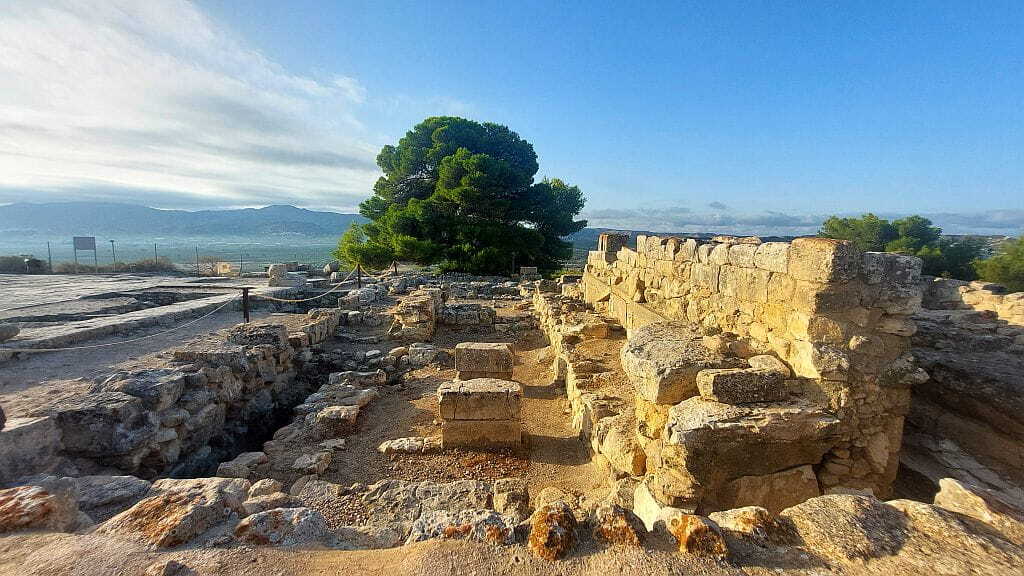
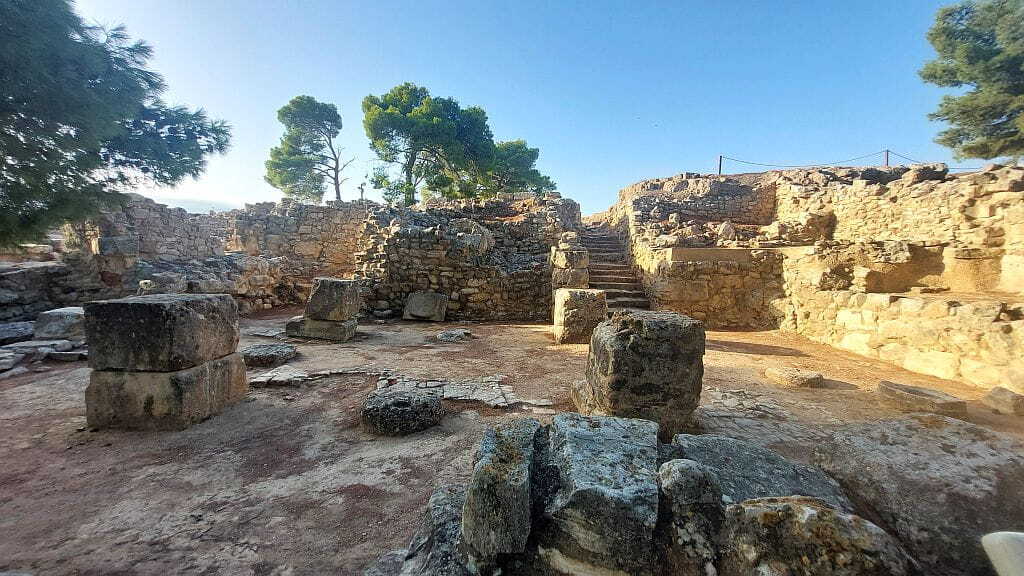
Remains of stairs leading higher were found, suggesting that there were more floors in ancient times.
It is known that copper and bronze were produced here. It was a vibrant trading center. Traces of copper ore, water channels associated with its smelting, and artificial slopes enabling the transport of smelted metal ingots to the port have been preserved.
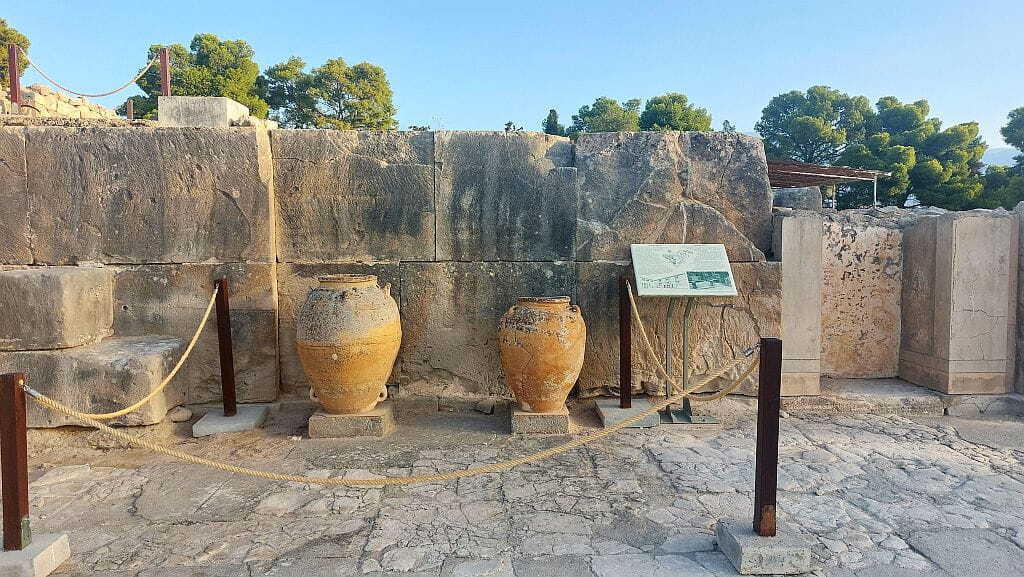
Numerous artifacts were also found, including ceramics, examples of which, such as jugs and pithos, are popular souvenir photos.
Western courtyard
The first courtyard after passing through the gate is called the Upper Courtyard. On the south side, due to the significant difference in ground level, it was supported by a solid retaining wall.
The Upper Courtyard served as a balcony from which one could observe the events taking place in the Western Courtyard located on a lower level.
The two courtyards were connected by a majestic staircase.
The Upper Courtyard contains 17 circular depressions in the ground, indicating the presence of an equal number of wooden columns, which likely supported a covered colonnade.
Grand Staircase
An impressive staircase, beginning in the Western Courtyard, led to the monumental Propylaea, the main and impressive entrance to the New Palace (1700-1450 BCE).
The portico consisted of a central column, of which only a single column remains. Beyond it was a solid wall with a double opening.
The floors of the Propylaea were plastered, giving it a lavish appearance.
From the Propylaea, there were two exits to different parts of the Palace:
- one, through the Peristyle, to the "Royal Apartments,"
- the other to an internal staircase that terminated in the Vestibule of the Magazines and the Central Courtyard of the Palace.
Theater in the Western Courtyard
The large, paved Western Courtyard dates back to the era of the Old Palace (1900–1700 BCE) and played an important role in the lives of its inhabitants.
To the north, it is bounded by a high wall that supports the Upper Courtyard.
Eight wide steps at the foot of the wall served as an auditorium for the theater. The Western Courtyard served as a theater for religious events and various ceremonies.
Old Palace Warehouse
The extensive palace warehouse complex consists of an antechamber, a warehouse corridor, and the warehouses themselves.
Beneath the floor of the antechamber, the archives of the Old Palace (1900-1700 BCE) were discovered. Over 6,000 clay seals were found, which were used to record goods in the warehouses.
Separate warehouses were used to store goods delivered to the palace and warehouses for goods produced by the palace. The westernmost, covered warehouse contains tall pithoi (storage jars), one of which bears an inscription in Linear A.
Stone rings
The southern end of the Western Courtyard is occupied by four large stone structures known as "Kouloures" (rings), part of the Old Palace complex. Archaeologists led by Evans discovered similar structures at Knossos and gave them this name. Their exact purpose is unknown, but they are widely believed to have housed offerings from the palace chapels, or granaries.
Central courtyard
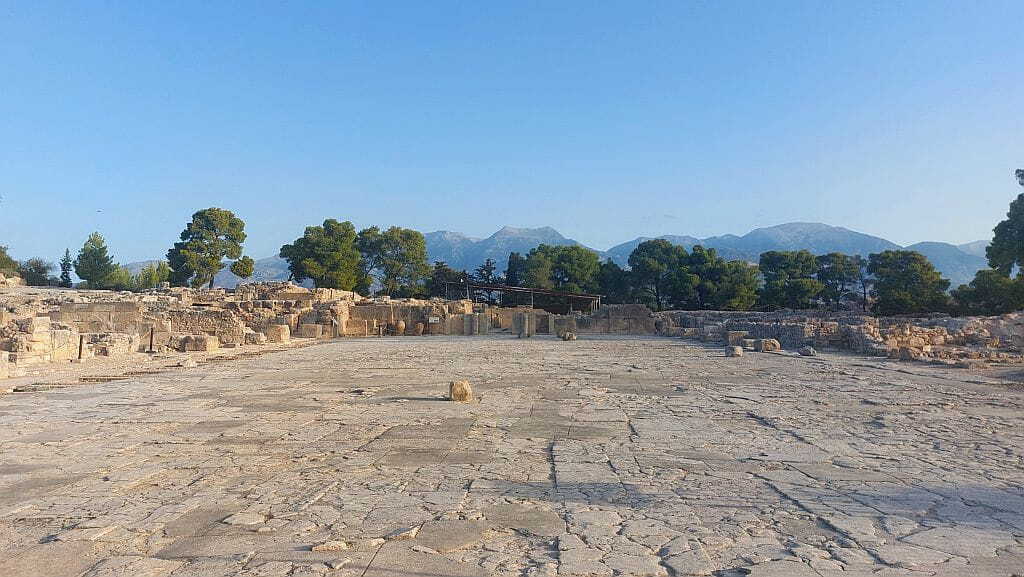
The largest courtyard, known as the Great Courtyard, is a typical architectural feature of Minoan palaces. It was the center of the palace's economic, social, and religious life, a place of events that could be observed from windows and balconies.
The Central Courtyard of the Palace of Phaestos was built during the period of the Old Palace (1900-1700 BCE) and was also used in the New Palace, with minor modifications.
The rectangular, paved, open area had colonnades along both long sides.
Two Pithoi, or large storage jars, were found in buildings constructed in the courtyard after the destruction of the Palace.
North Wing
It was one of the most important wings of the Palace, believed to have housed the "Royal Apartments." It also contained rooms, inner courtyards, corridors, and stairs leading to the upper floor.
A magnificent gateway led to the "Royal Apartments" complex. On either side are two niches decorated with murals, likely housing guards. Beyond the gateway is a wide corridor with a drainage channel that led to the inner courtyard, which in turn led to the "Royal Apartments" complex.
The term "Royal Apartments" was coined by Evans, the discoverer of the Palace of Knossos, and has been consistently used by archaeologists here. The rooms were undoubtedly apartments with distinctive architectural features, such as open balconies and colonnades, skylights, and pools. Plasterboard floors and colorful wall paintings gave these apartments a particularly luxurious appearance.
The Queen's Megaron
One of the "Royal Apartments" has been identified as the Queen's Megaron.
It consists of a beautiful, spacious hall with a double colonnade opening onto a skylight. The floors are plastered with red boulders filling the gaps.
The benches running around the walls of the Megaron and the lower portion of the walls were made of plaster. The upper portions of the walls are decorated with frescoes depicting plant motifs.
Two beautiful rhyta (sacrificial vessels) were found in the room: one decorated with the cult symbols of a double axe and a sacred knot, the other with a reed pattern.
Two staircases, one on the west and one on the north, led to the upper floor of the Megaron and to the peristyle, where one of the main entrances to the "Royal Apartments" was located.