Ancient Tylissos in Crete
is not a popular site, somewhat forgotten. However, extensive research indicates that it was once a significant city, closely linked to the nearby, famous Minoan palace at Knossos, located just 18 km away.
The site was discovered by two travelers in the first half of the 19th century, who were already surprised by the size of the ruins. The coins found attested to the city's once significant importance.
Excavations began in the early 20th century, as Joseph Chatzidakis, archaeologist and founder of the Archaeological Service of Crete and the Archaeological Museum of Heraklion, interestingly recounted.
Quite by chance, in 1906, he saw four enormous bronze cauldrons for sale in a coppersmith's workshop. On behalf of the museum, he purchased them and began preparations for research. After receiving permission and funding, he began excavations in 1909. By 1912, he had discovered three extensive structures, named Houses A, B and C, which are open to visitors, while the objects found are kept at the Heraklion Archaeological Museum.
Excavations continued into the 1950s. It was then concluded that the three houses discovered were actually "residences," as indicated by the extensive buildings and luxurious layout of the rooms. The city's architecture was compared to the palace in Malia, and the finds at Tylisos were deemed even more exceptional.
The three cauldrons, found and purchased for the museum by Chatzidakis, were considered unrivaled in the entire Aegean. They testify to the large population and the ability to obtain precious and expensive metals, which reached Crete only through a well-organized palace trade.
The bronze idol of Tylisos found here is large and considered a true work of art.
This leads to the conclusion that Tylisos was most likely once a major center for copperworking and that a bronze sculpture workshop operated here.
The discovered tablets with Minoan palace script attest to the importance of Tylisos, as similar objects were found only in palaces and stately residences.
History of Tylissos in Crete
It is known that it was inhabited from at least 2000 BC, but only ceramic vessels survive from this period. No fragments of the buildings have survived, so the size of the settlement is unknown, although it is believed to have been one of the most important on the island.
Likely, as is the case in most cases, the city underwent successive reconstructions in subsequent periods.
From the Minoan period, spanning from 1650 to 1450 BC, three large residences, marked A, B, and C, have been excavated. It is believed that the city experienced its greatest prosperity during these years.
It is known that later, between 1450 and 1200 BC, residence C and the portico were expanded.
Tylisos continued to be inhabited in the years following the Minoan era. Ruins from this period have been found primarily on the top of a low hill. Information on subsequent urban developments is difficult to obtain. Nevertheless, it is known that the city was continuously inhabited and maintained close contacts with Knossos, as evidenced by discovered inscriptions listing the names of the city's citizens. The oldest inscription found dates back to around 450 BC.
Tylisian Beliefs
The city had its own coins depicting Hera and Apollo. Athena was also worshiped.
Interestingly, the largest annual festival was dedicated to Hera, who is not mentioned much in Crete.
Coins discovered at Tylisos depict, on one side, the head of Hera crowned with a palm wreath, earrings, and a necklace. On the opposite side, there is a naked Apollo holding a bow in his right hand and the head of a wild goat in his left. In front of him is a small laurel tree, and behind it is the inscription "Tylision."
Tylisos Urban Planning
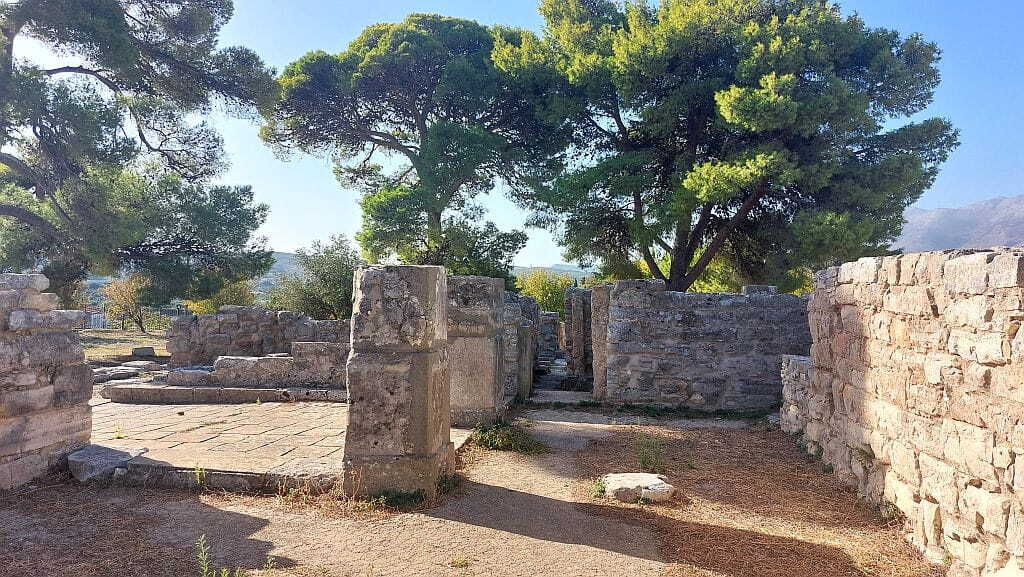
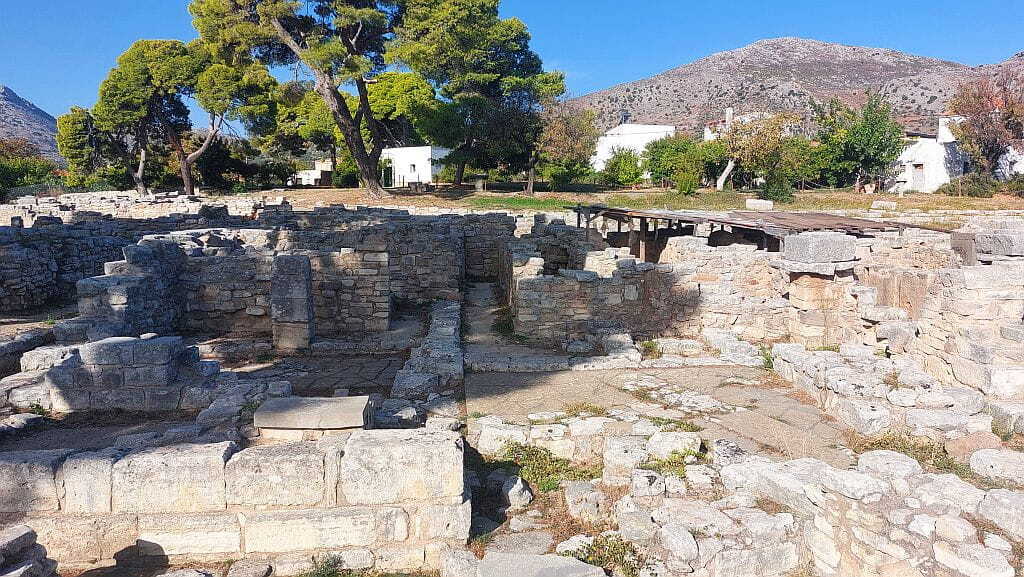
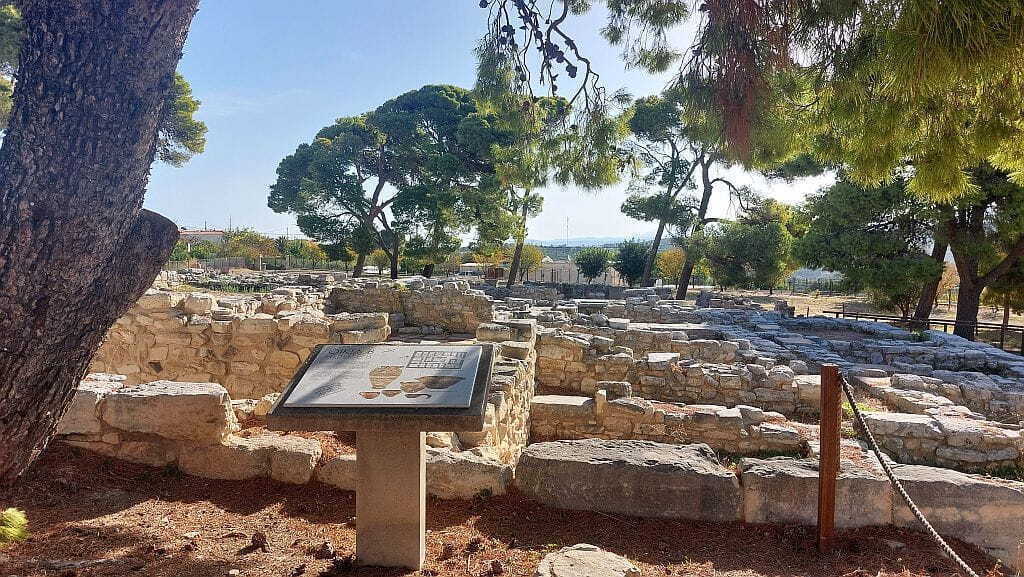
Three houses – residences – have been excavated, marked with the letters A, B, and C, arranged in an L-shape.
Residence A
This was the first to be excavated and proved to be the most impressive and representative. It was even called a palace. It is also the largest. It measures 34 x 18 meters and has 24 rooms. It is known that it had two stories, as it has a staircase.
In the representative section, vases and bronze objects were found, the most interesting of which is a statue of a worshipper.
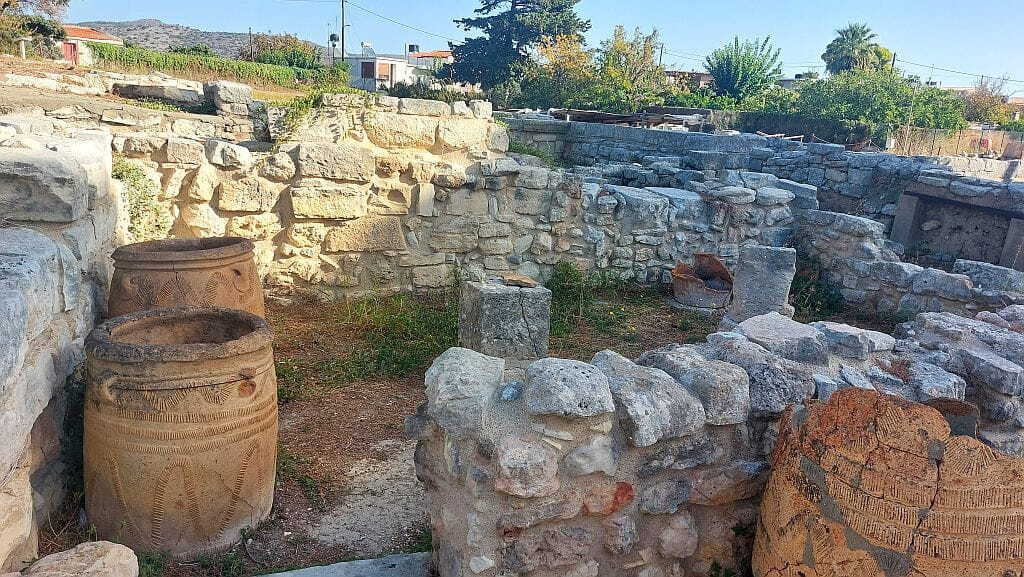
In the storage area, locals discovered, among other things, three enormous bronze cauldrons, which they planned to sell. An archaeologist stumbled upon them by chance and purchased them for the Heraklion Archaeological Museum, initiating extensive research at Tylisos.
Residence B
is less impressive in terms of its interior layout. Built rectangular, it was also two stories high. It likely served as a warehouse and complemented Residence A. Among the most remarkable finds are jugs, clay vases, and fragments of frescoes from the rooms on the first floor.
Residence C
although destroyed around 1450 BC and covered with earth, it has survived in good condition. It has an irregular shape. Similar to Residence B, it is smaller and less impressive than Residence A.
A sanctuary, a complex of storage rooms, and a washroom were discovered here. Communication between the floors was provided by three staircases.