🏛️ Is the Hippocrates Foundation Worth Visiting?
If you're interested in history, medicine, or simply enjoy discovering places with a unique atmosphere, the Hippocrates Foundation on Kos is definitely worth a visit. This is not a museum you can explore in just a few minutes. Its greatest treasures are the knowledge, fascinating stories, and insights hidden within the many information panels.
🕰️ Take your time.
Set aside at least 1.5 to 2 hours to explore this remarkable place at your own pace. It was here that ideas were born that continue to shape modern medicine to this day.
💙 There is no better place to understand why Hippocrates is still regarded as the Father of Medicine.
📌 Key Takeaways
🩺 Hippocrates was one of the first physicians to separate medicine from superstition and religious beliefs.
🌿 He taught that diseases have natural causes and should be treated through observation, experience, and knowledge.
🏛️ His approach laid the foundations of modern medicine.
It was here, on the island of Kos,
that the revolutionary idea was born:
diseases should be understood—not simply feared.
Hippocrates' Medical Office
The room known as Hippocrates' Medical Office features reconstructions of devices used by the father of medicine to treat broken bones, dislocated joints, and spinal injuries.
One of the information panels describes in remarkable detail how Hippocrates believed a medical office should be designed. According to him, it should be:
✔ well lit,
✔ spacious,
✔ well organized,
✔ equipped with all the necessary medical instruments,
✔ comfortable for both the physician and the patient.
Sounds familiar? More than 2,000 years later, many of these principles are still followed in modern medical practices.
🔍 Did you know?
Hippocrates advised physicians to carry a portable case containing essential medical instruments whenever they travelled.
You could say it was... the world's very first medical bag.
Medical Instruments Ahead of Their Time
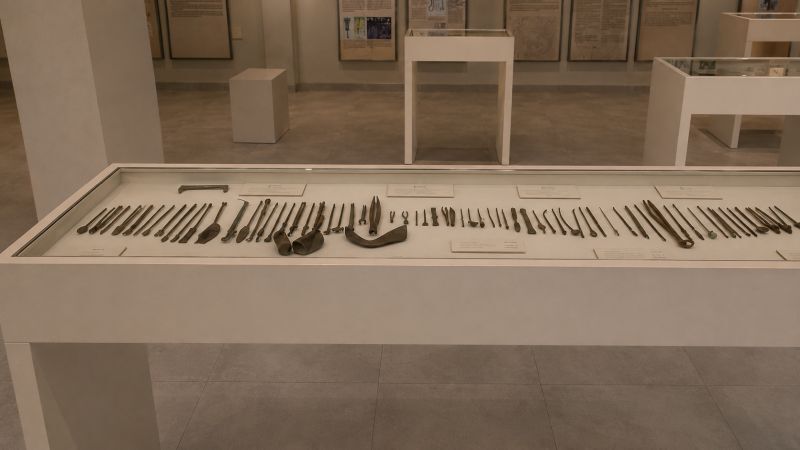
One of the display cases features surgical instruments used for procedures such as trepanation of the skull. Surprisingly, many of them closely resemble instruments still used in modern medicine.
Even more impressive, however, was Hippocrates' way of thinking. He believed that every patient should be properly prepared before surgery, that doctors needed good lighting, a comfortable workspace, and the assistance of skilled helpers.
Today, these principles seem perfectly obvious. More than 2,500 years ago, they were nothing short of revolutionary.
💙 Zwiedzo-Maniacy Tip
Don't rush through the Main Exhibition Hall. The real treasures are not only the exhibits themselves but also the information panels. They reveal just how many modern medical practices have their roots in the teachings of Hippocrates.
Hippocrates Was Ahead of His Time
Studying the Development of the Human Embryo
One of the information panels describes a fascinating experiment carried out by Hippocrates in his attempt to understand embryonic development.
To observe how a living organism develops, he asked a hen to incubate twenty eggs. Each day, he broke open one egg and carefully examined the embryo at a different stage of development.
Based on these observations, he developed his own theories about the growth of the human fetus.
Remarkably Accurate Observations
Although some of Hippocrates' theories later proved to be incorrect, many of his observations were surprisingly accurate.
He correctly described:
✔ the average length of pregnancy as about 280 days,
✔ the development of the fetus during different weeks and months of pregnancy,
✔ the correct head-down position before birth,
✔ the ability of premature babies to survive after reaching a certain stage of development.
Considering that these discoveries were made in the 5th century BC, his knowledge was truly remarkable.
🔍 Did you know?
Hippocrates was one of the first physicians to use the term Oophoron, meaning "the organ that carries eggs." The modern scientific term for the ovaries originates from this ancient Greek word.
The Mother's Life Came First
Other information panels reveal how seriously Hippocrates regarded the safety of women during childbirth.
When a mother's life was in danger, he was prepared to perform highly complex obstetric procedures. He even designed specialized surgical instruments to assist with difficult deliveries.
Although some of these methods are considered controversial today, they demonstrate his determination to save lives and his willingness to search for practical medical solutions.
Medicine Instead of Magic
Hippocrates' greatest revolution was not his instruments or his medicines—it was the way he thought about disease.
Before his time, illnesses were widely believed to be punishments sent by the gods. Treatment relied mainly on prayers, rituals, and offerings.
Hippocrates was among the first to argue that diseases have natural causes and should therefore be observed, studied, and treated through knowledge and experience.
This marked the beginning of evidence-based medicine.
💙 This is one of the Foundation's most important messages.
What Will You See in the Main Exhibition Hall?
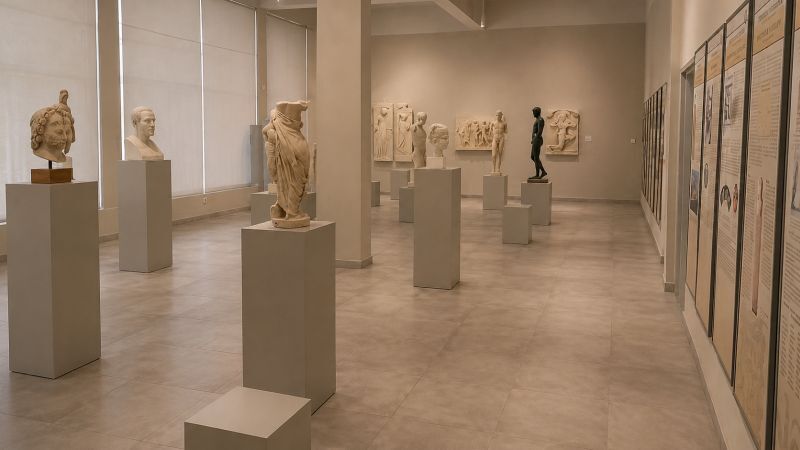
The Foundation's main exhibition hall displays faithful replicas of some of the most fascinating artifacts related to the history of medicine. Each exhibit tells a different story and illustrates the remarkable influence Hippocrates had on the development of modern medical science.
Olive Oil Jar
One of the most interesting exhibits is a replica of a clay olive oil jar dating back to the 15th century BC. The olive leaf decorations indicate that the vessel was used to store olive oil.
In ancient times, olive oil was far more than just a food product. It was widely used to clean wounds, dress injuries, and promote healing. It also formed a natural protective barrier that helped keep dirt and bacteria away from wounds.
🔍 Worth knowing
The original jar is on display at the Archaeological Museum of Heraklion on the island of Crete.
The Ephebe of Marathon
The Main Exhibition Hall also features a replica of the famous bronze statue known as the Ephebe of Marathon, considered one of the finest examples of ancient Greek sculpture.
The young man symbolizes one of Hippocrates' most important beliefs—the harmony of body and mind. According to the father of modern medicine, a person is an inseparable unity, and a healthy body cannot exist without a healthy mind.
🔍 Worth knowing
The original statue was recovered from the sea off the coast of Marathon and is now on display at the National Archaeological Museum of Athens.
Asclepius and Hygieia
One of the most impressive exhibits is a replica of a marble votive relief depicting Asclepius, the Greek god of medicine, and his daughter Hygieia, the goddess of health.
The scene portrays the healing of a patient lying on a bed. On the left stands the patient's family. Notice how the human figures are shown much smaller than the two deities—a common artistic technique used to emphasize the divine status and importance of Asclepius and Hygieia.
The original marble relief was discovered at the Asklepieion of Piraeus and dates back to the 4th century BC.
The Monument of Telemachus
Another fascinating exhibit is a cast replica of the Monument of Telemachus—the man who played an important role in the development of ancient medicine.
Few people realize that the Asklepieion on Kos was not the only healing sanctuary of its kind. The largest and most famous one was located in Epidaurus. However, during the Peloponnesian War, reaching Epidaurus became extremely difficult.
Taking advantage of a period of peace, around 419 BC, Telemachus founded another Asklepieion in Athens, near the Theatre of Dionysus, at the foot of the Acropolis.
🔍 Worth knowing
The original monument is on display at the Acropolis Museum in Athens.
International Hippocratic Foundation on the island of Kos
The International Hippocrates Foundation is one of the most fascinating places on the island of Kos for anyone who wants to learn more about the life and legacy of the father of modern medicine. Although it is often referred to as a museum, it actually serves as an educational center.
💙 Take your time while exploring this remarkable place. Its greatest treasure is not the exhibits themselves, but the wealth of information displayed on the many information panels. They offer a fascinating insight into the development of ancient medicine and reveal how Hippocrates' ideas continue to influence modern medical science.
Botanical Garden
Behind the Foundation building lies a spacious four-hectare botanical garden, home to around 240 species of medicinal plants and herbs that played an important role in Hippocrates' medical practice.
Each plant is identified by three different names:
✔ the name used by Hippocrates,
✔ its Latin name,
✔ its modern English name.
Many of the plants are also marked with QR codes, allowing visitors to learn more about their medicinal properties and traditional uses.
🔍 Worth knowing
Don't be surprised if some of the plants appear dry or seem to be missing. Many species bloom only during certain seasons, so the appearance of the garden changes throughout the year.
Hippocrates and his students relied on an impressive variety of natural ingredients to prepare medicines.
💡 Did you know?
🌿 794 species of plants,
🐑 104 animal-derived substances,
🪨 105 105 minerals.
Using leaves, flowers, roots, plant extracts, and minerals supplied by herbalists, they prepared powders, ointments, syrups, drops, tablets, suppositories, and many other remedies.
Even more fascinating is the fact that some substances used in Hippocrates' time later became the basis of modern medicines. These include aspirin, ephedrine, artemisinin, tamoxifen, and vincristine, a drug widely used in cancer treatment.