Artemisio on the northern part of the island of Euboea
is a seaside town located on the northern coast of Euboea. It is spelled differently: Artemisio, Artemizion, Artemizjon. Nevertheless, when mentioning an important event: the Battle of Artemisium, the vast area around the settlement is considered, including the adjacent maritime area.
Course of the Battle of Artemisium
In August 480 BC, a naval battle occurred on the northern coast of Euboea, near Cape Artemisio, between Persia and Greece.
The strait of Artemisium was the site of the first major naval battle between the Greeks and the Persians.
The prevention of the Persian invasion was planned in two directions;
-
land-based in the Thermopylae pass, which aimed to defend the lands of central Greece, and
-
naval in the vicinity of Artemisium, which would defend the entrance to the Euboean Strait.
The close proximity of both actions aimed at mutual connectivity and possible assistance.
Against 1200 Persian ships commanded by Xerxes, about 300 Greek ships faced them. Depending on the sources, these numbers vary. The unequal forces of both sides are always emphasized.
A favorable circumstance for Greece was the storm that the Persian ships encountered as they sailed towards Euboea. Being in unknown waters, without knowledge of the local currents, Persia lost about 200 galleys.
The naval battle at Artemisium began on the third day of the land fighting at Thermopylae. Before it started, news arrived that although Persia had a significant numerical advantage, it had not yet succeeded in overcoming the defending Greeks.
As the Persian ships approached Euboea, according to plan, the Greek forces blocked the route right at the channel Oreos (today's Oreoi). The Persians could not break through.
Persia attempted to attack from the other side. They sent 200 ships to encircle the island and strike from the other side.
History repeated itself: a strong storm engulfed all the galleys.
Despite the losses on the Persian side, they still had a numerical advantage in ships. The following days of fighting did not yield triumph for either side.
On the third day, news of the defeat at Thermopylae reached them.
This information prompted the commander to make the decision to retreat the fleet south at night. The ships reached the Saronic Gulf near Salamis, where, reinforced by Athenian forces and others, they prepared for further military actions.
An interesting story is that of a diver and his daughter, whom the father properly trained in the art of diving. Both were recruited by Xerxes to help safely maintain the ships in unknown waters.
Both divers, when the storm broke out, dove underwater and cut the anchors of many Persian galleys. These crashed against the coastal rocks.
The war was fought simultaneously on two fronts: the naval one in the Euboean Strait, and the land one at Thermopylae. It ended ambiguously, without a victory for either side. Only later, after the battles were moved to Salamis and Plataea, did Persia lose the war and have to retreat to Asia defeated.
Masterpieces found in Artemisium
The Battle of Artemisium is not the only significant event for which Artemisium is famous.
In April 1926, fishermen, while fishing, pulled a bronze statue's left arm from a net brought up from the sea.
Two years later, in September 1928, fishermen and sponge divers retrieved the remaining part of the statue from the seabed.
The bronze figure was handed over to the appropriate authorities and transported to Athens.
The assembled bronze statue is now one of the most remarkable works displayed at the National Archaeological Museum in Athens.
Expecting that the seabed might hide other equally important and valuable items, investigations were conducted in November 1928 in the area of Cape Artemisium.
At that time, the front part of a horse and a small rider were discovered. Missing fragments were found during excavations in 1929 and more in 1936.
The finds were also transported to Athens, where they were assembled and now constitute one of the most valuable exhibits in the National Archaeological Museum.
The bronze statues found are:
-
Zeus or Poseidon known as the God of Artemisium, and
-
the Small Rider.
The value of these finds is particularly high, as many prototypes have not survived to this day. They contain significantly more bronze than others displayed in museums.
Artworks made in ancient times from bronze, when they ceased to hold emotional value in later years, were often melted down. The recovered metal was used for other purposes. Both statues are unique, as they are the only large exhibits in the museum.
There are several hypotheses confirming the fact that two enormous bronze statues ended up in the waters of Artemisium, which mutually exclude each other.
It is certain that in the 2nd century or at the beginning of the 1st century B.C., a ship with two valuable works of art entered the Artemisium Strait, where it sank. This dating is based on ceramics, vases, and lamps found on the ship along with the statues.
The God of Artemisium
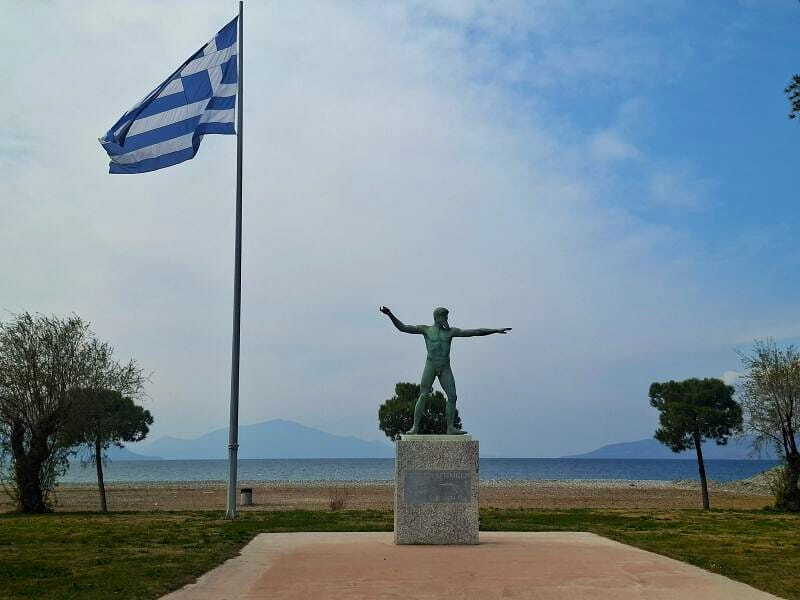
In the town of Pefki, right by the port on the beach, a replica of the statue known as "The God of Artemisium" was erected in 2022.
The original sculpture made of bronze was discovered in 1928 in the sea near Artemisium.
It is located in the National Archaeological Museum in Athens.
The sculpture is one of the most valuable and famous statues in the museum.
It depicts a naked, bearded man.
To this day, there are disputes about whom the statue represents. Some claim it is Zeus while others say it is Poseidon. The fact is that "The God of Artemisium" exhibits features of both Olympian gods.
The sculpture is dated to around 460 to 450 B.C.
The Rider from Artemisium
holds a prestigious place in the National Archaeological Museum in Athens.
The sculpture was retrieved from the wreck of a ship off the coast of Artemisium in northern Euboea.
It was retrieved in parts, in 1928 and 1937.
It was later assembled.
To this day, the artifact is missing, among other things, the reins and whip that the rider held in his hands.
The work is dated to around 150 to 140 B.C.
The Metaxas Bunker
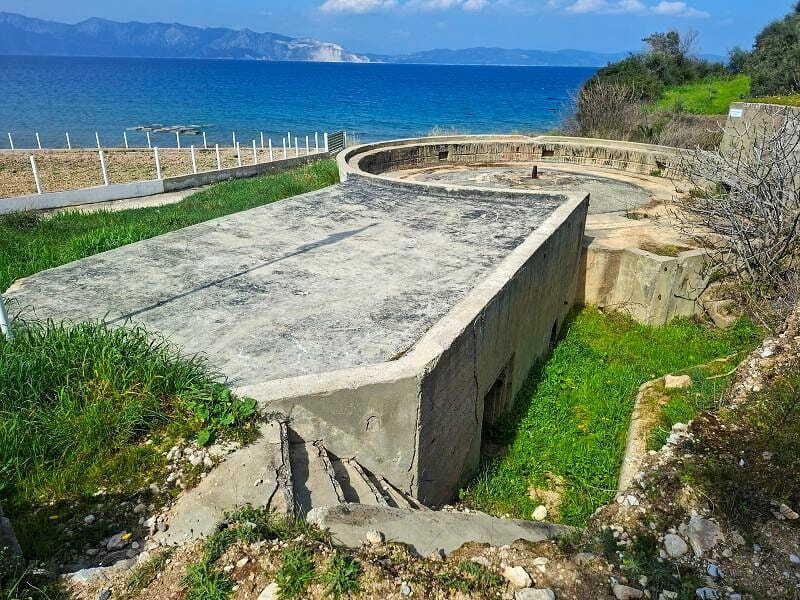
is a remnant of a coastal fortress from World War II, located in the northern part of the island of Euboea.
The name "Metaxas" comes from the surname of Ioannis Metaxas, a general and Prime Minister of Greece from 1936 to 1941.
In 1938, he created a coastal defense system consisting of eight similar fortifications located along key Greek maritime routes.
Located on the northern coast of Evia, 2 km from the town of Gouves, it is locally known as Fort Gouves.
The fortress's task was to defend the entrance, primarily from the sea side, to the northern Euboean and Pagasetic Gulf, protecting nearby ports.
Today, the fortress resembles abandoned bunkers, most of whose rooms are not accessible to visitors.
During World War II, the fortress was an integrated complex of reinforced concrete blocks connected by underground tunnels.
Inside them were officers' quarters, barracks for soldiers, command centers, radio and telephone stations, dining halls, food and water storage, fuel and ammunition depots, as well as medical points.
The fort was equipped to sustain a fully armed garrison for a minimum of ten days of combat.
Use of the bunker during World War II:
In April 1941, Luftwaffe bombers attacked the coasts of Evia, the Metaxas fortress and the patrol boat Damaskini, which controlled the waters of the Artemisio Strait. The fortress's anti-aircraft guns shot down an enemy plane. Unfortunately, the Damaskini fell victim to incendiary bombs and was subsequently sunk on Easter Sunday.
On April 23, 1941, after capturing Athens, German troops ordered the destruction of the heavy guns of the fortress. As a result, the Germans occupied the area, and in the summer of that same year, they handed over control of Fort Metaxas to the Italian troops.
In the autumn of 1944, Fort Metaxas was handed over to Greek security battalions.
During the Greek Civil War, the fort served as a hideout for partisans of the resistance movement.
Many years of destruction completely ruined Fort Metaxas, which is now seen merely as an interesting observation point.
Reportedly, thanks to the efforts of the local Gouves association, the fortress structures were cleaned and secured.
Although the fort is open to the public, most underground chambers remain inaccessible, mainly for safety reasons.