Exploring the island of Evia by car
Below are my own, subjective suggestions for sightseeing routes with a brief description of the recommended places. They are well-tested as they include the most important spots on the island Euboea and additionally Athens, as they are literally within reach.
You can find the location of the described places in the Guide to Evia.
If you are traveling with a child, I encourage you to purchase the Child's Guide to Evia.
The red route, or the trail of ancient Eretria
This route is designed for those interested in antiquity.
Most of the monuments in Eretria are closed on Tuesdays, so it's worth visiting on any other day of the week.
The name of the route is not accidental. On this day, you will mainly explore Eretria, which are the remnants of an ancient, important, and wealthy polis on which a modern seaside town was built.
In Eretria you literally walk on historical sites. There are so many that it is impossible to see all the excavations in one day.
I suggest visiting Eretria in the exact order proposed below. This is due to the opening hours of some monuments.
It is worth driving to the Macedonian thunder.
For those interested in history, I recommend visiting Lefkandi, which is about 12 km away from Eretria. Here you can find unrenovated but very important monuments, such as the Toumbas monument.
The Toumbas monument is an elongated structure (47×10 m) with an arched end on one side. The object dates back to the 10th century BC. Remains of a man and a woman as well as horses were found here. It is believed that the find pertains to the burial of a ruler, among other reasons, because rich gifts brought from abroad were found with the deceased.
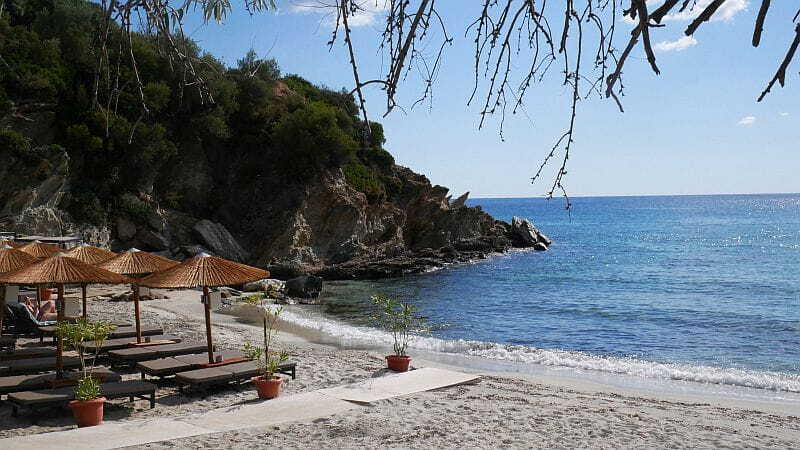
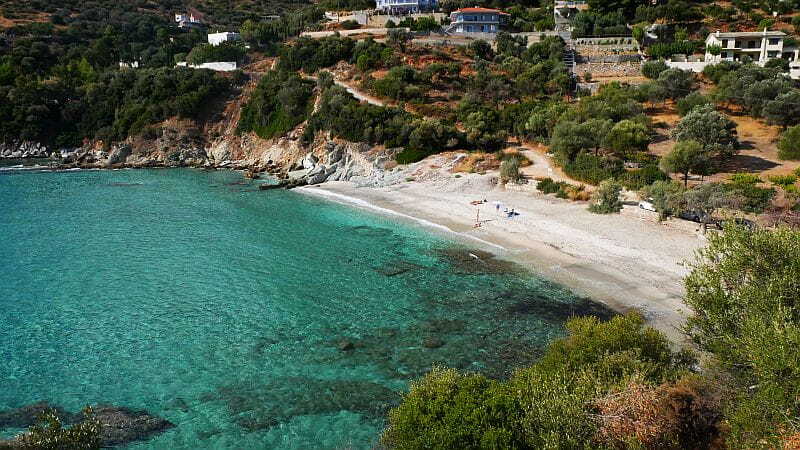
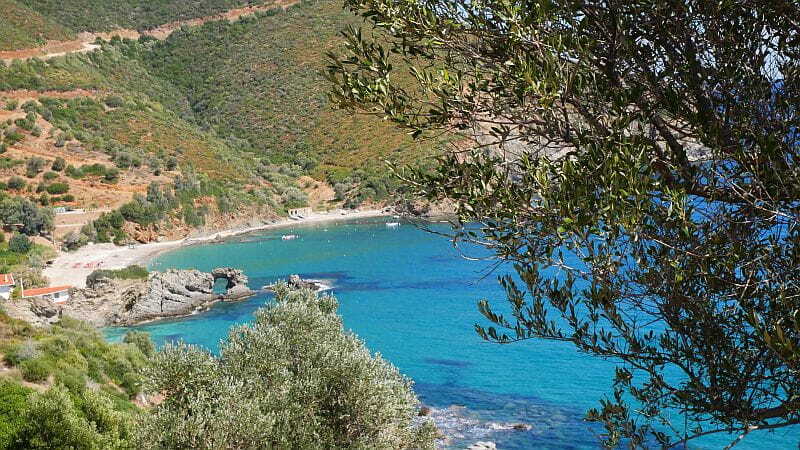
People who want to relax on the beach can do so in Eretria, where there is a beach with all amenities, or at the Klimaki beach, which is 44 km away, a small cove beach with fine sand and wonderfully turquoise water.
The trail of ancient Eretria
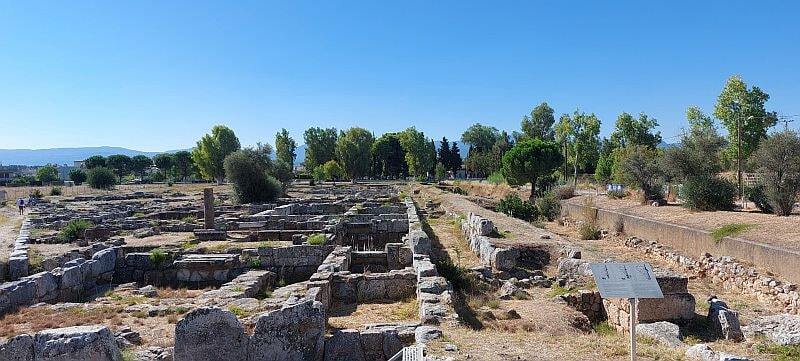
The western district of ancient Eretria mainly consists of residential houses dating back to the 4th century BC, which have been numbered on the local information board. Three buildings, marked with numbers I, II, and IV, were remodeled between the 4th and 2nd centuries BC, only to be completely destroyed by the Romans in 198 BC. An exception was the house marked with number I, which was rebuilt after the invasion and used until the 1st century BC.
Walking around the vast area, the outlines of walls built according to the grid of Hippodameia are clearly visible. A road is clearly formed between the buildings. During the excavations, archaeologists found remains from earlier periods, dating back to the 7th century BC. An example is a small cemetery "Heroon" with a terrace of tombs.
In the archaic period,
Eretria was surrounded by a defensive wall, which was repaired in the 4th century BC. Nearly five kilometers long, it started at the Acropolis and surrounded the entire ancient Eretria. It marked the boundaries of the city. Here, in the western district of ancient Eretria, was the western gate. A road led here from Chalkida.The ancient theater dates back to the 5th century BC. In the following years, it was remodeled multiple times. The size indicates how large the city of ancient
Eretria was. The outer diameter of the theater reached 91 meters, and 25 rows of seats accommodated 6,000 spectators.The ancient gymnasium is a complex of partially covered buildings intended for strenuous exercises. In ancient times, gymnasiums were an integral part of the city, as sport was one of the most important areas of life, including public existence. The layout of the area was strictly defined and briefly included running tracks, fields, porticos, and accompanying buildings serving as changing rooms, oil or sand rubbing rooms, baths, or for various exercises.
The House of Mosaics dates back to 370 BC. It was named so because four beautiful floor mosaics were found here. Looking through the windows of the modern pavilion, you can see the outlines of the walls of a private house: a living room, courtyard, kitchen, and bathroom.
After viewing the House of Mosaics, it is worth heading to what seems today a neglected Sebasteion. Although it is a place difficult to visit, as you can see only a few stones, it was one of the main parts of the city in ancient times.
One of the two main roads leading to the theater and further, through the western gate, to Chalkida, led here.
Roman baths, or public baths from the Roman period, are not open for visiting today. Unfortunately, all the excavations are covered with a black tarp, although the curious can see that interesting monuments are hidden under the black sheet.
The northern district of the city, where the discovered remains represent the period from the 8th to the 4th century BC. This is evidenced by an information board showing the urban planning in overlapping epochs.
The district was characteristic of the road artery connecting the Temple of Apollo with the agora and further to the port.
The wealthiest period was the 4th century BC. Among the most significant finds are nine broken Panathenaic amphorae and a large amount of gold stored in a vessel from the 8th century BC. Due to these discoveries, the site is called the "District of Panathenaic Amphorae."
The eastern sector was excavated in 1967 by the Swiss School of Archaeology in Greece. The excavations do not present well. Although fenced off, the dense vegetation reveals little. It is no wonder that only the most interested tourists come here.
Archaeological studies have shown that there was a road here, 4.3 meters wide, sufficient for two-way traffic. It connected the eastern and western parts of the city. The road was built from many successive layers of compacted earth and gravel materials, supported by strong retaining walls.
It has been proven that the road was systematically repaired, indicating the city's ongoing concern for maintaining the road network. These tasks were primarily performed by state slaves.
Other finds excavated here are the remains of two residences, indicating domestic architecture and walls from the 5th and 4th centuries BC:
-
the first remains, dated to the 5th-4th centuries BC, consist of rectangular foundation blocks, on which other limestone blocks are placed - the superstructure was made of wood and sun-dried bricks,
-
among the remains of the second house, dated to the 4th century BC, one can see the remains of a well located in the courtyard floor.
The Temple of Apollo Daphnephoros, is one of the most important excavations in Eretria.
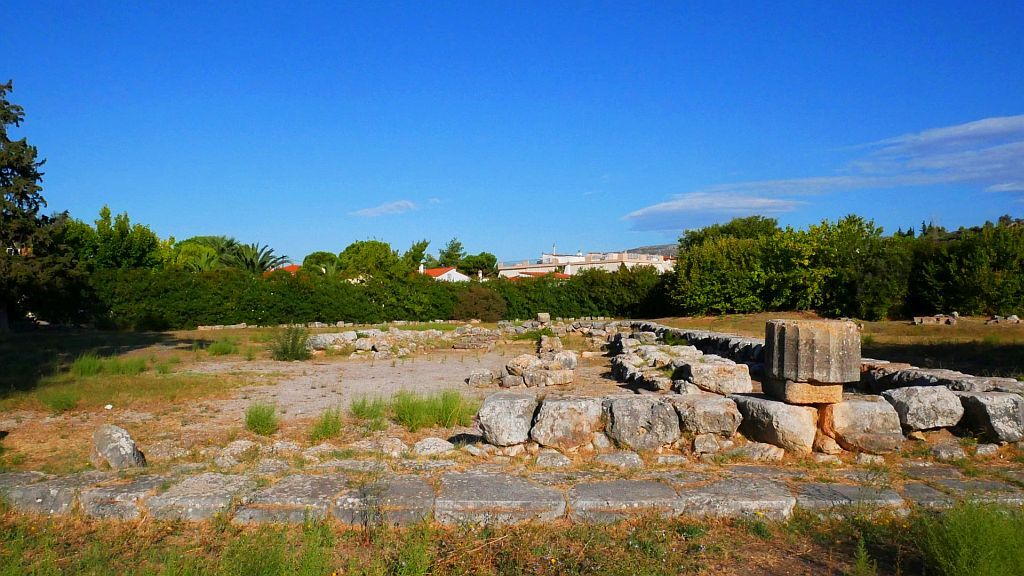
The Agora in Eretria on Evia, the heart of the city where political, religious, and commercial life took place in ancient Greece, is another "disappointment." Here, there are not even any remains of ruins. The entire square has been leveled, now covered with green grass.
And yet, it is here that the mysterious Tholos stands, a circular building. It was likely built in the 5th century BC, remodeled in the 4th, and later in the 3rd century BC. Unrestored, it shows only foundations that barely rise above ground level. The span raises questions about what might have been here. Although there is no information on this topic, it is known that its purpose could have been varied, ranging from a tomb, which likely was not the case, to an administrative room, or even a sanctuary.
The Hellenistic baths represent one of a series of bathing facilities, dated from the Hellenistic period (considered from the death of Alexander the Great in 323 BC to the Roman conquests ending with the takeover of Ptolemaic Egypt in 30 BC) to the imperial period. They offered a rich insight into nearly half a millennium of bathing practices and the related infrastructure.
During the Hellenistic period in Eretria , three different types of bathing practices were offered:
-
cold water showers drawn from large pools,
-
hip baths with hot water,
-
steam baths.
The significance of the local baths is confirmed by the warm springs, which still abound, especially in the northern part of the island, e.g., in Loutra. Cold spring waters still enchant with numerous streams and waterfalls scattered throughout the area of Evia.
The Iseion in Eretria, the temple dedicated to the goddess Isis, although in ancient times it was one of the most important places of worship in all of Evia. Today it is overgrown and does not encourage visits. Nevertheless, it is worth knowing that the goddess Isis has her roots in Egyptian mythology. She was the protector of families, the home hearth, marriage, and above all, fertility. Her cult was brought to Greece by merchants who came from Egypt after the unification of the states by Alexander the Great.
The temple was probably built in the 4th century BC. After the city was destroyed by the Romans in 198 BC, it was rebuilt. It did not constitute a single building, but rather a center of worship similar to the Heraion on Samos. It was a place surrounded by other buildings and auxiliary rooms.
The excavations that can now be seen only from behind a fence are the result of work started in 1917.
The Palestra is located right next to the Iseion, so I encourage you to visit.
Unfortunately, while the aforementioned Iseion is fenced off and not open to visitors, the Palestra is overgrown with weeds in the literal sense of the word, although it is also fenced. Unfortunately, it is also difficult to discern the former glory.
And yet the Palestra, which was the school of wrestling and boxing, two very important sports of ancient Greece, was part of the gymnasium. Free citizens (that is, non-slaves) boys and youths were educated here under the guidance of an experienced trainer. This education was no less important and valued than today’s school education.
Public palestras were located in every esteemed Polis where games were organized.
The ancient acropolis is a hill worth climbing. At the back of the gymnasium, a convenient path begins. It is worth noting that the climb is accompanied by remnants of an ancient wall. At the top, there are remains of two towers and the Temple of Athena. From the acropolis, there is a beautiful view of Eretria and the adjacent sea area.
On the slope of the acropolis there are the remains of two other temples:
-
the Temple of Artemis, and
-
the Temple of Demeter.
They are not easy to find. To make it easier, I will add that the outlines of the walls are not visible while climbing. Only when you are a little higher can you spot them.
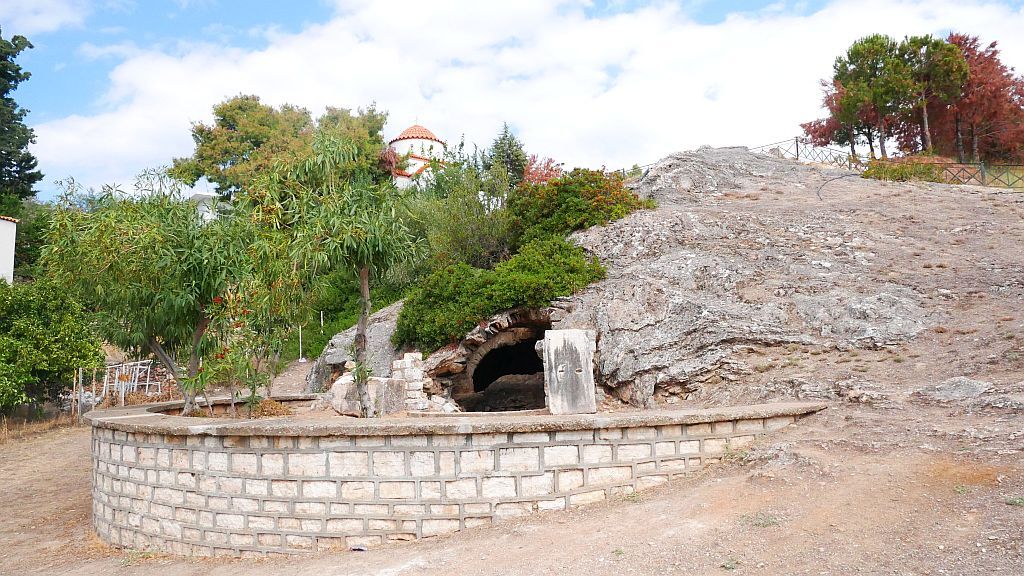
The Macedonian tomb is located on a hill to the northwest of the city of Eretria. It is worth driving there, as it is one of the most important monuments of the island of Evia.
It is worth starting the tour at the Archaeological Museum, where you can obtain a map of the Ancient Eretria. Moreover, while strolling through the streets of the city, you can often encounter information boards with maps.





The capital of Evia – the blue route
Chalkis, the capital of the island was one of the two major powers in ancient times, alongside Eretria. Successive periods have overlapped. Archaeologists often have to decide which buildings from which period are worth uncovering.
It is very likely that in Eretria the ancient times were discovered and made available to visitors, while in Chalkis the medieval and later times.
For the capital offers monuments from later times. Perhaps this is why the objects are better preserved.
I suggest visiting in the following order
Karababa Castle It is the best-preserved castle on Evia and the most popular. I recommend visiting early in the morning when there are not many tourists yet and parking is not a problem.
Old Bridge. It is small and unassuming, hiding a few curiosities.
Promenade walk A favorite spot for the island's residents. It is definitely a pleasant place to stroll. At the end of the promenade is a red building that houses the Knowledge Center about Chalkida. Just behind the building is a beach favored by locals with all amenities and a nice view of the mountains.
Old Archaeological Museum It is modest and small, as the largest and most important exhibits are in the new museum. Nevertheless, it still hides interesting artifacts worth seeing.
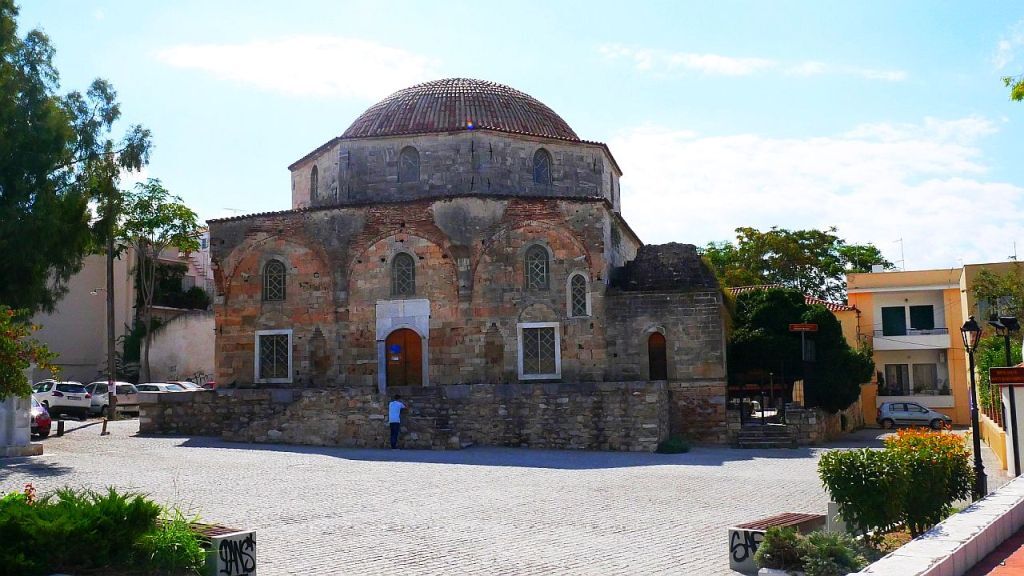
Emir Zade Mosque To my knowledge, it is the only preserved mosque in Chalkis. Unfortunately, it is not open to visitors. However, the building itself is interesting. Pay attention to the fountain next to the building, which hides interesting reliefs.
St. Paraskevi Cathedral The building is interesting in that although it dates back to the 13th century, it was built on an earlier one from the 6th century, of which several elements have survived. The cathedral is significant because its patroness is St. Paraskevi, the patron saint of the city.
Venetian House Although the building may not impress everyone from the outside, it is a place frequently visited not just to sit at a table. The object is not open to visitors, but it is worth peeking through the bars inside. I assure you, the interior can be stunning.
Arethousa Archaeological Museum It is possible to walk to the museum, but it is worth driving, especially since there is a spacious parking lot nearby. It is also worth leaving the car for longer to visit other sites.
The museum is really large, so it's worth reserving plenty of time for the visit.
Arethousa Spring A small and unremarkable water reservoir is linked to a mythological tale interesting enough that the New Archaeological Museum took its name.
Abandoned factory The ruins of the facility are remnants from the years when the city became an industrial center.
Kamares Aqueduct Although the accessible piece is well-preserved. Moreover, it crosses the city bypass, whose vibrations do not weaken the structure of the object.
A section of the aqueduct located a few kilometers away is probably part of the Kamares Aqueduct, as it lies on its extension.
Two Towers They are about 7 km away from the New Archaeological Museum.
The towers are usually associated with a defensive system, but these likely served primarily to observe the water level in the nearby river Lilantas.
Fort in Fylla An interesting fact about this castle is that the Venetians built it not mainly to protect themselves from invaders. According to historians, the fort was built to protect against the locals.
Vasilikou Tower The restored building is worth visiting. The audiovisual exhibition provides a lot of information about the castles on Euboea.




Northern Evia - orange route
The northern part of Evia is considered the greenest part of the island. This was true until July 2021, when a massive fire ravaged large areas. We, Poles, are proud of ourselves because we helped a lot in extinguishing the open flames. The Greeks appreciated our equipment and the determination of the firefighters.
The northern part of the island is still recovering. The vegetation is slowly rejuvenating and is beginning to amaze again.
It's worth visiting not only for the beautiful landscapes. Two statues were found here that are now the pride of the National Museum in Athens. The first naval battle between Greece and Persia took place here.
Despite such a vast hidden history, I assure you – you won't get bored sightseeing.
I suggest visiting in the following order
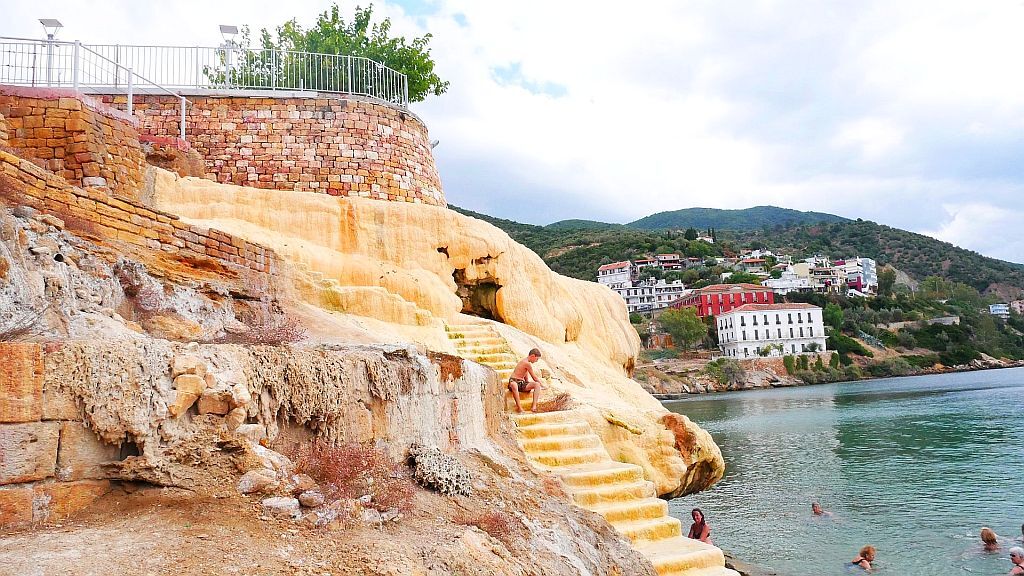
Edipsos – thermal springs.Thanks to the thermal waters, the residents of Edipsos were wealthy. Wealthy people and rulers came here to take healing baths. It is said that at one time, there was debauchery here that rivaled that in Corinth.
The baths have a specific, sulfuric smell that not everyone finds pleasant, especially since in the hot summer it is not always enjoyable to immerse oneself in hot water.
Edipsos – thermal springs, another place with hot springs, with a different scenery – however, these are the same springs as mentioned above.
Edipsos – archaeological collection, is open only until 3:00 PM (closed on Tuesdays). It is worth visiting. Exhibits found in the nearby area are displayed here.
Edipsos – Sulli cave, although neglected, is an interesting place. Today it looks like a cave, but it was actually a building – baths built by a Roman general. The structure was covered by a dome, on which sediment from sulfur water has settled over the centuries. As a result, the building today closely resembles a cave.
Edipsos – ruins of Roman baths. In front of the supermarket, there are archaeological excavations covered with glass. Not much can be seen through the glass, but the layout of the rooms is typical of Roman baths.
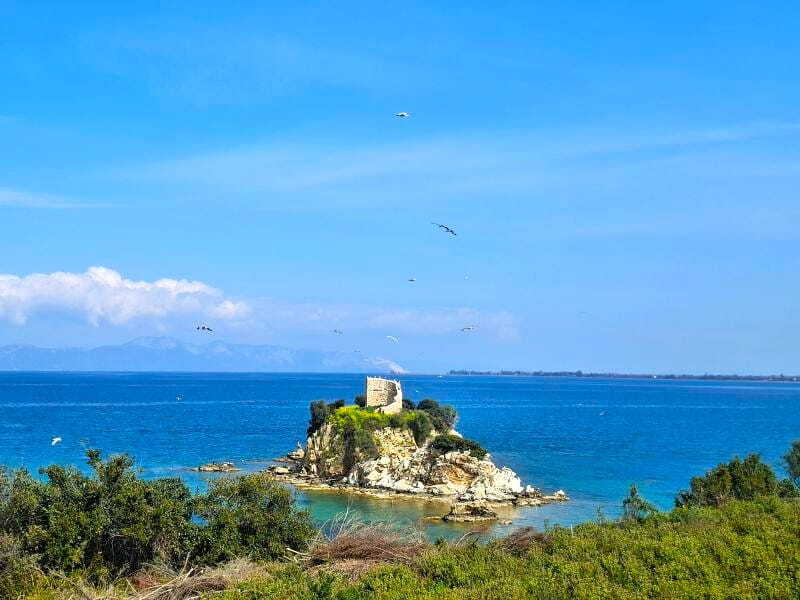
Nisiotissa Beach is valued not only for its clear water and pleasant palm surroundings. The biggest attraction is the view of a small islet with ruins… well, it is unclear whether it is a windmill or a castle.
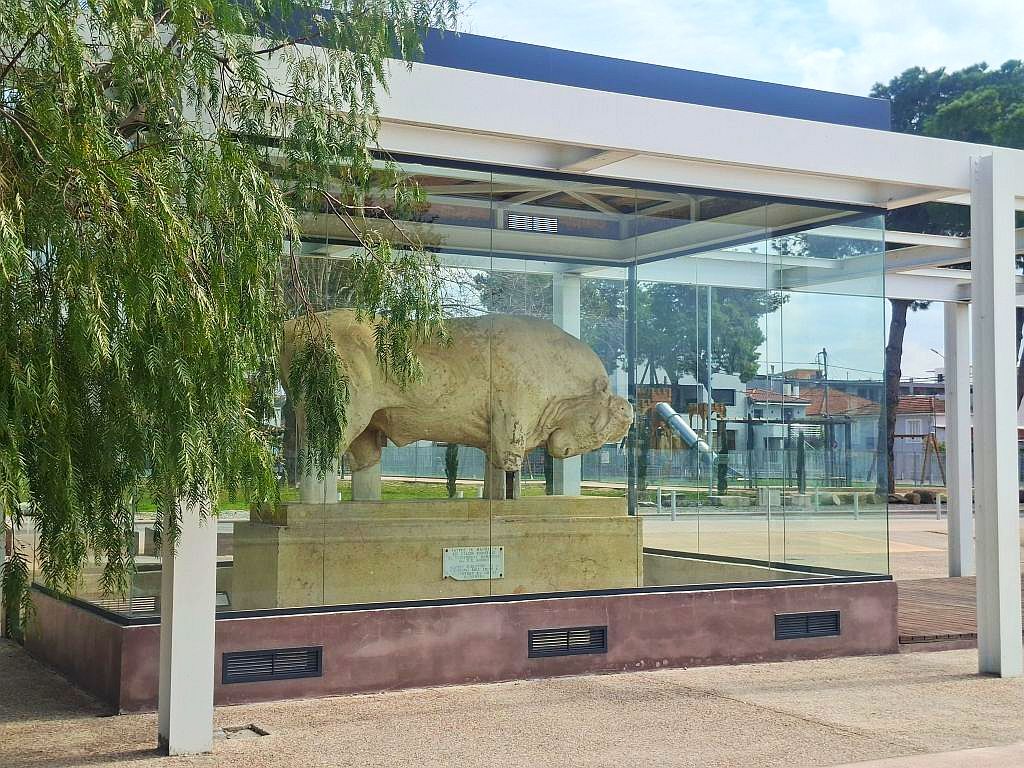
Oreoi – stone bull, is a must-visit place for those interested in Greece. In the port of this small town, there stands a massive, very heavy stone statue depicting a bull preparing to charge.
Oreoi – archaeological collection. Next to the bull statue, there is a building with findings discovered in the nearby area. To my knowledge, it is not open to visitors, I recommend checking it while viewing the stone bull.
The castle in Oreoi. An interesting fact about the place is that there was a citadel here as early as the 4th century BC, which was later rebuilt in subsequent centuries. In the 13th century, the Venetians built a fort with underground passages here.
Today, little remains, so I recommend this place only to those interested.
The Istiaia wetlands are an interesting area for those who appreciate nature. Here you can find fish and birds that are hard to find elsewhere. All you need is silence and time.
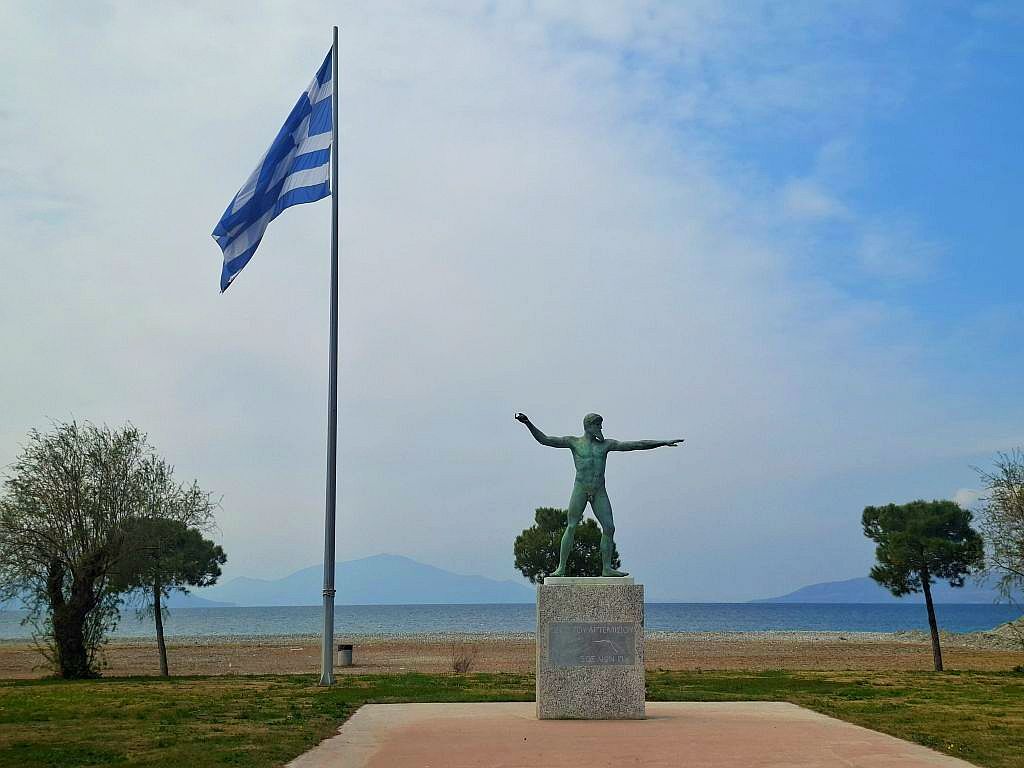
Pefki – The God from Artemision. In the nearby waters, fishermen accidentally discovered part of an exhibit. After two years, together with sponge divers, they retrieved the rest of the statue. Today Zeus/Poseidon (there are still disputes about who it is) is one of the most remarkable masterpieces of the National Archaeological Museum (which pertains to all of Greece). There is no one who visits the above museum and overlooks this exhibit. It is one of the most notable bronze works discovered in Greece. This is a place that cannot be missed. A reproduction of the God from Artemision has been placed here, in the spot where it was found. As the author of The Guide to Evia, I cannot fail to mention that after the discovery of the God from Artemision, extensive studies of the nearby sea were conducted. It turned out that it was not without reason.
The Rider from Artemision is another exhibit that holds a prestigious place in the National Archaeological Museum in Athens. Not without reason, this artifact has found a prestigious place and is the most photographed by visitors to the museum.
Vouliki – Fort Metaxas is a place that is interesting in that it requires personal interest. There are no informational signs here, no exhibits secured by barriers.
It is an abandoned and neglected place. However, it is interesting for those interested in history and views.
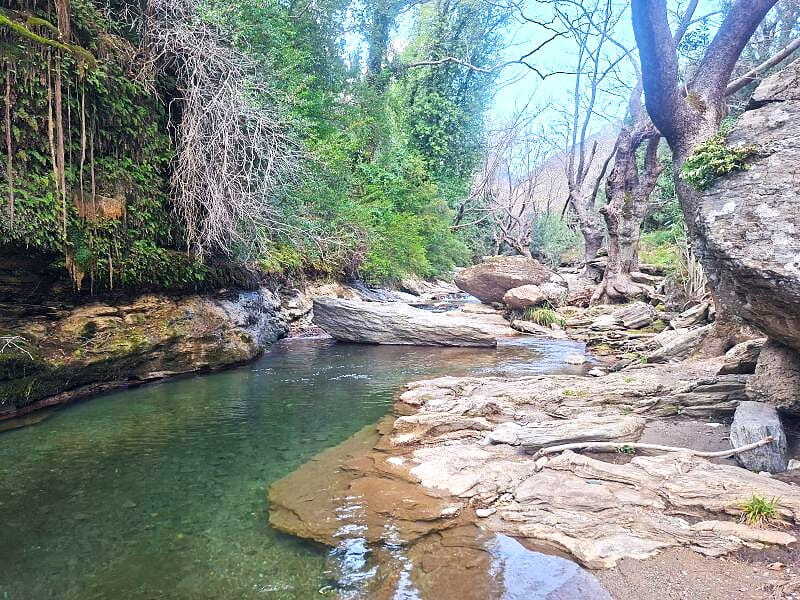
Geriakou Waterfall is captivating because, as one of the few, it is literally accessible right after stepping out of the car. It looks best in spring. The scorching summer makes the waterfall less impressive.
Fossilized cherry forest is a phenomenon, as it dates back nearly 2,000,000 years. Unfortunately, it has recently been closed to visitors.
Drimonas Waterfall. Before the fire in July 2021, it was a very popular place to visit. The trails and infrastructure in the form of taverns and playgrounds show how frequently this place was visited. Regardless of human factors, nature quickly rejuvenates – this is the case with the Drimonas Waterfalls. The plural form is not accidental. Well-maintained paths with wooden (rebuilt after the fire) railings encourage exploration. You can come here with a child who will certainly enjoy walking along the paths shaded by trees. The temperature here drops by at least a few degrees, making it pleasant to explore the other waterfalls.
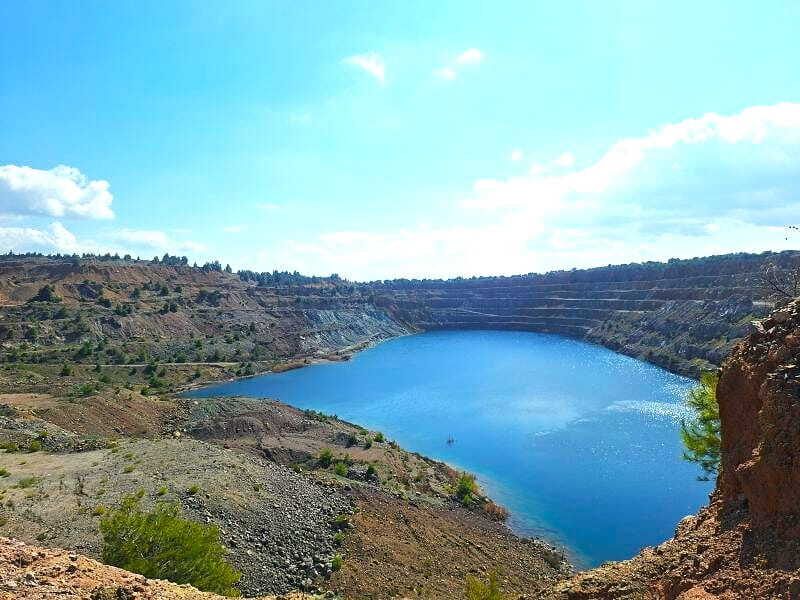
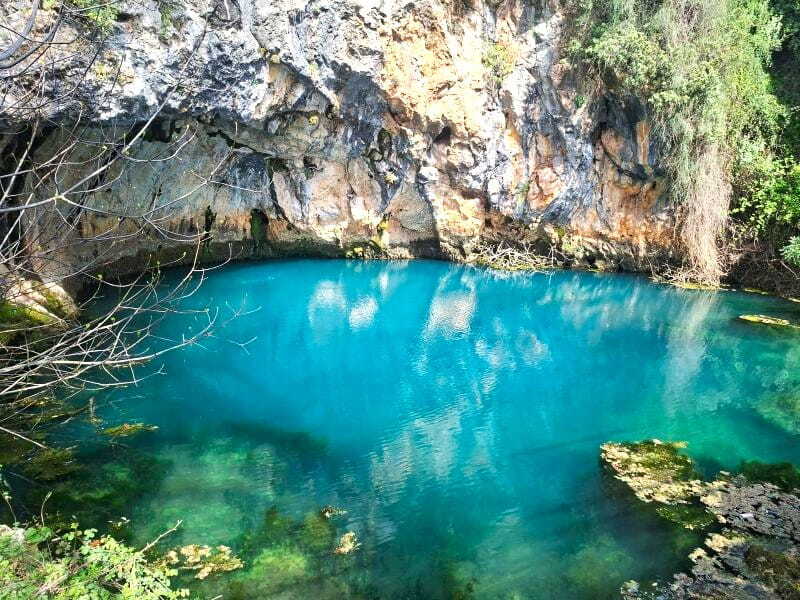
Post-mining ponds are a sight to behold. The turquoise water against the backdrop of white, deep mining pits is impressive. Nature has restored the vegetation. It is worth leaving the car in a convenient spot and taking a walk, as there are several ponds.
Southern Evia – green route
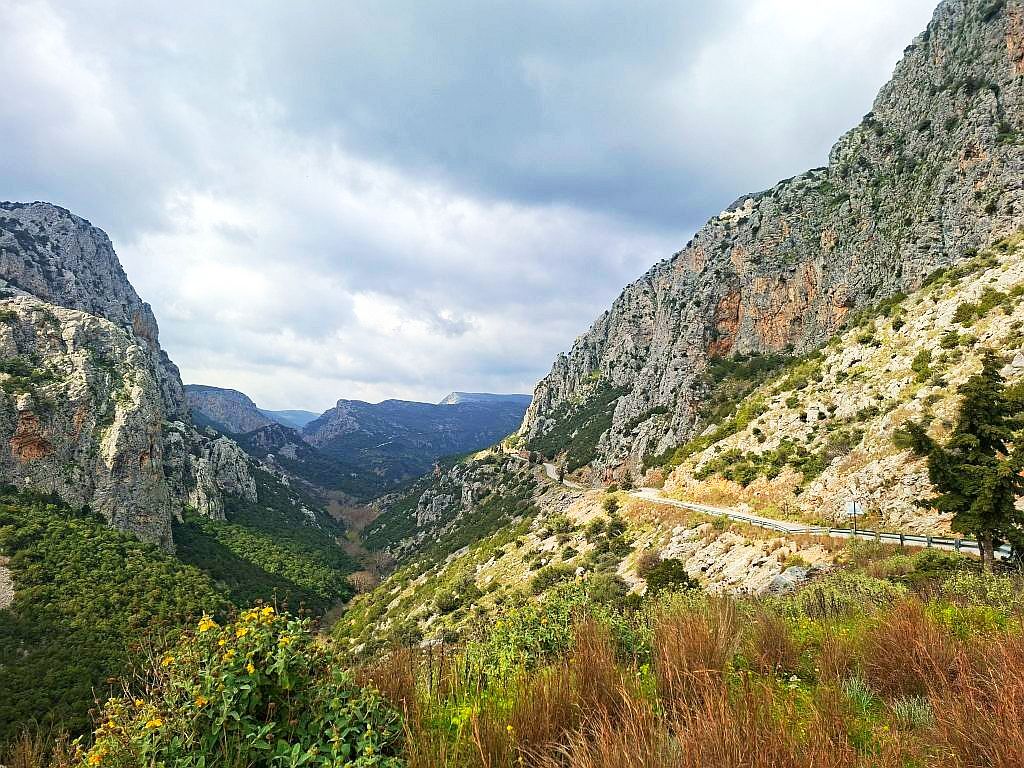
Southern Evia is considered rugged. There are fewer good asphalt roads here, and the terrain is even more mountainous.
It is worth the effort to visit this part of the island. Here are the famous dragon houses. There are said to be as many as 25. I suggest visiting a few that are relatively easy to reach.
The marble quarry from ancient times is also an interesting place. However, it requires some physical fitness as it is located at a certain height.
Attention!
It is not possible to visit all the proposed places below in one day. It is worth analyzing, preferably with a map, whether it is better to divide the visit into two or even three days, or to choose the most interesting places for yourself.
I suggest visiting in the following order
RizokastroI recommend it to people truly interested, as not much remains of the castle. Located on a hill, it requires a climb of about 140 m.
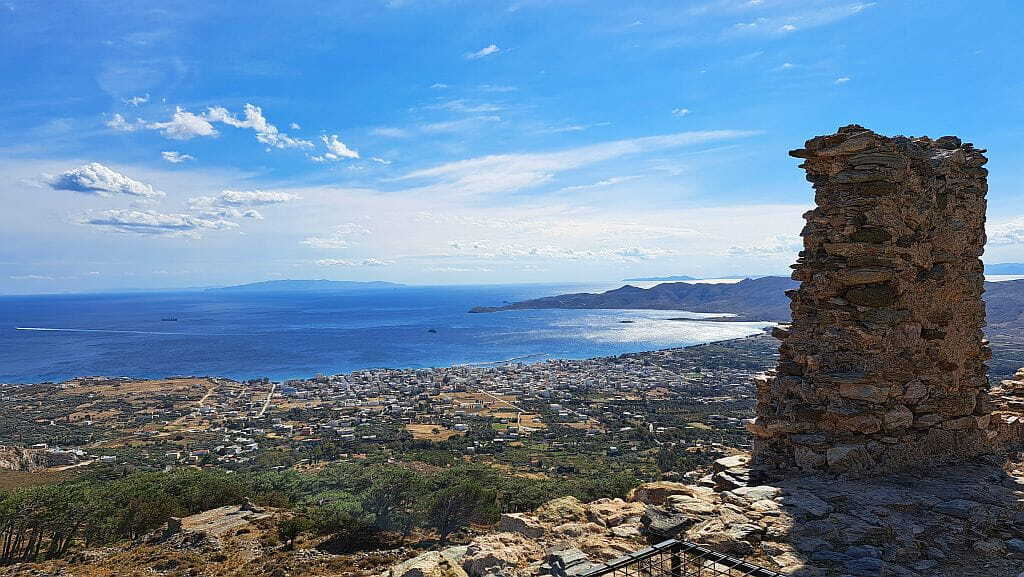
Acropolis of Dystos. The stone wall from ancient times, later reinforced by the Venetians, overlooks a vast plain. You need to drive a bit on a dirt road and climb the hill to see the monument. This place will seem interesting only to those who appreciate little-known and unrenovated monuments.
Styrais a charming town famous for its equally famous dragon houses. The settlement is located in a hilly area, providing nice views, especially after dark. A charming place is the tavern set in stone walls, with a stone fountain and a very old tree.
Dragon houses of Styra. They are not the best-preserved monuments of this type in Evia, but they are certainly the most famous. This is a must-visit place! A convenient asphalt road leads to a small parking lot. From there, you need to climb a bit along a comfortable and well-marked trail.
Dragon houses of Kapsala. Driving about 9 km south, on a winding road, it is worth stopping by the next dragon houses. They are literally within reach. An additional plus is the beautiful views from a small elevation.
The prosecutor's mausoleumin the town of Karystos located in the south of the island. It is worth stopping here as there are several places worth seeing. The mausoleum today seems like an uninteresting monument. In reality, it was a rich tomb of an important and wealthy Roman. It is believed to have belonged to the overseer of the marble quarry. The Romans highly valued the local marble and exported it to distant countries, making a fortune in the process.
Archaeological Museum is a small museum in Karystos housing exhibits found in the nearby area. It is worth visiting, but you should remember that it is only open until 3:30 PM and is closed on Tuesdays.
Bourtzi Castle beautifully located in Karystos, right by the sea, was meant to protect the island from enemies coming from the south. Today it has been restored and is open to visitors.
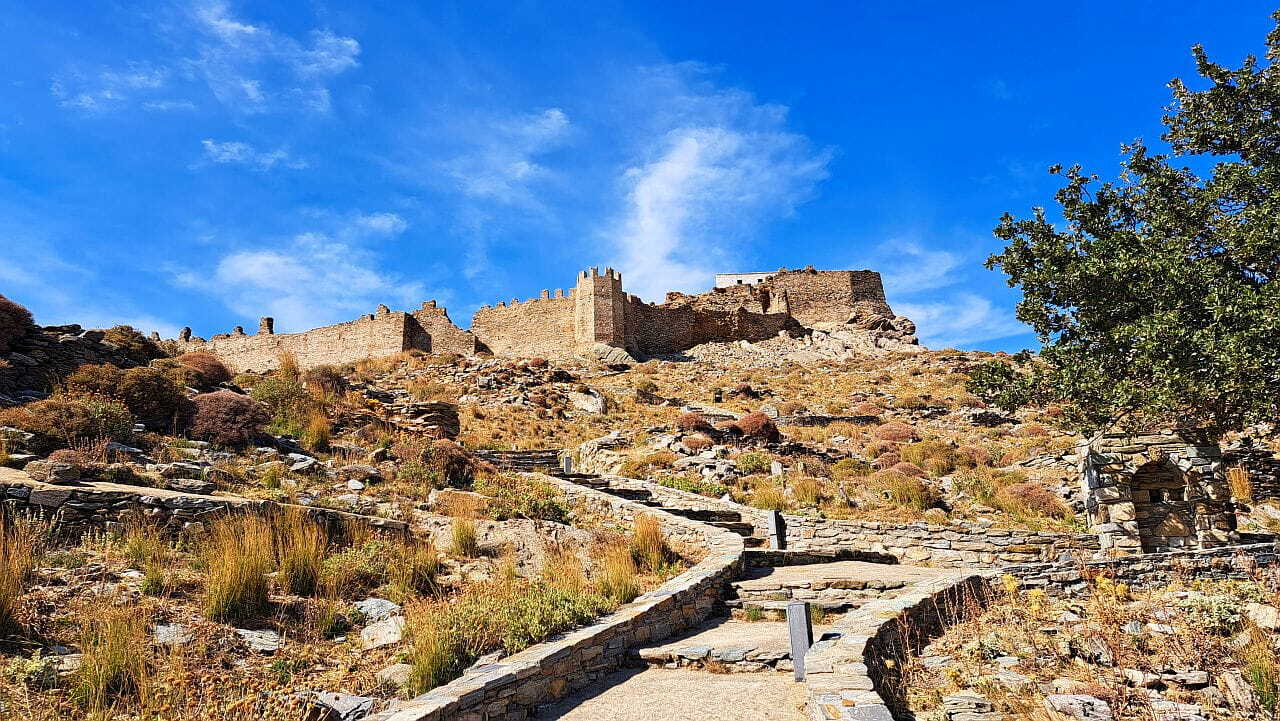
Rosso Castle, which is accessible via a good road that ends at a small parking lot. You need to walk a bit uphill to pass through the gate. The castle is open 24 hours. Some are enchanted by it, especially for the beautiful views, as it is situated on a hill, while others feel quite the opposite. The ruins do indeed seem neglected. The frightened herd of goats encountered here only confirms this notion. Regardless, it is one of the most photographed castles in Evia.
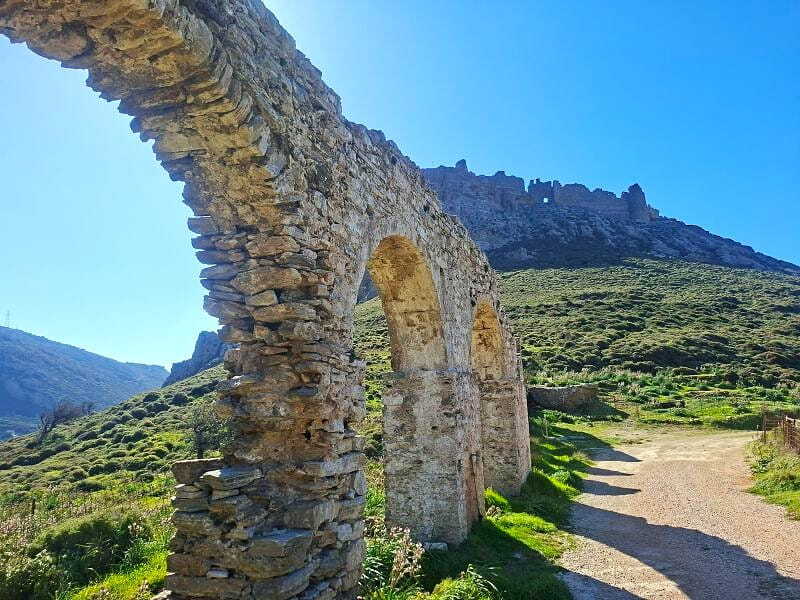
Aqueduct, of which a small section has survived. It supplied water to the castle. Unfortunately, the last short stretch of road is not of the best quality.
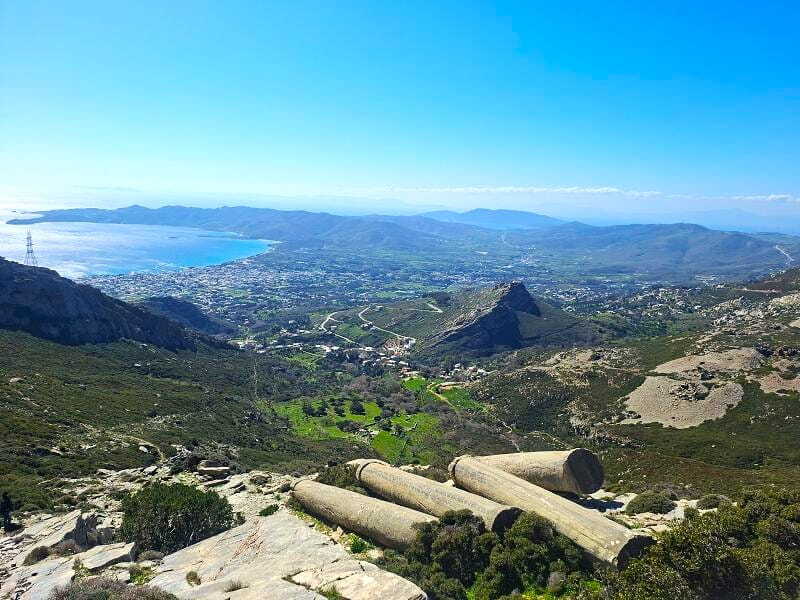
Quarry. The area around Karystos was rich in marble known as Cipollino. The discovered quarry was exploited even in ancient times, but it was only during the Roman period that precious stone was extracted here on a large scale. Today, huge columns, extracted whole, lie as a reminder. The quarry is located at a considerable height. When heading to the quarry, you need to equip yourself with appropriate footwear and prepare for a long, at least hour-long walk one way.
Monolith is a round element extracted from the ancient quarry. I could not find information regarding the time of extraction, purpose, and reason for its abandonment.
Waterfall which has the great advantage of being located right by the road. Therefore, there is no need to embark on a hiking trip. However, one should consider that at the end of a hot summer, the waterfall may temporarily dry up. A winding, mountainous road leads to the waterfall, but it is of good quality, with beautiful views.
Dragon house of Ochi requires a full-day hike. Mount Ochi is 1398 m above sea level, which is why it is only suitable for fit hikers and those well-prepared. There is no asphalt road leading here. The preserved dragon houses here are the best preserved and most impressive.
Great Sand beachit's an interesting beach with fine sand.
Evia Wednesday – blue route
In this part, there are the most routes of relatively good quality, so you can travel without worrying about your vehicle. Unfortunately, it's another day with many kilometers to cover.
I suggest visiting in the following order:
Politiko Tower is located in the center of a small town, accessible by a good road. I recommend it to those who enjoy this type of architecture.
Mining pond is worth seeing and walking around. The turquoise water against the backdrop of a deep white pit is impressive.
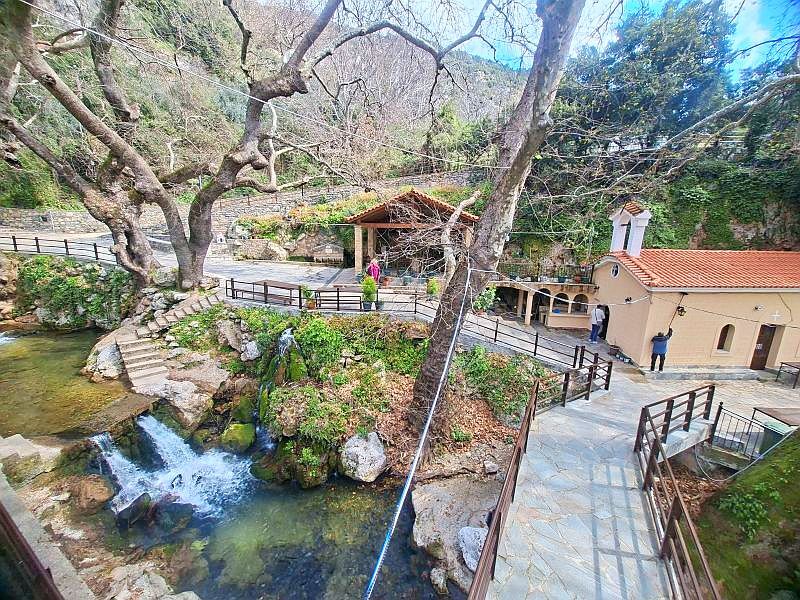
Kampia is a charming place, surrounded by greenery, ponds, bridges, and fountains.
Kalethra is a waterfall with a pool of water amidst the greenery. It's great that it's right by the road. Unfortunately, it sometimes dries up in the hot summer.
Manikiatisis a waterfall that is worth dedicating time and effort to. You have to leave the car by the road and descend down the trail. Further along the bottom of the gorge, you need to reach the waterfall. The water falls from 25 meters, which is impressive against the bright rocks.
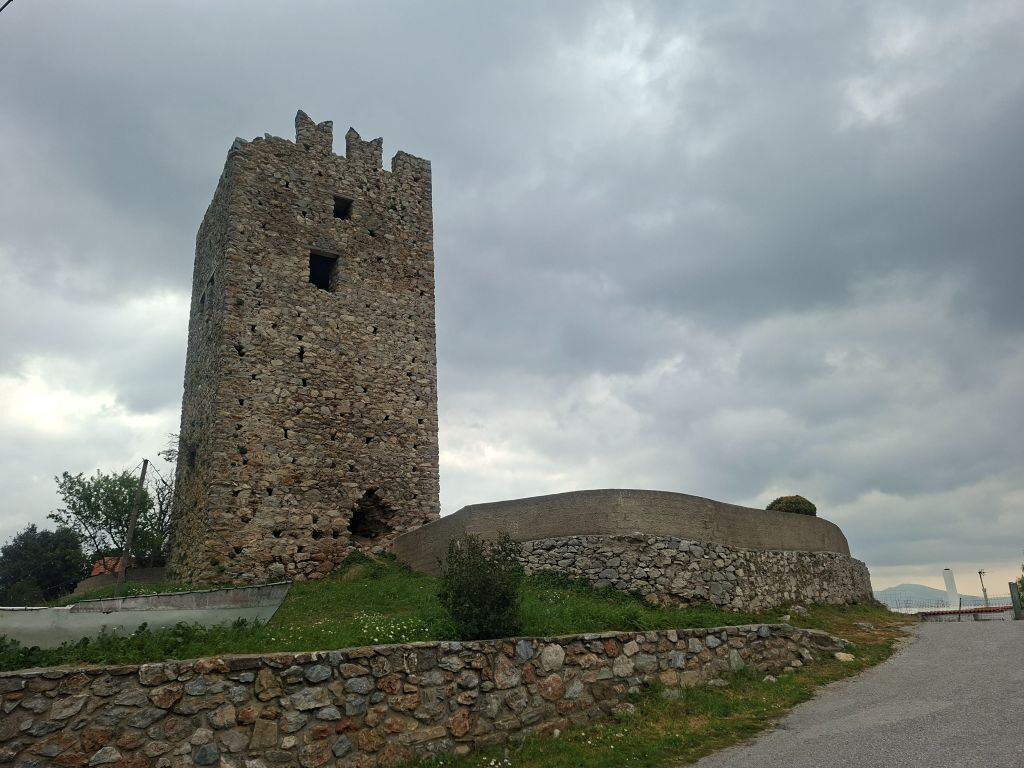
Trachilios Tower was built in the 13th century by the Venetians to relay information about impending danger. It is located in the center of the village, accessible by a convenient road.
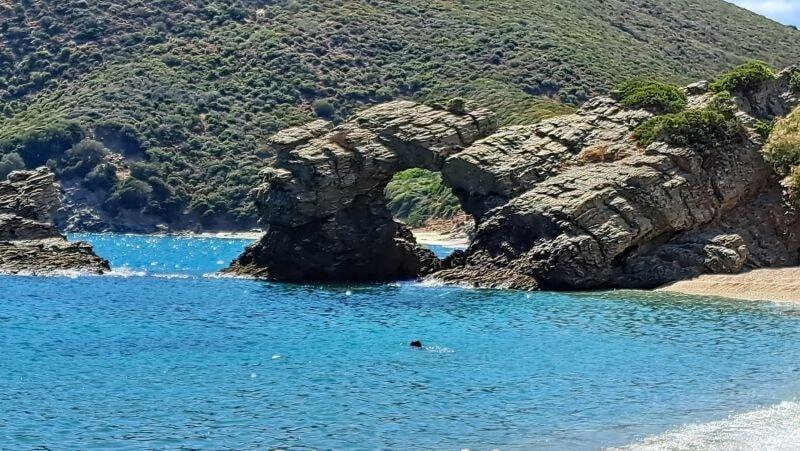
Kalamos Beach is a suggestion for the end of the tour. I recommend resting at the beautiful Kalamos beach. The water here has a lovely turquoise color, and the entry into the sea is shallow for a long distance, making it great for children. All amenities are available: sunbeds, toilets, showers, taverns, shops... There is also a popular rock formation with a vertical opening.